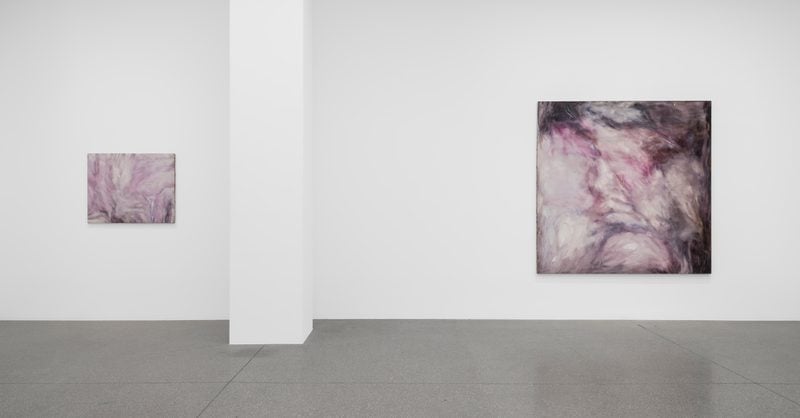
Gazed at by Nature
Yoko Matsumoto

White Cube Seoul
6, Dosan-daero 45-gil, Seoul, Seoul null
Tue–Sat 10am–6pm, closed Sun–Mon
Admission
Free Admission
About
Surveying Yoko Matsumoto’s career-defining pursuit of luminosity, ‘Gazed at by Nature’ brings together paintings and works on paper from 1985 to the present day. Attesting to a lifelong negotiation between two worlds, Matsumoto initially worked with water-based acrylic paint for its likeness to East Asian _sumi_ ink, before going on to master the medium of oil paint so integral to Western art history and tradition. For the artist, questions of colour, and the ability of painterly medium to transform the canvas surface, to impart lightness and depth, have been her central concerns. ‘In my paintings, darkness could be white, blue, and indeed, pink’, she has noted, ‘where there is light there is naturally always darkness, whether I work in acrylics or oils, I always feel that I am always pursuing this alternation in my work’. The illuminating essay by art historian Reiko Tomii below provides the broader context of Matsumoto’s artistic inquiry: from the ‘negative legacy of modernism’ in Japan and her arts education in 1950s Tokyo, through to her formative encounters with Abstract Expressionism in New York in the late 1960s. Read less Read more _Yoko Matsumoto’s Pursuit of Luminosity_ Reiko Tomii Looking at painting is not easy. As one of my painter friends once complained, many people simply cannot see painting – especially abstraction. I have to agree. In fact, I am among those guilty as charged. Take, for example, the painting of the Tokyo-based artist Yoko Matsumoto. Living in New York, I have only had a few chances to see her works in person. I must confess: initially I didn’t really look with the attention necessary to truly see the artist in them. But when I encountered her works recently, I was intrigued. What struck me was how tremendously adept she is in both oil and acrylic and how successfully she expresses luminosity in each. Why does this matter? Because ‘light’ had long been considered the missing element in Japanese modernist painting executed in oil, in effect, the entire genre of _yōga_ (Western-style painting). The centuries-old Western medium of oil painting was imported to Japan in the mid-19th century, as the country briskly began its Westernisation under the banner of modernisation. While the Impressionists made an indelible mark on global art history through their use of oil paint to express light, Japanese modernists struggled in mastering the medium. Matsumoto has transcended this local history through two key endeavours. First, by the mid-1970s, she created her ‘pinks’, which represent her effort to express light through the water-based medium of acrylic. In the early 2000s, she then shifted to the ‘greens’, and later to the ‘blues’ and the ‘whites’, pursuing the same goal through oil. Taken together, her works speak to her ambition and tenacity in overcoming the negative legacy of modernism in her homeland by creating something uniquely her own. With these series, she has negotiated one crucial tension in the formation of Japanese modernist painting. Oil has long haunted modern Japanese painters. In Japan, and more broadly across East Asia, water was the primary binding medium of painting, with its historical dominance paralleling that of oil in the West since the Renaissance. Mixed with _sumi_ (soot), water produces _sumi_ ink. This centuries-old material has proven particularly conducive to the moist climate of the Far Eastern archipelago, making possible, for example, _Broken Ink Landscape_ (_Haboku sansui_, 1495) by the 15th-century Zen monk Sesshū. In modern Japan, however, practitioners of yōga had to confront a completely different tradition imported from the West and struggled with the viscous medium of oil. As Japan, after being defeated in World War II, was reintegrated into the international community, critic-curator Atsuo Imaizumi visited Paris and Venice in 1951–52 to research European modernism and the presentation of Japanese contemporary painting. He was shocked at the mediocrity of the Japanese works compared to those of their European counterparts. Upon his return, he summarised the shortcomings of Japanese oil painting with two crushing adjectives: ‘muddy’ and ‘clumsy’.1 That is, Japanese canvases appeared ‘muddy’, with their executions amounting to no more than ‘clumsy’ attempts at modernity. In short, they had not mastered the lingua franca of international art. In the case of Yoko Matsumoto, she studied oil painting at the country’s top art school, Tokyo University of the Arts, from 1956 to 1960. The education she received was conservative. She detested the gloomy classrooms of the oil painting department, filled with canvases of female nudes rendered in heavy brushstrokes.2 ‘Despite all the beautiful colours in the world, they all painted with such dirty shades!’, Matsumoto recalled. She aspired to go in the opposite direction: to paint buoyant abstractions in transparent colours, to express light through oil. Matsumoto experimented with different types of oils without success. Indeed, the pinks she managed to produce in oil were, in her words, ‘opaque, heavy, and disagreeable.’ All she wanted was to ‘create a painting with no constraint and move my hand freely to my heart’s content,’ but after graduating in 1960, she felt herself ‘chafing under the weight of the Western tradition that is oil.’ In June 1967, Matsumoto married the art critic Teruo Fujieda and later that summer, she accompanied him to the United States.3 By the end of the year, the newlywed couple settled in New York and Matsumoto explored modernist masterpieces in the city’s museums: Picasso’s _Les Demoiselles d’Avignon_ (1907) and Matisse’s _Dance_ (1910) – works she had only previously known through reproductions – were revelations in person, as were the large canvases of Abstract Expressionists.4 These works compelled her to discard much of what she had learned in Japan. The one who most attracted her, however, was Helen Frankenthaler, who had invented the soak-stain method using turpentine-thinned oil paint.5 When Matsumoto found Frankenthaler’s gigantic _Mountains and Sea_ (1952) at the Metropolitan Museum of Art 6 – a ‘beautiful picture that is so thinly painted’ – she visited the Met weekly to see it. Seeing these works in person, she began to re-educate herself on what painting could be. Another crucial discovery in New York was Liquitex, the commercially available acrylic paint.7 Although acrylic is water-miscible, unlike _sumi_ ink it is not intended for drawing or staining. Matsumoto nonetheless decided to work with it for its affinity with water, which reminded her of _sumi_. She believed then, and still does, that _sumi_ ink painting represents the quintessence of Japan’s painterly tradition. Above all, she was drawn to Liquitex because it offered a shade of pink that she particularly liked. Her aspiration was to create ‘coloured _sumi_ painting’ that would be comparable in ambition to that of her American predecessors – such as Pollock, Newman and Rothko – yet realised through a water-based medium that would assert her Japanese sensibility for space. By 1974, her first signature pieces were born. Her ‘pink paintings’ feature floating forms that remind me of flowing mists and drifting clouds. In some, pink dominates. In others, pink veils, contends with or otherwise intermingles with black, with the light contained within these pink forms shimmering against the darkness around them. To create such amorphous abstractions, Matsumoto takes full advantage of her water-based medium. That she works horizontally, with the stretched canvas laid on the floor, is signalled by the profuse drips visible on all four edges. These drips are bright and raw, unlike the rather subdued palette found on the picture’s surface. The painting reveals the artist’s labour and control, inventively expended by the daubing, wiping and layering of watery colour.8 In Matsumoto’s ‘pink paintings,’ light emerges from water. Matsumoto’s tireless pursuit of luminosity in pink continued until 2004, when she returned to the medium of oi