In Bloom
Vivian Greven

Perrotin
10 Dosan-daero 45-gil, Gangnam-gu, Seoul, SOUTH KOREA
Admission
Free Admission
About
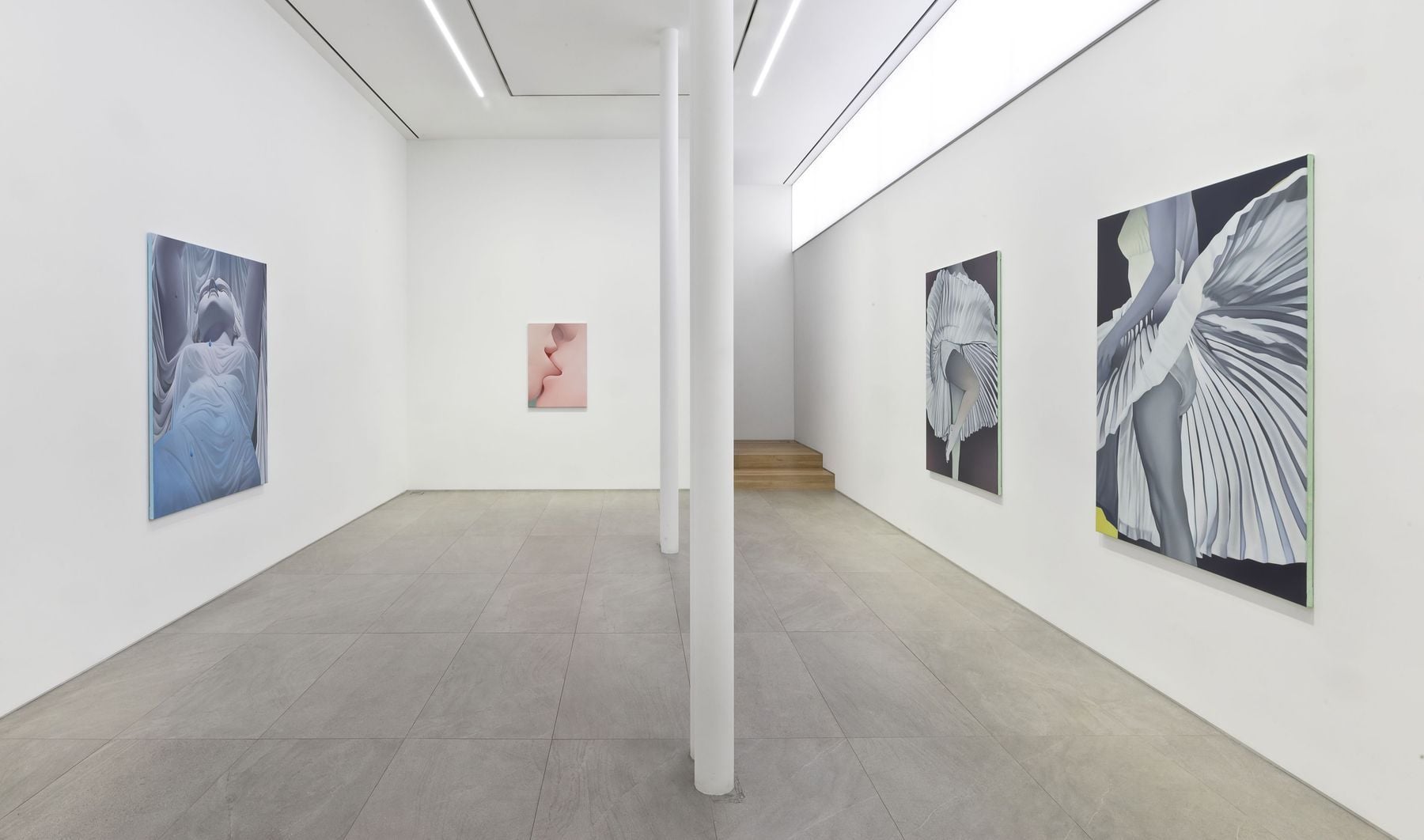
_At the Threshold of Blooming Moments_ Mysterious figures fill the canvas, and the viewer's gaze glides across the painted surface. Fragments of touching bodies separate and reconnect, alternately revealing and concealing themselves. The eye lingers on a hand holding a flower before naturally drifting towards its blossom. In one work Daphne transforms into a tree; in another tears, moisten the mythical Undine. Light and shadow entwine and spread softly throughout the image. Metamorphosis is not merely a formal change. It is an event in which identity and boundaries are unsettled and ontological transformation takes place. It suspends distinctions between human and nonhuman, reality and fantasy, creation and disappearance, leading beings into new realms of possibility. Yet transformation is not an extraordinary or unreal event reserved only for mythical heroes. From birth until the end of life, human beings undergo endless external and internal shifts, continually placed within the flow of change. In this sense, Greven's focus on metamorphosis is less about transformation itself than about exploring the ongoing process through which humans and all beings in the world continuously come into being. Particularly striking in Greven's narratives of metamorphosis are hands, women, and flowers. According to the artist, the hand is a fundamental sensory organ: a medium that perceives change, connects different states, and serves as the point of contact through which transformation occurs. At the same time, it functions as a visual device that compels viewers to witness the moment of change, as seen in _Daphne's Hand I_ (2026), which reinterprets Giovanni Lorenzo Bernini's _Apollo and Daphne_ (1622–1625). Above all, the artist's hand gives form to invisible thought, imbues matter with narrative and meaning, and captures fleeting moments, turning them into eternity. Women appear as subjects undergoing change, while flowers and plants bloom as symbols that make change visible. Because the process of transformation carries both danger and exhilaration, anticipation and fear remain inseparably intertwined. Flowers, too, are symbols of ambivalence. They evoke the beginning of life while simultaneously recalling the inevitability of decay, embodying the tradition of vanitas. They convey contradictory emotions at once: splendor and emptiness, celebration and mourning, culmination and decline. The vivid colors that fill the flower petals in Greven's works contain the order of nature, while flowers resembling marble sculptures seem to delay the passage of time toward an ending. Daphne's body, transforming into a tree, encompasses all of these meanings. This context can also be found in _Undine I_ (2026), based on Chauncey Ives's _Undine_ (1880). Undine, the water spirit whose body is partially enveloped in blue light, contains within herself the beginning and end of life, as well as eternity. Nothing in this world remains in its original form forever. The body continually changes, while life and death endlessly interact. Beings in the world do not simply disappear; they alter and take on new forms. Birth is an event that brings a being into existence in a new way, while death marks the interruption of self-identity. What is important is that metamorphosis is not a temporary event in which one thing is replaced by another, nor is it a completed result. Rather, it is an ongoing process in which different states remain in contact as they transition from one to another. A being does not change instantaneously but gradually undergoes alteration, blurring the boundaries that define it. Greven also avoids remaining fixed in a single point through her formal and expressive approaches. Images that provide concrete form and volume, such as the water droplets depicted in _Undine I_, create the experience of painterly illusion. Yet figures rendered as flat fields of color, as in _After Daphne II_ (2026), along with the flattened backgrounds found throughout much of her work, emphasize the inherent flatness of painting. The artist's exploration of the origins of painting deepens further in _Bond IV_ (2026). By superimposing Bernini's _The Ecstasy of Blessed Ludovica Albertoni_ (1671–1674) with imagery drawn from erotic cinema, the artist traces how the transformation and dissolution of the body in states of ecstasy have been culturally constructed through visual traditions. At the same time, _Bond IV_, in which rectangular frames containing painted hands are repeated and layered, evokes the realm of art as a space separated from reality—a pictorial world that simultaneously defines and limits space while opening it onto infinity. It may also be read as a metaphor for the countless rectangular windows through which images and illusions are generated today. At the same time, these overlapping frames continually remind us that the depicted forms are not physically present objects, but image-illusions. Perhaps for this reason, the figures in Greven's paintings maintain a certain distance, as though they conceal a secret. They are beautiful enough to hold our gaze, yet remain beyond reach. This condition of seeming to exist somewhere between presence and absence may be an inherent quality of images themselves—captivating us while forever preserving their distance. It can also be experienced as the loneliness of images left behind after reality has disappeared. Greven's refined palette and controlled brushwork reinforce this atmosphere. An image always contains the absence of the being it represents. It clearly presents a presence, yet because that presence has already vanished, the image is both identical to and different from it. The works, in turn, give seductive form to this absence. At the same time, Greven's work evokes the fragmented world of images that characterizes contemporary experience. Close-up views of body parts bring us so near that the whole can no longer be seen, while cropped images prevent us from fully grasping the beings they depict. With the exception of _Daphne's Hand I_ and _Undine I_, the works do not reveal the figures' faces or eyes, moving constantly between disclosure and concealment. _Marilyn I_ and _Marilyn II_ transform the dress of the cultural icon Marilyn Monroe into floral forms, shifting the viewer's gaze away from objectification and consumption toward contemplation. Within the pictorial space, Marilyn transcends the conventions and projections historically imposed upon her. The sense of distance described earlier also activates the viewer's aesthetic imagination. Curiosity and attraction arise when something remains concealed and cannot be fully grasped at a glance. Beauty contains a degree of opacity; it requires concealment. In this sense, ambiguity and possibility, concealment and delay, and shifts in direction become strategies of beauty. In this way, works of art are connected not only to the visible world that artists capture but also to invisible depths such as the inner self. From the very moment an artist depicts them, forms become symbols that cannot be confined to a single fixed meaning. Greven's works reveal themselves in luminous clarity, yet at times retreat into a profound mystery that cannot be fully understood or possessed. They repeatedly draw near and move away. And in that process, endless layers of meaning are generated through continual variation.