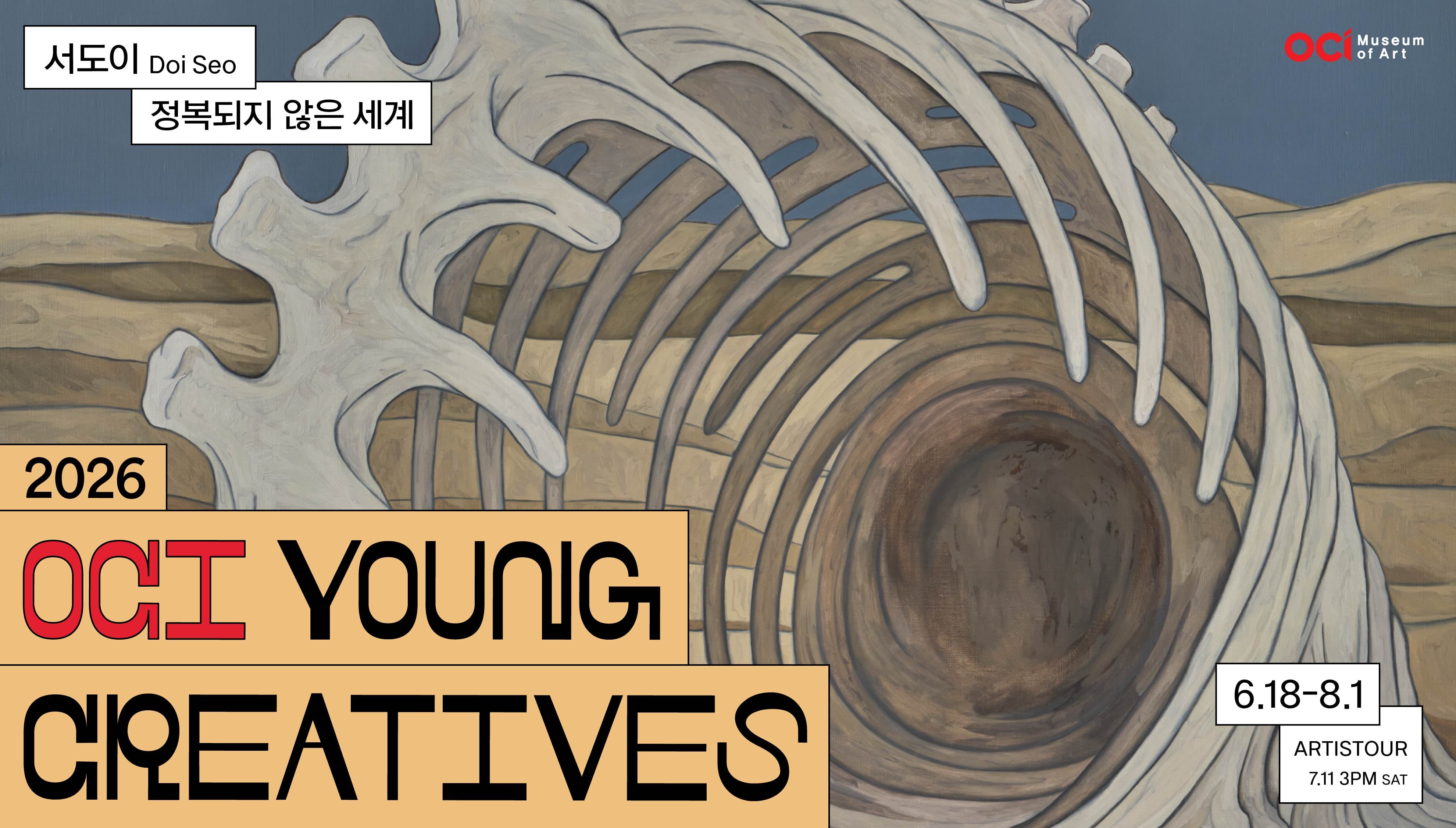
The Unconquered World
Doi Seo
OCI Museum
우정국로 45-14, 서울특별시, 종로구 45-14
화–토 10–18시
Admission
Free Admission
About
Vanished Stories, Retained Images We often experience how the past, though assumed to have already passed, remains unfinished, lingering within present sensations and perceptions. Events may fade, yet the sensations, images, and unresolved narratives surrounding them persist, taking on different forms. This exhibition begins precisely with such remnants of the past and with attempts to break free from them. Doi Seo’s work does not aim to reproduce or document specific events. Rather than leaving experience as a fixed fact, she treats it as a possibility that can be rearranged and reconfigured. For her, experience is not complete but an open structure that can always be read in new ways. What matters here lies not in “what actually happened” but in the narrative form it takes and the image that remains. The artist further expands these concerns through the concept of “roleplay.” If life is a script, it can be revised and lead to a different ending. The moment one moves beyond a given role and shifts into another position, the same event can acquire an entirely different meaning. Seo perceives the world through drawing, an approach closely connected to the ritualistic structure that runs throughout her practice. The rites and repetitive ceremonies she experienced in the past served as ways of invoking an invisible world, and the sensibility shaped through this process later became a significant foundation for her work. Ritual is not merely an act but a mechanism that allows one to experience the nonexistent as though it were present; stories and belief are the essential elements that activate this mechanism. The exhib ition The Unconquered World is the result of an expansion of this ritual sensibility and narrative structure into painting. The works leading up to ACT3, in particular, develop the artist’s earlier performative and narrative experiments further, focusing on the ways images themselves construct a world. Here, painting no longer functions as a tool for explaining or proving an event but operates as a medium that sensorially invokes the invisible. The symbols that appear in the artist’s paintings, such as trees, forests, stars, and spinning tops, are not confined to any one meaning. Rather, they are rooted in universal associations long shared by humanity while also layered with the artist’s own experiences and contexts. Just as stars suggest possibility and forests evoke fear or the past, these motifs carry certain layers of meaning and, through repetition and transformation, come together to form a scene. Recalling ancient myths or wall paintings, the images return to an archetypal state in which temporal layers are erased. The artist’s process of sketching in graphite and then smudging oil paint further intensifies this sensibility. The pictorial surface remains uncertain and slippery, like the traces of an old memory. At this point, painting is no longer concerned with representing an object but becomes a process of translating stories that have already disappeared, or perhaps never possessed a tangible existence in the first place, into visual experience. Instead of reading a clear narrative from the canvas, the audience forges connections among fragmented images and symbols. This experience extends beyond contemplation, expanding into a field that calls forth each viewer’s own memories and sensations. Seo’s work forms an important point of connection with the paintings of Hilma af Klint in its revelation, through painting, of a world that does not exist yet is intensely experienced. This connection, however, is grounded less in formal similarity than in the more fundamental question of “how to translate the invisible into images.” If af Klint sought to convey through painting an order that did not physically exist, drawing upon spiritual experience, for Seo, the “nonexistent world” emerges not so much from a transcendent realm as from layers of imagery and narrative left behind by experience. It is not a world that exists externally but one formed through accumulated and transformed structures of sensation and memory. In this context, painting functions not as a tool for conveying truth but as a mechanism for sensorially reconstituting what has disappeared and for evoking new imagery. In recent works, the artist makes this process more explicit through the intersection of different concepts. Viewing her life as a causal structure, she reverses the paths laid out within it. What seemed destined for a predictable outcome is interrupted at a certain moment, giving rise to a renewed point of departure. The image of the “neutron star” that appears here symbolically embodies this transformation. Just as a star that has exhausted all of its energy collapses upon itself and is simultaneously reborn in a new form, the artist dismantles past narratives and reconfigures them in different ways. What matters in this process is not the complete erasure of the past but the disruption of its operation in a singular direction. In other words, an event is no longer fixed to a single meaning and is instead opened onto a field of multiple possibilities. The title The Unconquered World encapsulates precisely this attitude. Here, “unconquered” refers not only to a state free from domination by an external force but also to one that cannot be reduced to a single interpretation or narrative. The world cannot be explained through one specific meaning, nor can it ever be fully understood or possessed. Seo’s work transforms this impossibility not into a lack but into a possibility. Since the world can never be entirely conquered, we can imagine and construct it in ever new ways. The images generated in this process exceed the realm of representation and carry the power to reorganize our sensations and perceptions. Ultimately, this exhibition reads as a proposition: to regard the past not as a fixed story but as something that may be rewritten and redrawn; to imagine the invisible, and to create scenes that do not exist. Painting is the site where these possibilities are most intensely condensed. There, we finally encounter a world yet to be conquered. - Leeji Hong (Curator, National Museum of Modern and Contemporary Art, Korea)