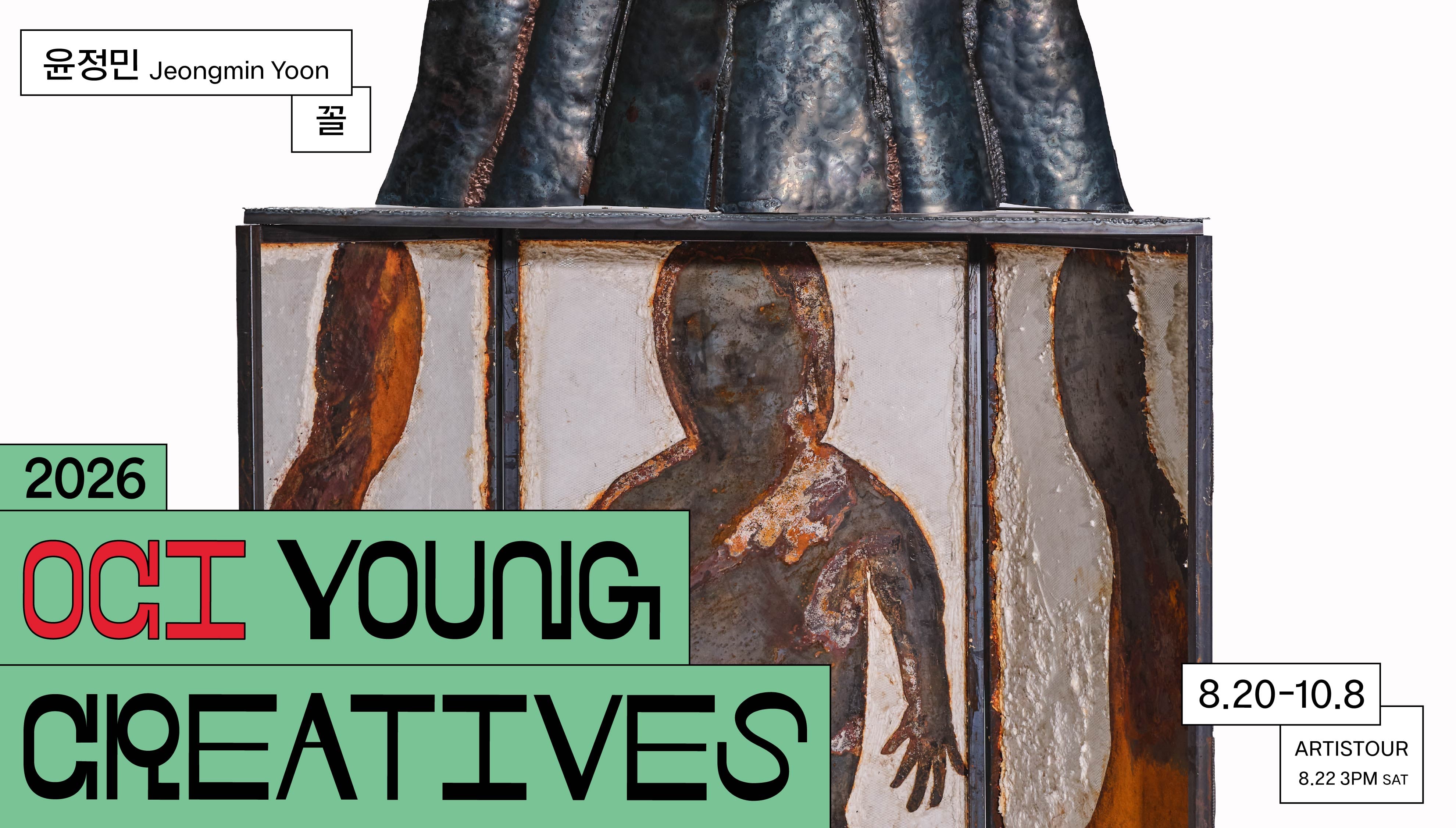
《Kkol》
Jeongmin Yoon
OCI Art Museum
우정국로 45-14, 서울특별시, 종로구 45-14
화–토 10–18시
Admission
Paid Admission
About
**The _Kkol_ of Fate** Among the various conditions that constitute sculpture as an artistic form, the one that, predictably enough, exerts the greatest influence is, after all, its principal material properties and the manner of their working. And so the sculpture of Yoon Jeongmin, which brings to the fore the materiality of metal such as iron, emanates its own presence fully and just as it is, in a form that is, as one would expect, traditional in manner. His sculpture, which also traverses or occupies time and space three-dimensionally, advances toward a distinctive formal invention of its own, such as the so-called "spatial drawing." From the category of form-making, Yoon's sculpture has deliberated on how, at the present juncture, its own form might sustain its essence. Beyond the narrative path that gives weight to the concept of "family," Yoon's reflection on life is likewise strongly bound to the context of material form. In particular, that he has chosen not "casting," the technique that might be called the standard method of making sculpture, but "forging"—cutting and hammering iron directly into shape—also externalizes his handcrafted traces more sharply. The conditions that make up Yoon's sculpture bring into the present, at the meta level, a thinking bound to the criterion of contemporary sculpture, and once again synchronize this with the process of a search for a distinctive identity. Through this, he returns the meaning of aesthetic enactment to a point of recursive recognition concerning artistic form, and further binds it to the inner consciousness that surrounds the identity of his own existence. Even though, in formal terms, Yoon's work clearly borrows the material and technical conditions of traditional iron sculpture, the grounds for nonetheless calling his sculpture contemporary lie precisely in a form-making attitude that renews those very conditions once again, and distinctively, in the field of the interior. In such a context, the notion of so-called "Koreanness" that Yoon posits may be understood as encompassing culture and the entirety of the modes of living derived from it, and it is constructed as something that transcends any single, fixed ethnic representation. For this reason, the folkloric sense he summons cannot be fixed as the object of a certain and definite definition. That "locality" to which he attends emerges at the imagistic level that comes alive amid the relational life of everyday experience. Thus Yoon's interest arrives at family, as the representation of life's most private category. It is quite natural, then, that in the course of exploring the conditions of the being that constitutes itself around the relational web called family, he should have arrived at _saju palja_ (四柱八字), grounded in _myeongnihak_ (命理學, the study of fate). This worldview gauges a person's fortune and fate and divines the future through the superposition of _saju_ (四柱), meaning four pillars, and _palja_ (八字), meaning eight characters. In it, our _saju palja_ is determined by the year, month, day, and hour of birth. The acquired course of a life, unfolding from the individual's innate disposition, proceeds by virtue of the ceaselessly changing, fluid principle of _eumyang ohaeng_ (陰陽五行, yin-yang and the five phases). Of course, how far a thinking grounded in such an unprovable, inherited system of knowledge can explain an individual life must still be left to each person's own judgment. Yet for Yoon at least, _saju palja_ appears to operate as a principal imperative of the inner necessity driving his aesthetic practice as an artist, and as an axis of symbolic mediation that extends the artistic component of such form-making into the dimension of his own life and identity. The foundational work that holds these principles in their totality is _Tree and Root_ (나무와 뿌리), 2026. The work is constructed by combining iron, which forms the center of Yoon's form-making; _hanji_, the traditional Korean mulberry paper that symbolizes a locality at once Korean and East Asian; and phosphor bronze, which, through its heterogeneous material properties, distinguishes them or joins them. This composition figures a kind of _sinmok_ (神木), a divine tree, that gathers into a structure of materiality the narrative of fated growth and origin surrounding his own life and family. Meanwhile, _ohaeng_ (五行) is the thought that interprets the transformations of all things in the universe through the five phases of wood, fire, earth, metal, and water. It takes concrete form in the _Fire_ series, 2026, and the _Water_ series, 2026, which embody the phases of fire and water bound up with his own _saju palja_. In the former case, each work refers to the forms of _jangseung_ and _sotdae_, indigenous devotional structures erected at the entrance to a village to block misfortune and pray for abundance; in the latter case, the work passes by way of a child's body and the dynamism of its movement. The _Sang_ (相) series, 2026, which mingles with these and fills time and space, renders unformalized lesser ghosts and spirits of various orders visible as animist beings. The massed figures of this work disclose a primal belief in souls that, transcending the boundary between nature and culture, are said to dwell in things. Yoon's exhibition _Kkol_ (꼴, roughly "shape" or "the look of a thing"; OCI Museum of Art, 2026) may thus be called the declaration of an attempt: to reconsider anew, from the perspective of traditional fatalism, the formation of identity grounded in the form-making enactment of the artistic medium and in the relations of a lifetime, and, from there, to realize a bright, hopeful, affirmative future. Thus the _kkol_ that Yoon brings to light does not stop at surface appearance or at a state of resigned compliance with a superficial destiny. Rather, it must be called the result of an active will toward life, made manifest once again in the dimension of the sensory through a handcrafted artistic act. In this way, his sculpture calls to mind—now, here, for precisely us—an aesthetic form of the belief that, beyond a powerless compliance with fate, one can pioneer its _kkol_ through artistic practice. **-** Jintaeg Jang (Independent Curator)