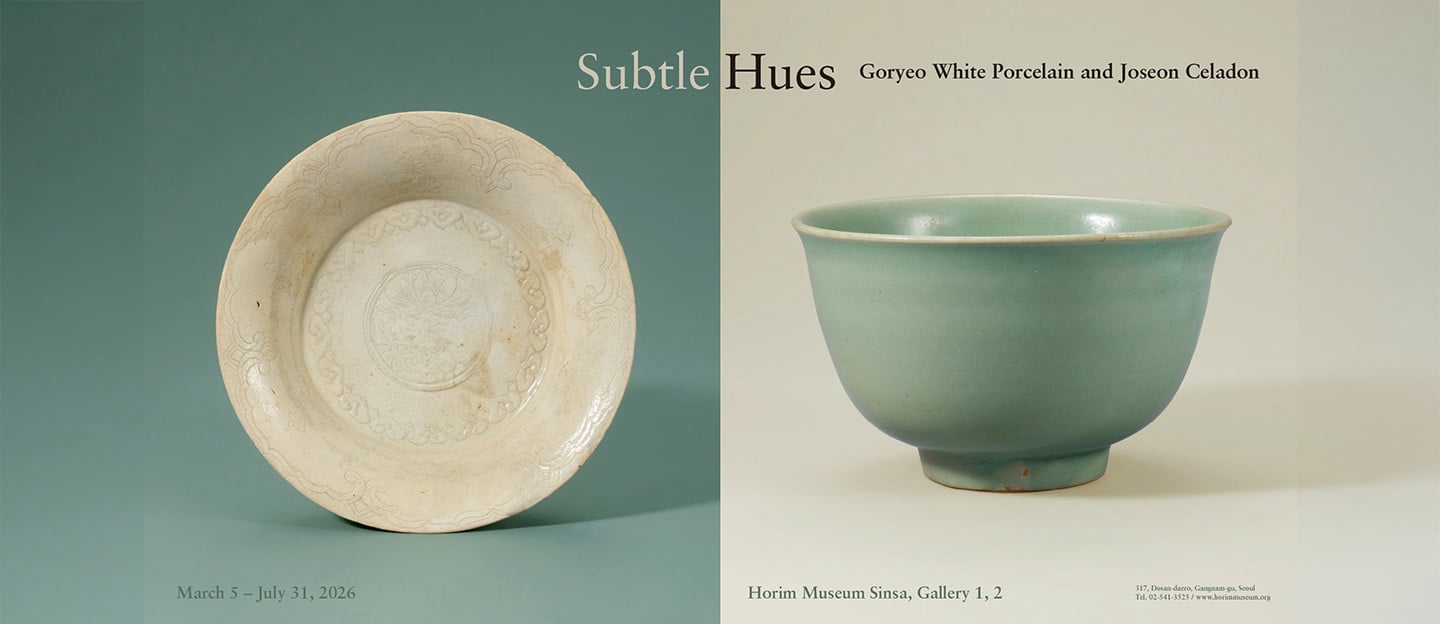
Subtle Hues: Goryeo White Porcelain and Joseon Celadon
Unknown

Horim Museum
53, Nambusunhwan-ro 152-gil, Seoul, Gwanak-gu
Tue–Fri 10:00–17:00, Tue–Sat 10:30–18:00
Admission
Free Admission
No admission fee is mentioned, consistent with museum practices.
About
Goryeo white porcelain was produced in small quantities alongside celadon wares from the early Goryeo period. By the late 10th to 11th centuries, kilns dedicated to white porcelain were operating in areas such as Seori in Yongin and Jungam-ri in Yeoju, marking the beginning of more systematic production. However, as celadon achieved remarkable technical and artistic advancement in the late 11th century, the status of white porcelain gradually diminished. Even so, a limited number of high-quality white wares—comparable to elite celadon—continued to be produced at certain kilns in Gangjin and Buan. During the Goryeo period, the production of white porcelain remained far smaller in scale than that of celadon, largely due to the difficulty of securing high-quality white clay and the technical challenges of maintaining stable high-temperature firing. Nevertheless, the continuous production of white porcelain demonstrates the strong contemporary aspiration for pure white ceramics. In terms of form, Goryeo white porcelain closely resembles celadon. The most significant difference lies in the clay body. White porcelain was made from clay containing lower levels of iron oxide, resulting in a higher degree of whiteness. However, lower-quality examples often contain impurities, giving them a dull grayish-white tone. In many cases, incomplete vitrification during firing left the body relatively soft. Imperfect bonding between the clay body and glaze could also result in uneven surfaces or areas where the glaze lifted or separated. Because of these technical limitations, Goryeo white porcelain remained in the shadow of celadon. Yet its rarity and transitional character have made it an important subject of appreciation and scholarly study. The 15th century in Joseon dynasty was a period in which a wide variety of ceramic wares were produced, including buncheong ware, white porcelain, celadon, and black-glazed ceramics. However, after the establishment of the royal kiln system (gwanyo, 官窯) in Gwangju, Gyeonggi Province during the 1460s, white porcelain came to represent Joseon ceramics most prominently. At the royal kilns, small quantities of celadon continued to be produced alongside white porcelain until around the late 17th century. Unlike buncheong ware, which inherited the inlaid celadon tradition of late Goryeo, Joseon celadon of this period was made by applying a celadon glaze over a light-colored clay body. This type is known as baektae cheongja(white-bodied celadon) or baektae cheongyuja(white-bodied celadon-glazed ware). In form, these celadon vessels were essentially identical to white porcelain, differing only in glaze color. Celadon continued to be produced from the early to mid-Joseon period largely because it was used by the royal court, particularly by the Crown Prince (Donggung, 東宮). Historical records show that the Joseon court strictly regulated the types of vessels used according to social rank. The Gyeongguk Daejeon Juhae(Annotated National Code, 1554) states that white porcelain was used for the king’s table (eoseon御膳), celadon for the Crown Prince, and decorated wares (chaemun-gi, 彩文器) for official banquets and diplomatic receptions. This system of distinction remained in place until the late 17th century. Later, as the production of blue-and-white porcelain increased and social regulations gradually loosened, the production of celadon came to an end. The use of celadon by the Crown Prince was closely tied to Confucian cosmology, particularly the theory of yin-yang and the Five Elements. The Crown Prince was associated with dawn, the east, and the color blue-green. These symbolic associations influenced the choice of ceramic vessels. Joseon celadon thus represents a rare example of how the ideology and philosophical worldview of the Joseon dynasty were embodied in ceramic art.