Presences Adrift
Choi Yoonhee
G Gallery
748 B1 Samseong-ro, Gangnam District, Gangnam-gu 06070
Mon–Sat 10am–6pm
Admission
Free Admission
About
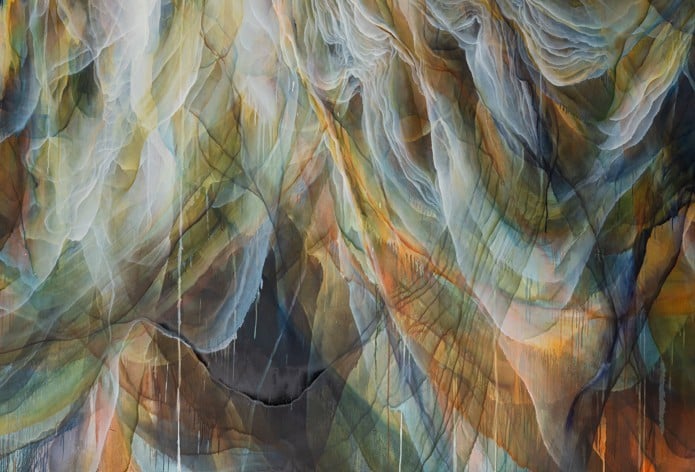
The world of painting seems to be born within the limited space of a two-dimensional canvas. However, it is also the trace of a moment where visible and invisible images of reality intersect. What Yoonhee Choi reveals through her paintings is, as the artist notes, a record of the present she embodies through her own senses. Held across two spaces, G Gallery and PCO, her solo exhibition Presences Adrift takes a multi-dimensional look at the artist's evolution—from three large-scale paintings from Tuning In (2024), to her series Time Standing in a Passage, up to the present in 2026, spanning watercolor drawings on paper, murals, and oil paintings on canvas. Ranging from canvases the size of the artist's own body, to smaller watercolor drawings proportionally scaled-down or enlarged from the Body Landscape series, to large-scale murals, the 40-plus new works in this exhibition unfold a rhythm, starting from her watercolor drawings on paper, where the colors and forms grow clearer and deeper. The holes, thin lines, and thin, membrane-like planes created as watercolor dissolves and sets in water are like essential elements—they become the core of Choi's painting, acting as portals extending into other spaces. The holes and traces of watercolors are transmitted onto the canvas, where thin lines drawn with diluted oil paint spreads across surfaces created by repeated rubbing and absorption. This exhibition is presented across two venues: PCO features works that freely experiment with dissolution, through watercolor drawings and on canvases that resemble murals; while G Gallery showcases canvases whose surfaces resemble overlapping layers that have accumulated into a solid form, yet still retain the delicacy of thin membranes. Choi's work does not have a fixed beginning or end. Rather, it exists as an ongoing process in which, from the moment it is perceived, it continually converges and dissolves. Borrowing the notions of "path" and space discussed by critic Eunju Lee in "The Interface of Painting: Pathways Inside and Outside," we can trace the routes that the images in Choi's paintings have been taking. Prior to 2024, her practice was closer to fragmenting sensation, or reconstructing paintings by reassembling fragmented sensations. Now, instead of stitching together disconnected moments, she converges scattered tributaries into a larger current. This does not mean that the flow has become singular or unified; rather, where her points of connection once resembled dotted lines, they are now lines that reveal continuities that are at times faint and at times unmistakably clear. Although the artist's repetitive process of applying, absorbing, and rubbing pigment across the surface has remained unchanged, the imagery that once evoked veins and the body's interior has gradually expanded into layered planes, blurring the boundaries between inner and outer space while extending its terrain both widely and deeply. For Choi, painting is both a body that represents herself and a mirror through which she confronts herself. She describes her work as the landscape of a body in which surviving organs or lingering voices remain, using this metaphor to evoke the long, invisible embodied experience embedded within her paintings. The faint yet multilayered membranes produced by placing, rubbing, and absorbing pigment onto the canvas accumulate into something resembling a vast, translucent geological stratum, or transform into curtains of soft, layered fabric. At the same time, through repeated rubbing and polishing, the painting is compressed into a smooth, flat surface. At the moment, Choi is more consciously aware of where she stands and the space she is looking at; she is more engaged with the sensation of seeing. Whereas her earlier gaze was directed at tracing the afterimages of her own sensations and tracks, constructing a broad topography of them, the boundaries between the interior and exterior are no longer vague. Accordingly, unlike earlier works that alluded to an immeasurable spatial scale while inviting viewers to imagine the whole, her new works suggest that only a portion of this unknown space has been enlarged, or that the work is lingering at a single point for an extended time. Viewers encounter the artist's world through paintings—they become both a passageway and a hole. In Choi's watercolor drawings that feature small black holes, sometimes the entire rectangular canvas itself becomes a black hole, naturally functioning both as an entrance and as a dead end. Rather than imposing a fixed orientation, the artist creates images liberated from gravity, opening pathways through which one may enter the painting from any direction. Consequently, the landscape surrounding the hole is necessarily open in every direction. It is a space that is at once empty and full, and therefore never fixed. In her earlier works, she depicted spaces that were viewed either from outside the hole or from within it; the hole was positioned either before or behind the viewer, so the artist may have felt little need to explicitly reveal or discuss it. According to Choi, after beginning to draw with watercolor in the autumn of 2025, she felt compelled to paint the hole itself. This seems to suggest that she now stands at the threshold of the hole's entrance. The title of her 2024 work, Time Standing in a Passage, may also have reflected an unconscious awareness of the trajectory her paintings were taking at that time. Direction is determined by where one stands. Yet perhaps it is only when one's sense of position is lost that one can fully study the space within oneself. The compulsive search for the "correct" direction can exhaust us and dull our senses, yet it may also open a path that can lead anywhere. Borrowing the titles of Choi's own works, perhaps it is time to tie a knot, choose among north, south, east, west, and begin opening the way slowly.