DOOSAN Humanities Theater Special Exhibition: The Multilingual
Gim Ikhyun, IM Youngzoo, Chung Seoyoung, Choey Eun Young Cho
Doosan Art Center
15, Jongno 33-gil, Seoul, Jongno-gu 03129
Tue–Sat 11am–7pm, Sun–Mon closed
Admission
Free Admission
No admission fee mentioned; standard for Doosan Art Center
About
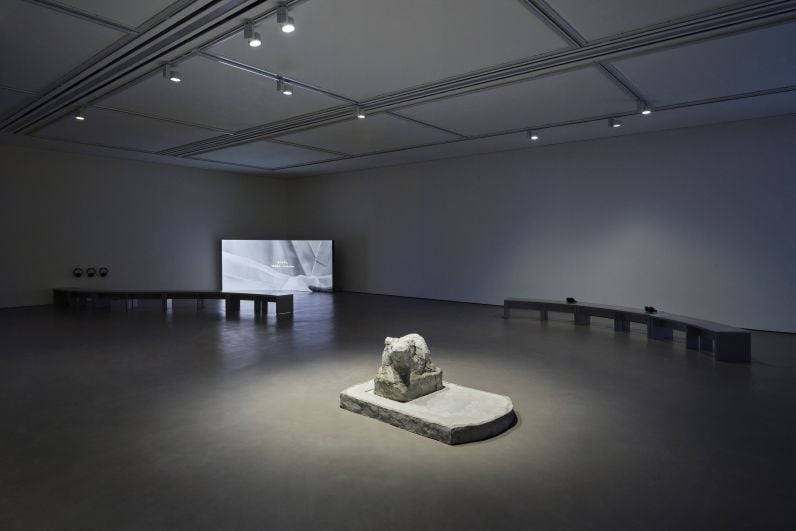
My grandmother, who passed away last year, had been nicknamed “the multilingual grandma” at the nursing home where she had spent the final years of her life. Born in 1930, she gradually erased her present and drifted closer to her past, and as her language and cognition regressed to those of a child, she suddenly began speaking in a mixture of Japanese, English, and Korean. Hearing my mother tell me about grandma’s new nickname, I let out a brief sigh—perhaps of amazement, perhaps of grief—and in that moment, the grandmother I knew shattered into pieces and dispersed into the air. Will I be able to retrieve these fragments? My understanding of my grandmother cannot escape a series of refractions and distortions. Therefore, regardless of the amount of effort, the grandmother I remember will move toward a new figure. This exhibition holds a thought for all individuals who are like my grandmother, who continued to shape her identity until the last moment of her life, and everyone around them entrusted with the role of remembering them. It is up to you to choose whom or what to recall and how to hold them in your heart. A sculpture without an author or a subject. _A Wanderer_ (2022) by **Chung Seoyoung** lies idle in the middle of the exhibition space, like a nameless cornerstone one often comes across on the street. Plastered with layers of cement as if being patched up, the mass is in a tentative state of congealment, potentially being everything and nothing at once. A Wanderer, which you are forced to encounter repeatedly here, will likely appear different each time. In the numerous movements and encounters that occur in a person’s lifetime, one’s own will inevitably becomes intertwined with those of others. The individual, as the sum of all events and experiences encountered as well as affects held, can only remain a mystery. To approach this fluid portrait, I suggest that we veer off course from the usual methods of “understanding” we’ve been accustomed to, willingly embrace misunderstanding, and remain present while holding onto a vague faith toward the essence that will never be compromised. A sentence unowned. _I Ordered a New Body and It Never Came_ (2026) by **Choey Eun Young Cho** is a transformed utterance that has passed through the bodies of others while being translated and revised several times. The original conversations with the artist’s own Korean grandmother and an American elderly woman with whom she shared an equally familial bond become lost in the process of being translated from Korean to English and back to Korean and being read aloud by the artist. The memories of the two women, who possessed different generations, languages, ethnic backgrounds, and historical circumstances that could not be unified into one narrative, move from one language to another and from one’s mouth to another’s ears, during which time the sentences gradually faded, digress, and gain an unexpected rhythm. At a point where it becomes indistinguishable whose memory arrived through whose sentence, multiple eras and narrators come alive simultaneously and proceed toward the future. In I Ordered a New Body and It Never Came, the past is not time that has passed but time that continues arriving through other mouths. Events told in the future tense sound more like anticipations than retrospections, and memory becomes something to be passed through, rather than possessed. As the time imprinted on one’s body gets transferred to another body, language connects the two as an incomplete medium. A story overheard. Like the melody of a popular song that lingers on the tip of your tongue despite not knowing when and where it started, some memories with unknown origins outlive a generation. Through the artist’s confessional narrative, _Kakumei 鶴鳴_ (2026) by **IM Youngzoo** explores how a heritage that cannot be explained in any words manages to continue and transform through the following generation. From faint memories of her grandmother, the artist overlaps her grandmother’s impression of a crane’s call and her code-like Japanese with her mother’s crane dance and intimate confession, evoking senses where the remnants, mimicry, transmission, rejection, and admiration of shamanism that remain in a family are entwined. The young twenty-four-year-old bride who used to be so afraid of shamanism that she couldn’t eat for a month after seeing the shrine hidden behind curtains on the first day of her marriage now moves her body in front of her daughter’s camera after a lifetime has passed. The ambivalence of the artist’s mother, who mutters, “I could do that too,” while watching a shaman dance even though she hates shamans, shows that something she believed erased still exists within her in a different form. The boundaries between ation and mimicry, tradition and remainder, and fear and affinity become loosely distant and are still close together. We live with things that are indecipherable, like gestures that persist despite having lost all meanings. A belief transferred. The classification of the “Bronze Age” widely accepted since 1836 identifies the trends of a particular period by deducing patterns of connections among artifacts discovered in a mixed state. This recognizes that the past moves toward the future, intertwined in multiple layers. On the other hand, during the time when photography was trusted as an apparatus for objective ation, that very belief saved Auguste Rodin from the suspicion of lifecasting—_The Age of Bronze_ (1877). However, a photograph is always only a part of a thing and time. The thousands of sculpted body fragments—abattis—and the seven thousand archival photographs of The Age of Bronze left by Rodin allow us to imagine new relationships among parts that can never truly become a whole. _A Bronze Age_ (2026) by **Gim Ikhyun**, which traverses all these facts and beliefs, goes beyond an art historical rearrangement to highlight the vulnerability in the way we remember history and people amid countless omissions and ideologies. This perspective expands to the statue-building culture of and around the Colonial Joseon period to trace modern and contemporary statues in Korea and Japan and calls attention to the fact that statues functioned as ideological tools of modernity. Whenever politics and social beliefs shifted, the sculptures of an era were demolished or relocated and re-erected. Some were melted down to become different statues, while the author of one monument became the subject of another by a subsequent generation. Ultimately, the present that has reached us now after passing through a period is a vestige of the