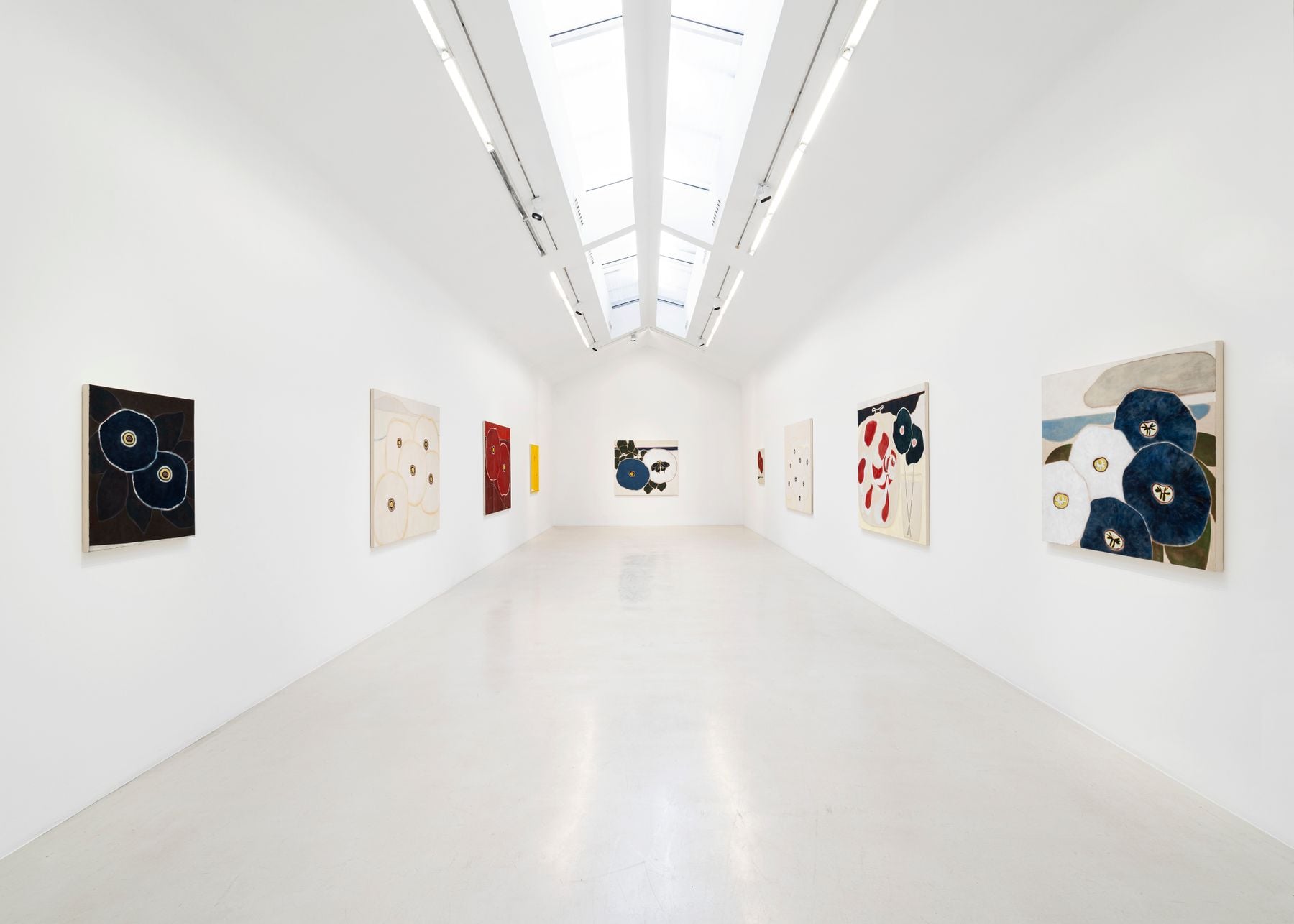
When I Think of You in Spring
Susumu Kamijo

Perrotin
76 Rue de Turenne, 75003 Paris, France 75003
Admission
Free Admission
Commercial gallery, no explicit admission fee mentioned. "Book your free guided tour" implies general admission is free.
About
Perrotin is pleased to present Susumu Kamijo’s second exhibition in Paris, following The Sun Inside in 2023. This new presentation immerses us in a calm and poetic world, populated by monumental flowers, animals, and landscapes defined by intuitive lines. Susumu Kamijo’s painted world is filled with large flowers, fruit, and sometimes animals: butterflies, parakeets, sailfish. Occasionally, one encounters a few everyday objects. It is a calm world. In the background, certain elements hint at the scene’s scale: a cloud floating in the sky, a horizon line over the sea, a colorful hill. Yet it is a form of painting that never tries to create the illusion of depth or tell a story. Applying art historian Leo Steinberg’s 1968 distinction between the vertical “window” model of painting and the horizontal flatbed picture plane (originally developed in relation to Robert Rauschenberg’s work), it becomes evident that Susumu Kamijo’s practice aligns with the latter. His inclusion of landscape elements follows an intuitive logic, focused entirely on exploring the flatness of the pictorial surface. The artist explains, “If I sense that something is needed in that spot, I might add a cloud, and that helps maintain the composition’s equilibrium.” His chromatic choices follow a similar pattern: certain colors and color combinations draw him in, not for their representational value, but for their ability to organize the painted surface and create visual and emotional effects. The large, recurring flowers function primarily as formal devices. The artist describes their inherent dynamism as a principle of outward expansion radiating from a central point. In short, the flower is an intriguing motif because it carves out its own space. “Like a big bang, a nebula,” he adds. Whites in Field, 2026 by Susumu KAMIJO Details & Inquiry Yellow-Singing, 2026 by Susumu KAMIJO Details & Inquiry In many respects, Susumu Kamijo paints like an abstract artist, which was evident as early as 2016–2017, when he first gained recognition with his series of poodle paintings on paper. These works, based on the repetition and variation of a motif, helped shape his formalist style. Born in Japan in 1975, Kamijo has lived in the United States since the age of sixteen. There, he quickly discovered Abstract Expressionism, a tradition he continues to explore, citing Francis Bacon, Philip Guston, and Milton Avery (a mentor to Mark Rothko and Barnett Newman) as major influences on his own practice. His earliest paintings, created during his student days (earning a BFA at the University of Oregon and an MFA at the University of Washington), were indeed abstract. Yet this purely formal approach cannot fully account for the impact or the meaning of his work. Kamijo acknowledges that his sense of composition is deeply rooted in personal biography. “I grew up in the countryside, in the mountains of Nagano. For me, glimpsing the horizon or the sea was a truly rare experience.” This explains why a line or the expanse of a blue plane of water function as visual events in his paintings. View of Susumu Kamijo's exhibition 'When I Think of You in Spring' at Perrotin Paris, 2026. Photo: Claire Dorn. Courtesy of the artist and Perrotin Red Blooms, 2026 by Susumu KAMIJO Details & Inquiry Forever Unforgotten, 2026 by Susumu KAMIJO Details & Inquiry Sun Yellows, 2026 by Susumu KAMIJO Details & Inquiry Symbolism, too, invariably seeps into his work. The cut flower, beyond its formal role within a composition, is an ambivalent symbol deeply embedded in Western art history, combining a celebration of life’s beauty with a poignant awareness of its transience. “I like the idea of these two things, the tragic and the joyful, intersecting within the painting,” he explains. This recalls Andy Warhol’s playful approach to his 1964 Flowers series, which remains one of his most popular works. He intended the series as something cheerful and accessible, appealing to both the public and his gallerist, Leo Castelli (who first exhibited his hibiscus paintings). At the same time, the motif allowed Warhol to discreetly continue his obsession with mortality, in the vein of his Death and Disaster allegories, images of accidents and fatal catastrophes he had been working on since 1962. “I like the idea of these two things, the tragic and the joyful, intersecting within the painting.” — Susumu Kamijo For Susumu Kamijo, painting is connected to a sense of temporal discipline. He works on one painting at a time. Sometimes, things elude him; sometimes the process goes well, and sometimes it doesn’t. He persists until he “catches something,” as he puts it. His belief that he is merely a vessel through which his paintings emerge and that he derives “ultimate pleasure” from being controlled by it places his practice within the tradition of mediumistic painters, most notably Hilma af Klint. Yet this view also reflects something more pragmatic yet equally important: the temporal conditions of artistic practice. The ability to be alone in the studio, sometimes in the early morning, the freedom to organize his day as he sees fit, and the capacity to work while shutting out the information overload that defines our era. And, above all, to carve out moments dedicated solely to painting. For an artist who devoted himself fully to painting quite late, in his late thirties, this meditation-in-action on the value of time–both the time one has for oneself and the time that remains– carries profound significance. It will likely also resonate with those who engage with his work, and they might follow his advice: to pick a single painting from the exhibition that speaks to them and give it time. Text by Jill Gasparina, art writer and curator