Soulages-Hartung : Affinités électives
Hans Hartung, Pierre Soulages
Perrotin
76 Rue de Turenne, 75003 Paris, France 75003
Admission
Free Admission
Admission is not explicitly stated but is assumed free for a commercial gallery.
About
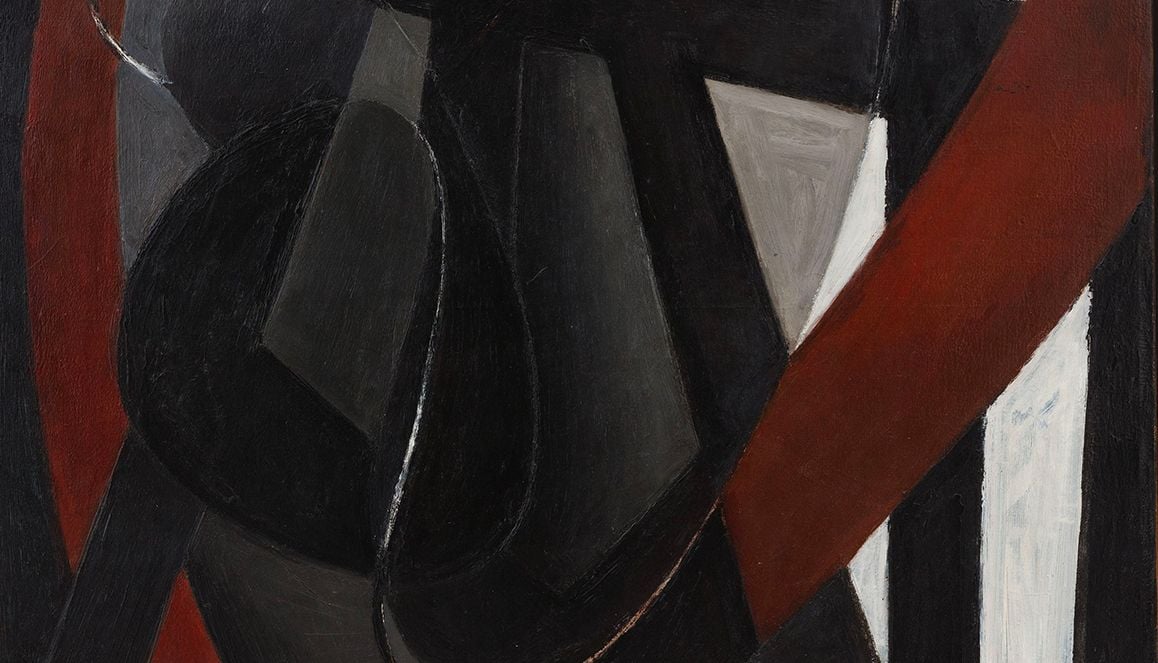
“We were outsiders”: this is how Pierre Soulages (1919–2022) described his generation of postwar artists in a filmed interview about his friendship with Hans Hartung (1904–1989), which Perrotin screens here for the very first time. This video from the Fondation Hartung-Bergman, along with an array of archival documents (including letters, photos, and notebooks), constitutes the starting point of this exhibition. Parallels between the two painters are explored through a selection of artworks, and tools that have rarely if ever left their studios. Soulages and Hartung were stimulated by the Mediterranean atmosphere and built spaces for art (in Sète and Antibes, respectively) where they renewed their creativity and engaged in increasingly radical experiments. They continued to talk, support and inspire each other, and to exchange gifts, such as the magnificent Brou De Noix (walnut stain piece) that Soulages gave to Hartung in 1948 (receiving two drawings in return), which is lent to the gallery for this occasion. The sustained interest that Pierre Soulages has always shown in Hans Hartung’s pastels underlies the decision to present them in Room 5. The two painters shared many concerns, although this has not always been understood. In the 1940s and 1950s, encouraged by bold women gallerists such as Lydia Conti and Myriam Prévot, they became known for a vocabulary of lines and shapes free from geometrical canons. They were soon identified as the leaders of a new abstract school, but their work also encountered hostility. In 1955, Waldemar George took a reactionary stance toward their art: “Hartung and Soulages seem to operate in the infernal circle of satanic and apocalyptic art.” Both painters explored notions of the sacred and interiority, while having a complex relationship to the American scene. In addition to observing their relationship to chiaroscuro and to light emanating from darkness, viewers will discover their lesser-known use of blue in the 1980s in this exhibition. Pierre Soulages and Hans Hartung, December 1987, Antibes. Photograph by André Villers.© Hartung & Soulages / ADAGP, Paris 2026. Archives of the Fondation Hartung-Bergman. The destiny of the two painters is marked by a fifteen-year age gap and different backgrounds. Of German origin, Hartung fought the Nazis and became a French citizen after Liberation; hailing from Aveyron in the south of France, Soulages was a young man with a committed, rebellious character. There are also some clear contrasts alongside their affinities. Hartung’s explosive, centrifugal, gestural approach differs from the sustained, measured structuring in the paintings of Soulages. This exhibition relates some of the echoes, parallels, and differences that construct the relationship between the two friends. It serves as a surprising and fruitful first step in preparation for the eightieth anniversary of the artists’ meeting at the Salon des Surindépendants , which will be celebrated in 2027 at the Musée Soulages in Rodez and the Fondation Hartung-Bergman in Antibes. PAS-37, 1947 by Hans HARTUNG Details & Inquiry Sans titre, 1950 by Hans HARTUNG Details & Inquiry Brou de noix sur papier 100 x 75 cm, 1948 by Pierre SOULAGES Details & Inquiry Brou de noix sur papier 64,5 x 49,8 , 1948 by Pierre SOULAGES Details & Inquiry A Rich Archival Heritage: A 40-Year Friendship View of Hans Hartung\'s studio in Antibes. © Hans Hartung and Anna-Eva Bergman Foundation The Hartung-Bergman Foundation houses a rich archive (correspondence, photographs, diaries, etc.) documenting the exchanges between Hans Hartung and Pierre Soulages, as well as their close-knit circle: Colette Soulages, Roberta González, Anna-Eva Bergman, and others. A vivid account in Hartung’s autobiography captures the nature of their dialogues in the late 1940s, a time when their artistic references both contrasted and complemented one another: Rembrandt, Goya, Van Gogh, Munch, and German Expressionism for Hartung; Romanesque art and megalithic forms for Soulages. Initially represented by the Lydia Conti Gallery, both artists later joined the Galerie de France under Myriam Prévot, a pivotal force in their careers. The abundance of postcards—particularly those sent by Pierre and Colette Soulages to Hartung and Bergman—attests to a lasting bond, sustained through shared images, travels, and cultural references. In Germany, the physician and collector Ottomar Domnick contributed to their visibility by presenting their work in several public exhibitions between 1948 and 1949 – a period of reconstruction marked by denazification. Yet their reception was not without opposition: critics could be scathing, such as Waldemar George, who declared in 1955 that they “seem to be spinning in the infernal circle of a satanic and apocalyptic art”. Colette and Pierre Soulages remained steadfast in their loyalty to Hartung, continuing to visit him at his home as his health declined and as he mourned the death of Anna-Eva Bergman in 1987. Pierre Soulages even celebrated his 68th birthday in Antibes. Tools from the Studio The technical question—and the move beyond traditional means—emerged early in the work of Pierre Soulages and Hans Hartung. By 1947, Soulages was already using tools from the craft world (house painters\' brushes, woodworkers\' scrapers) and sourcing materials from Adam, a Parisian supplier that offered items such as tanners\' scrapers and beekeepers\' knives. Throughout his life, he continued to explore a wide range of production methods. For Hartung, the expansion of his equipment and methods came later, in the late 1950s, sparking a wave of boundless inventiveness. He multiplied his processes by repurposing or crafting countless tools. He notably used body shop spray guns to pulverize paint, followed by garden sprayers, and also designed oversized brushes from branches in his garden, mounted on long handles. In an exceptional move, a selection of these tools has been taken from the studios and exhibited side by side. Pierre Soulages, Peinture 85 x 222 cm, 23 avril 1988 (detail), 1988, Oil on canvas, 85 x 222 cm | 33 7/16 x 87 3/8 inches. Photo: Tanguy Beurdeley. Courtesy of Pierre Soulages\' estate and Perrotin Recourse and Return to Blue 1982 Hans HARTUNG Details & Inquiry Hans Hartung constantly explored the color blue across a vast spectrum of tones. In his prints from the 1970s, he focused primarily on its depth, at the very threshold of black. Yet between 1980 and 1984, during his time in Antibes, his approach shifted dramatically toward much lighter hues (sky blues, azure, sometimes green-tinged tones), where the effects of Mediterranean light are unmistakable. These variations introduced an atmosphere that was open, peaceful, irenic, almost Edenic. 1988 Pierre SOULAGES Details & Inquiry In April 1986, blue made a sudden “intrusion” into Soulages\' work—an “accident,” as he called it. The artist himself traced its origin to an experience in Sète: a black canvas, exposed to marine reflections, seemed to be tinted with blue, to "clothe" itself in it, as he put it, without the addition of any pigment. This led him to introduce ultramarine blue into his Outrenoirs , exposing it by scraping away the surface layer of black. It is interesting to note that the relationship between black and blue is almost inverted in the work of Hartung and Soulages. Hartung presents expansive backgrounds across which dark touches—applied with his oversized brushes—suggest scattered streaks and swirls. Soulages, by contrast, reveals thin spaces of ultramarine beneath broad, structured layers. The Inner Paths of Chiaroscuro Pierre Soulages’ extraordinary work with black and his exploration of the relationship between darkness and light have produced a wealth of exhibitions and commentary, making fresh perspectives on the subject rare. One possible approach is to draw connections with other artists, even if none pursued this formal investigation with the same mastery. As a great admirer of Rembrandt, Hartung declared: "I love black. It is probably my favorite color," rendering the parallel far from arbitrary. In his work, however, black does not strive for the same absolute. Hartung seemed wary of too radical a reduction, as if holding back from an extreme asceticism—perhaps because the field was already masterfully occupied by his friend Soulages, or perhaps because a vivid taste for chromatic modulations always drew him away from such a singular focus. Even in his darkest works, blues, greens, and grays often subtly emerge. The juxtaposition of these two artists thus reveals both a profound kinship and a decisive gap. Yet their strongest bond may lie elsewhere, on a philosophical or even metaphysical level. Both were particularly attuned to the notion of "interiority". It is this, ultimately, that lends true depth to their respective uses of chiaroscuro, notwithstanding the clear differences in their methods and works.