Lorsque la beauté paraît
Lee Mingwei
Perrotin
76 Rue de Turenne, 75003 Paris, France 75003
Admission
Free Admission
Commercial gallery, 'Book your free guided tour' mentioned.
About
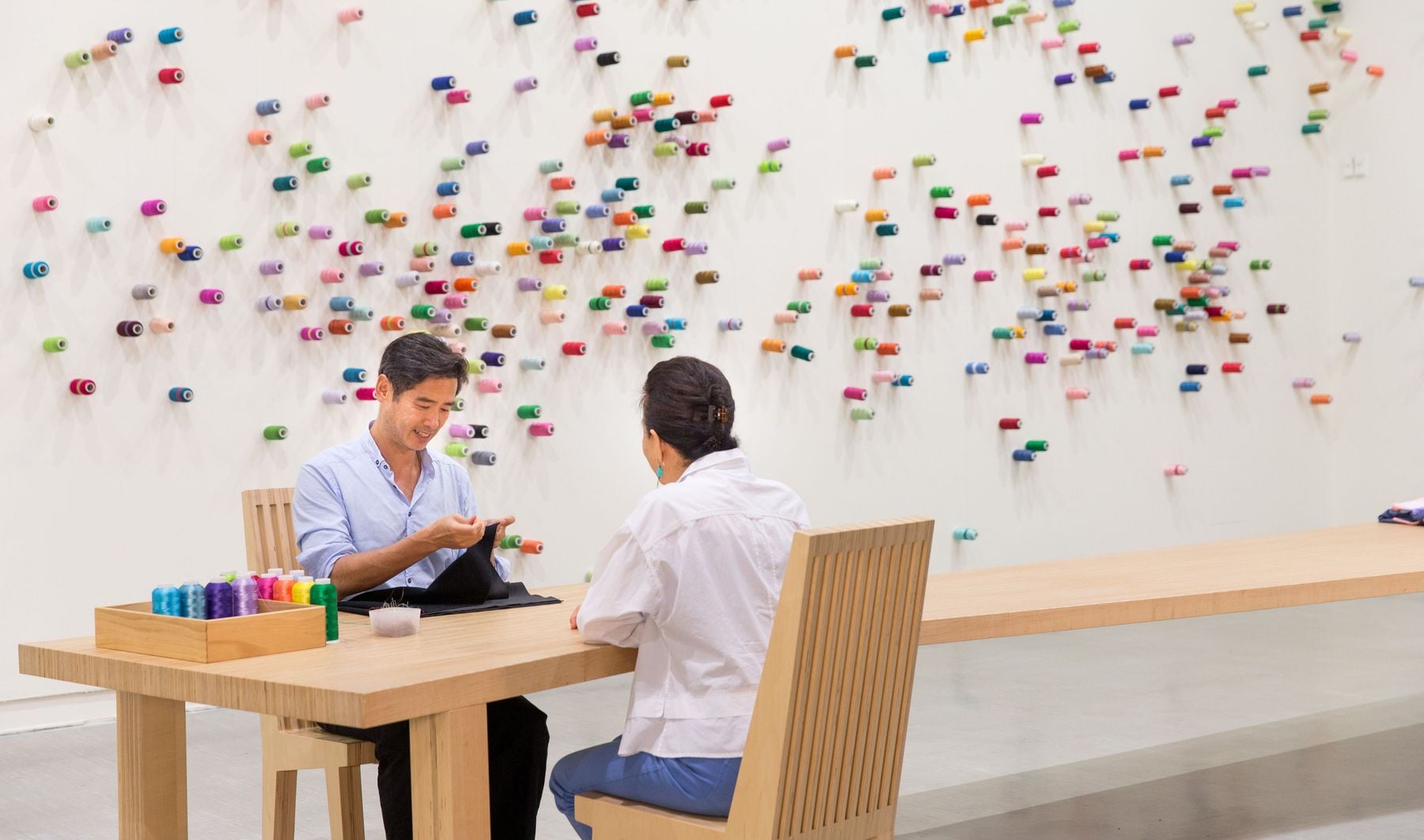
Perrotin is pleased to present When Beauty Appears , the second solo exhibition by Taiwanese artist Lee Mingwei with gallery and the first in Paris location. Over the course of the exhibition, visitors will have the opportunity to encounter a selection of interactive works, including La fleur en chemin (The Moving Garden) , The Mending Project , and The Copyist’s Paradox . Read here the full text of Thierry Raspail. Lee Mingwei’s work takes an approach that is different from our common conception of art. While most artists try to impose their view on the world by enclosing it within an object, Lee Mingwei does the opposite. He questions the world and offers no answer. And this way he questions us too. Directly. A question—never an assertion. Expressed through an object or a seemingly insignificant act, this question is addressed to an individual subject. The answer then belongs to us; it will always be highly personal, touching the deepest part of our being. Taking beauty as an overall perception of the world, as Mingwei does today, is a categorical position that challenges the brutality and cynicism of our world. So to speak of beauty is not to flee, but to fight. Lee Mingwei’s work is thus radically political. When beauty appears. What is our relationship to beauty? What is it, where is it hiding, when does it appear and in what form? This questioning runs through all the works in this exhibition—a set of seven pieces created between 1995 and 2025 that are now shown together for the first time. Most of Mingwei’s works have something ephemeral and contingent about them. For instance, one piece is supposed to be broken at the right moment, or another must be given away in order to exist. And some of them are configured as rituals. Ritual has the particular quality of being able to transform an object into a duration. The artwork is truly embodied in this short span of time. The ritual repeats itself but the situation it creates is new each time, for the person who experiences it is unique. A subtle welcoming; the importance of clothing; a certain solemnity; the fine quality of the materials; slowness; colored thread arranged on a wall; transparent alabaster; darkness; measured gestures; and silence. These are some of the figurative components that serve the fleeting moment and restore the emotional power of the experience. Ritual is the expression of their tacit presence. This is why rituals need to be brought to life, experienced, and experienced again. By limiting himself to the essential questions (which ultimately are very few in number), the artist makes this a matter of ethics. This is why his work does not contain many objects and does not form profuse series. On the contrary, one of the qualities of his art is that it cannot be the object of massive production. Not signing onto the dominant mode of overproduction means being profoundly connected to his time, or, at least, to ours. Substituting ritual, repetition, or disappearance for overproduction; exploring the game of personal relationships; targeting the intimate; considering fragility a strength; or arranging the chance encounter of two strangers during a shared moment—around a simple flower for example—is certainly the most beautiful offering possible in today’s world, where listening to others has become an exception. For Lee Mingwei, the offering has no “why” and no conclusion. It is where, perhaps in that single moment, beauty appears. And it is most often ineffable, inexpressible, immaterial, and nonnegotiable. La Fleur en Chemin (The Moving Garden), 2009 - 2026, Mixed media, ceramic. When visitors enter the first room of the exhibition, they are met by an imposing bouquet of flowers. This is an initial expression of courtesy for those who enter. The artwork is called La Fleur en Chemin , 2009/2026. It’s the story of two beings who theoretically have nothing in common, who know nothing about each other, and who were never supposed to meet. Yet, through chance, attention, and intuition, and through the artist’s intervention, this encounter does take place. If they wish, visitors may take a flower when leaving the gallery—as long as they go out of their way to offer it to a stranger. Nomos , in ancient Greece, refers to sharing and law. But here, in this brief exchange, without any reward except perhaps a smile or gentle surprise, a gesture that is both simple and radical occurs. It is indeed an offer without a “why.” It is at once quite trivial and also very meaningful, for it is nothing other than the primitive form of any kind of socialization. For the person who offers, the flower, having become this flower, will remain fresh for always. For the person who receives it, it will fade and die. But the gesture will remain intact. The movement from one hand to another, however fleeting, may be this unique moment when beauty comes into view. In the second room, three pieces are shown. The Mending Project , 2009/2026, waits for visitors: a long table, a chair, a colored wall covered with spools of thread, and a host. Clothing is an envelope that clings to the body and reveals us as much as it hides us. When it is worn out, it can be handed over to the colored thread and the care of the host who welcomes us. Sewing: the piece of clothing is repaired, and the clothing is given a mark of recognition. It is an act of care for a familiar clothing item and also a sign of distinction that transforms its wornness into a colorful mark. Its use value, like a trophy, now becomes an award. The item, previously a mass-produced object, is now unique. And beautiful. The renewed item, with thread ends still attached in a web of color, is placed on the table, visible to all. Stone Journey , 2010/2026. Lee Mingwei gathered smooth, round stones in New Zealand. They were shaped by the movement of 70-million-year-old glaciers. Held in the palm of the hand, they are cool and soothing. It occurred to the artist that he had changed the course of events by removing the stones from their context and giving them a new meaning. What does it mean to own a natural shape that is several millennia old? Back in Taipei, Lee Mingwei created a bronze cast of each of the stones, producing pairs. Anyone who buys a pair must commit to give away one or the other—either the stone, or its double made by the artist. Which one is more precious? What value will be assigned to each? Casting off one or the other means freeing oneself from the control of one or the other and reversing the gesture that introduced them into a new system of values. The loss then becomes a reverse copy of the initial removal, a symbolic exchange. But is it possible to stop wanting to impose the framework of our own thinking onto things? 100 Days with Lily , 1995. After the death of his maternal grandmother, Lee Mingwei decided to spend 100 consecutive days, 24 hours a day, with a lily as a sign of mourning. On the first day, he planted a bulb that would germinate, bloom, and fade. He documented this every day. The two life cycles, of the flower and the human, overlapped, and, after 79 days, the lily died. The artist then carried the bulb in his hands for the next 21 days. The five photographs shown here summarize this shared life trajectory by pausing on daily activities: eating, reading, sleeping. Life. The third room presents Breath Drawings and Chaque Souffle une Danse , 2024/2026, two works that are closely connected, with one expressed exclusively in space and the other in time. The Breath Drawings began with droplets of sumi ink (traditionally used for calligraphy) that Lee Mingwei, after a long meditation, placed on thin alabaster panels. Then the drawing was produced by the artist’s breath, which spread the ink over the surface. Each one is unique. For Mingwei, the breath, an intimate and natural union between the inside and the outside, is a form of resistance to the growing anxiety experienced in an increasingly violent world. But we cannot help but think of the principle of vital energy, the Q i , represented by the primordial breath born of the void and produced by the Dao , the ancient Chinese reality principle that gives shape to everything. It is original, One, but contains all changes. The individual breath that is revealed here is a metaphor for it. The tablets are then arranged vertically in the space, so that they fill it without crowding. Here, 15 tablets are shown. Each of the ink drawings on alabaster is activated by a master of ceremonies for whom Chaque Souffle une Danse becomes a ritual. In darkness, the celebrant slowly moves among the drawings, the sound of his steps becoming a component of the space. Then he lights a candle behind each of the translucent panels, stopping briefly at each one. Each drawing then appears in its transparency. And when all the candles have been lit, the celebrant reverses his steps to put them out one by one. Silence then joins the darkness. Stopping at a form and going beyond it. “The Qi informs and transforms each thing, in an operation with two sides.” In the fourth and last room, two artworks face each other: Le Son de la Pierre and The Copyist’s Paradox . Le Son de la Pierre , 2022/2026 is made of a ceramic disc, a stone, and a stand. The owner of the artwork may, if the situation presents itself, during a dismal or hopeless time, break the disc with the stone. This singular instant is the Greek kairos , an opportune moment that one must be able to seize. The gesture is also related to the Japanese tradition of kintsugi , which consists in restoring broken objects by beautifying them, an aesthetic of repair that accepts imperfections and grants them value. The Copyist’s Paradox , 2025/2026, overlays two stories, two texts, two distant voices. The first is an invocation to the Moon God that came about between the Tigris and the Euphrates. The other is a poem, an ode to impermanence from China during the Song dynasty. Thirty-four centuries and seven thousand kilometers separate them. Mingwei presents side by side an ancient inscription in clay from the collection of the Louvre and the copy of a jade tablet that can be held in one’s hand. The host leads us through these interweaving narratives where myth, memory, charm, and emotion merge. On the back of the jade tablet, a polished metallic mirror with blurry reflections places before our hazy gaze these distant present times, which then become strangely near. A piece of precious fabric recalls the artist’s intimate family world. What awaits us in the mirror is the nature of the poetic exchange. In the Asian tradition of Linmo , copying is not reproducing but internalizing the essence o