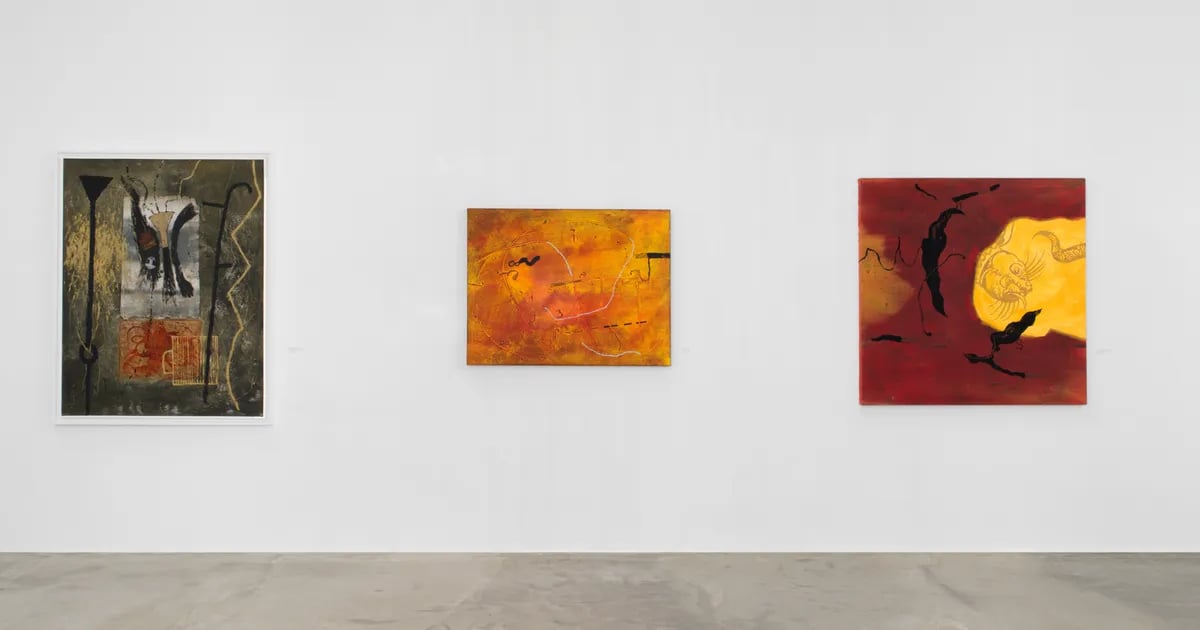
Richard Texier, Cosmographies 1987-2006
Richard Texier

Ketabi Bourdet
22 passage Dauphine, Paris, CA 75006
Admission
Free Admission
No admission information found, assuming free for a commercial gallery.
About
Ketabi Bourdet is delighted to announce Cosmographies , the first exhibition of French artist Richard Texier at the gallery. Since the late 1970s, Richard Texier has developed a singular body of work in which painting and sculpture become the vectors of a personal cosmography — an attempt to map the invisible forces that connect humankind, nature, and the universe. For its first exhibition dedicated to the artist, the gallery presents a group of works created between 1987 and 2006, a key period during which Richard Texier elaborated a visual language at the intersection of cosmography, the sign, and an abstraction traversed by totemic figures. Born in 1955, Richard Texier belongs to the generation of artists who, from the 1980s onward, profoundly renewed French painting by reintroducing a narrative dimension into abstraction. Trained in architecture and later awarded a doctorate in visual arts from the Sorbonne, he early on developed a transdisciplinary practice combining painting, sculpture, writing, and scientific reflection. His work is structured around a constant inquiry into the forces that shape the world — nature, physical phenomena, space — which he translates into a vocabulary of signs, hybrid forms, and trajectories. As he himself writes: « From the very beginning of my work, I felt an irresistible need to evoke the power of nature. » The title of the exhibition, Cosmographies , refers to the cosmic dimension of these works. In Texier’s practice, painting acts as a message addressed to the world: a gesture that seeks to capture and inscribe within matter the invisible energies that traverse reality. The artist thus states: “Color does not exist for me; only matter colored by energy matters.” His canvases function as imaginary cartographies where constellations, mental landscapes, and figures of signs appear, deliberately detached from any symbolic dimension. Works from the late 1980s already demonstrate this material and iconographic freedom. Untitled (1987), a large canvas combining oil painting, collage of metal pieces, and sand, reveals a pictorial space traversed by signs and suspended forms, alluding to the transformation of materials. This research continues in works from the early 1990s such as Untitled (1990), where the space of the canvas becomes a mental territory structured by floating forms. In the early 1990s, Richard Texier’s painting unfolds in a constant dialogue between microcosm and macrocosm. In L’enclos de la semeuse (1993), the pictorial surface transforms into a fertile field where seeds, trajectories, and signs appear, evoking natural cycles and elemental forces. These signs, often akin to writing or scientific notation, form part of an open vocabulary that the artist refuses to fix: « Armfuls of signs, letters, and numbers followed. None has the value of a symbol. They evoke chaos, the blurring of meaning, the imbalance that reigns around us. » Two sculptures also occupy a central place in the exhibition and reveal how Richard Texier translates into space the lines of force that run through his painting. Attacher le sens (1992), a juxtaposition of a steel arrow and a hemp rope, appears as an anchored form, tied to the ocean, whose power and infinity have always nourished the artist. The tension between the rigidity of the metal and the suppleness of the natural fiber creates an almost ritual figure, like a sign erected in space, in which the artist seems to seek to connect matter, thought, and the world. Facing it, La double aiguille de l’arpenteur (1992), a long sculpture in bronze and wood studded with steel elements, evokes an imaginary measuring instrument. Through its elongated form and taut lines, the work suggests the idea of orientation and trajectory, as if it were tracing in space the invisible coordinates of a cosmic territory. In Texier’s work, these sculptures do not constitute a mere extension of painting: they materialize its fundamental principles — axes, lines of tension, and points of equilibrium — and give form to the personal cosmography that runs through his entire practice. In the mid-1990s, the painting gains in material density and scale. In Version pour l’horizon (1996), a large oil on canvas produced on the Île de Ré, where the artist has a studio, the horizon line becomes a structuring axis that organizes the space of the painting like a cosmic landscape.. Works from the late 1990s, such as Nos Chemins (1998) and Les Mystères du Château (1998), develop a more architectonic iconography, where mental structures, figures, and fragments of imagined landscapes intertwine. This archaic and mythological dimension continues in sculpture with Totem (2000), a unique bronze with a dark patina whose verticality recalls the ritual figures or ceremonial objects that traverse the artist’s imagination. Completed in 2006, Hysme des deux mondes , a large diptych in oil on canvas, unfolds a pictorial universe of great amplitude in which natural forces, signs, and elastogenic forms enter into dialogue. This major work condenses the research carried out by Richard Texier since the 1980s: to conceive painting as a poetic cartography of the world, a space where science, mythology, and imagination converge. As the artist writes: « Permanent instability is an entropic principle that manages to find balance within a painting. Painting possesses the marvelous power to affirm a new order of the world and to celebrate life. » The work of Richard Texier has been the subject of numerous exhibitions in France and internationally, notably at the National Taiwan Museum, at the Manufacture des Œillets in Ivry, at the Villa Noailles, as well as at the Musée national de la Marine, which dedicated a major presentation to him in the late 1990s. The French State also commissioned a series of monumental tapestries centered on the Declaration of the Rights of Man and of the Citizen, presented notably at the Opéra Bastille, the National Assembly, the European Parliament, and the Musée du Luxembourg. Through this ensemble of paintings and sculptures, Cosmographies (1987–2006) highlights a fundamental period in Richard Texier’s career. In it, the artist asserts a singular vision: that of an intellectual and formal creation which does not merely seek to represent the world, but to reveal and map its underlying forces.