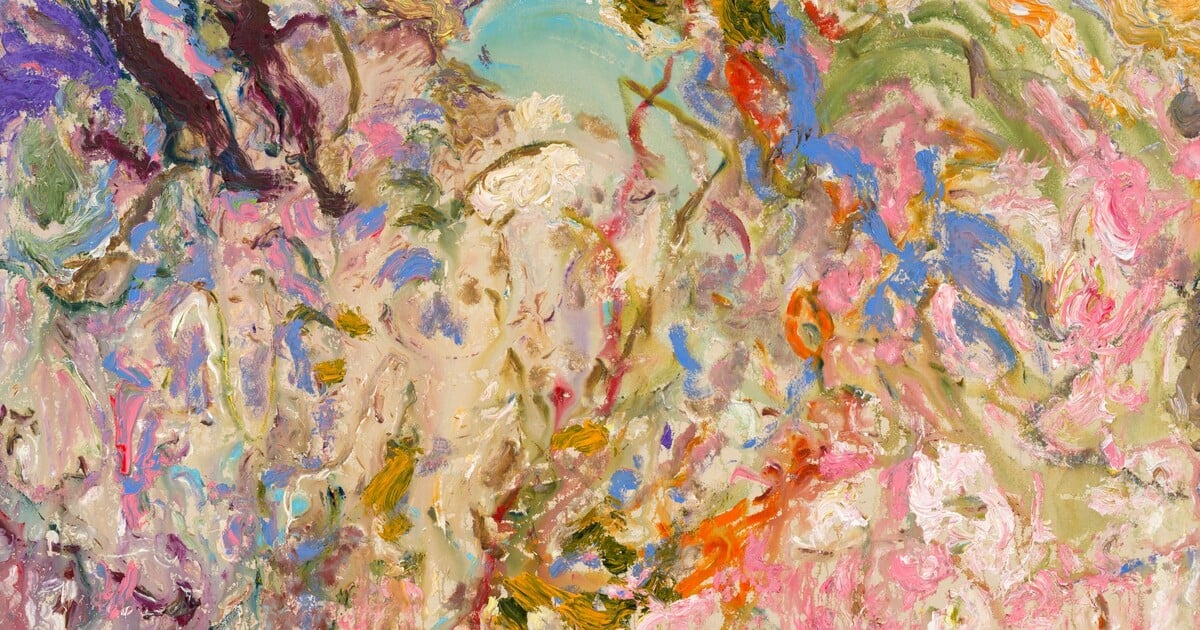
Larry Poons Kentucky Cols.
Larry Poons
Almine Rech Paris, Turenne
64 rue de Turenne, Paris, FR 75003
Tuesday — Saturday, from 11 am to 7 pm
Admission
Free Admission
Admission is free as this is a commercial gallery and no fees are mentioned.
About
Almine Rech Paris, Turenne is pleased to announce 'Kentucky Cols.', Larry Poons’ third solo exhibition with the gallery, on view from March 21 to May 21, 2026. This show, the artist’s first in Paris in nearly forty years, presents a series of new paintings, revealing the new directions in which Poons is taking his work. 'Kentucky Cols.' is organized in cooperation with Yares Art. Larry Poons, describes the strong impression made by a song he heard on the radio in the early 1950s: he compares this unusually intense experience to, smelling a flower for the first time. Looking at Poons’ recent paintings in this exhibition, viewers are seized by a similar sensation : not the representation of a flower, but the very experience of its opening and its blossoming. Ballroom Chassi , Pat Cloud , Clarence White , and How Many Hearts Have You Broken Today deploy imposing chromatic fields whose energy is less a matter of representation than of experience. Together, these works demonstrate Poons’ major role in the history of color-field painting. A little over ten years after that decisive musical experience, Poons made his very first painting, Rock and Roll (1958), an abstract geometric work. The painter musician—who, starting in 1961, got together for informal musical sessions with his friends Walter de Maria, La Monte Young, and Jasper Johns—developed a style of optical abstraction, and his famous dot paintings are some of the first pictorial experimentations of Op art. It is therefore not surprising that he was one of the artists featured in “The Responsive Eye” at MoMA in 1965, with Nixe’s Mate (1961) from his series of Dot Paintings. This exhibition played a key role in the international recognition of Op art, while also counterbalancing the influence of this trend by showing work reflecting post-painterly abstraction and color field painting. […] — Marjolaine Lévy, art historian and curator Press release read or download in English en Larry Poons Kentucky Cols. Mar 21 — May 21, 2026 | Paris, Turenne Almine Rech Paris, Turenne is pleased to announce 'Kentucky Cols.', Larry Poons’ third solo exhibition with the gallery, on view from March 21 to May 21, 2026. This show, the artist’s first in Paris in nearly forty years, presents a series of new paintings, revealing the new directions in which Poons is taking his work. Larry Poons 1 , describes the strong impression made by a song he heard on the radio in the early 1950s: he compares this unusually intense experience to, smelling a flower for the first time. Looking at Poons’ recent paintings in this exhibition, viewers are seized by a similar sensation : not the representation of a flower, but the very experience of its opening and its blossoming. Ballroom Chassi , Pat Cloud , Clarence White , and How Many Hearts Have You Broken Today deploy imposing chromatic fields whose energy is less a matter of representation than of experience. Together, these works demonstrate Poons’ major role in the history of color-field painting. A little over ten years after that decisive musical experience, Poons made his very first painting, Rock and Roll (1958), an abstract geometric work. The painter-musician—who, starting in 1961, got together for informal musical sessions with his friends Walter de Maria, La Monte Young, and Jasper Johns—developed a style of optical abstraction, and his famous dot paintings are some of the first pictorial experimentations of Op art. It is therefore not surprising that he was one of the artists featured in “The Responsive Eye” at MoMA in 1965, with Nixe’s Mate (1961) from his series of Dot Paintings. This exhibition played a key role in the international recognition of Op art, while also counterbalancing the influence of this trend by showing work reflecting post-painterly abstraction and color field painting. Poons’ lush abstract fields took shape soon afterward, in the early 1970s, following a conversation with Clement Greenberg. The artist had started a series of large canvases placed on the floor, on which he skimmed buckets of paint. During one of his studio visits, Greenberg drew the painter’s attention to several rolled canvases wrapped in plastic and leaning upright in the corner of the room: drips and splatters of paint––the side effects from Poons’ campaigns with previous canvases on the floor––had landed on the plastic, asserting themselves vertically and appearing almost weightless. It was like a light bulb went off. So Poons changed the way he worked: he put up a long roll of canvas around the walls all around his studio and began throwing paint at it, letting the momentum, gravity, and chance compose the surface. This is how Rail Road Horse (1971) came about, a work in acrylic on canvas that is almost eight meters long. Over fifty years later, the paintings shown here stem from a similar impulse, but are also clearly different: on a single, huge roll, wide as a field, Poons no longer throws color; he builds it with a brush, with free gestures, applying thick, energetic paint in an inexhaustible supply of color combinations. After studying the image, Poons crops the roll into independent paintings: these “moments” preserve the memory of the flow, while each still affirms its own intensity—that is why the painter has chosen them. This process—unrolling the canvas, covering it with acrylic paint, and then cutting it up—is not simply a technique, but a conception of painting reduced to its most direct essence. While Poons’ work is most definitely part of the history of American abstraction, it nevertheless remains dissident, by turning to look across the Atlantic. This dissidence is part of his painting and cropping process. Each canvas preserves the memory of a “before” and an “around” and is presented as a dual entity: both an independent composition and a fragment of a bigger whole. Dissidence is ultimately—and perhaps most importantly—located in the paint itself. The heavy, thick, crusty brushstrokes offer themselves as a spectacle, a symbol of painting that acknowledges and displays itself as paint. While much contemporary American abstraction tends to have a smoother surface, Poons maintains—almost all alone at this scale—a head-on approach to impasto and accumulation. These paintings then awaken the memory of Van Gogh’s fields and Bonnard’s gardens, where paint represents matter at the same time that it presents itself as matter, and where color rejoices in exhilaration. They also evoke Cézanne, whom Poons cites as an important threshold: “You understand, without the rigidity of what a painting is supposed to look like, it took a long time—until the twentieth century almost—when Cézanne would just do color. Everyone painted landscapes, why didn’t his look like everyone else’s?” 2 In other words, the arrival of a surface where color was no longer used just to describe, but exists for itself. For Poons, painting—whether it flirts with figuration or is completely liberated from it—can be summed up in a single act: setting up the canvas and applying color. And this is perhaps where this sensation of discovery appears for the viewer: not recognizing a form, but feeling, on the surface itself, the event of color—like smelling a flower for the first time. This exhibition creates something like that experience, like the first time we enter a garden. — Marjolaine Lévy, art historian and curator 1 Larry Poons was born in 1937 in Tokyo. He lives and works in New York. 2 David Rhodes, “In Conversation with Larry Poons,” The Brooklyn Rail, October 2017. 'Kentucky Cols.' is organized in cooperation with Yares Art.