Carroll Dunham
Carroll Dunham

Matthew Brown Gallery
390 Broadway, New York, NY 10013
Admission
Free Admission
About
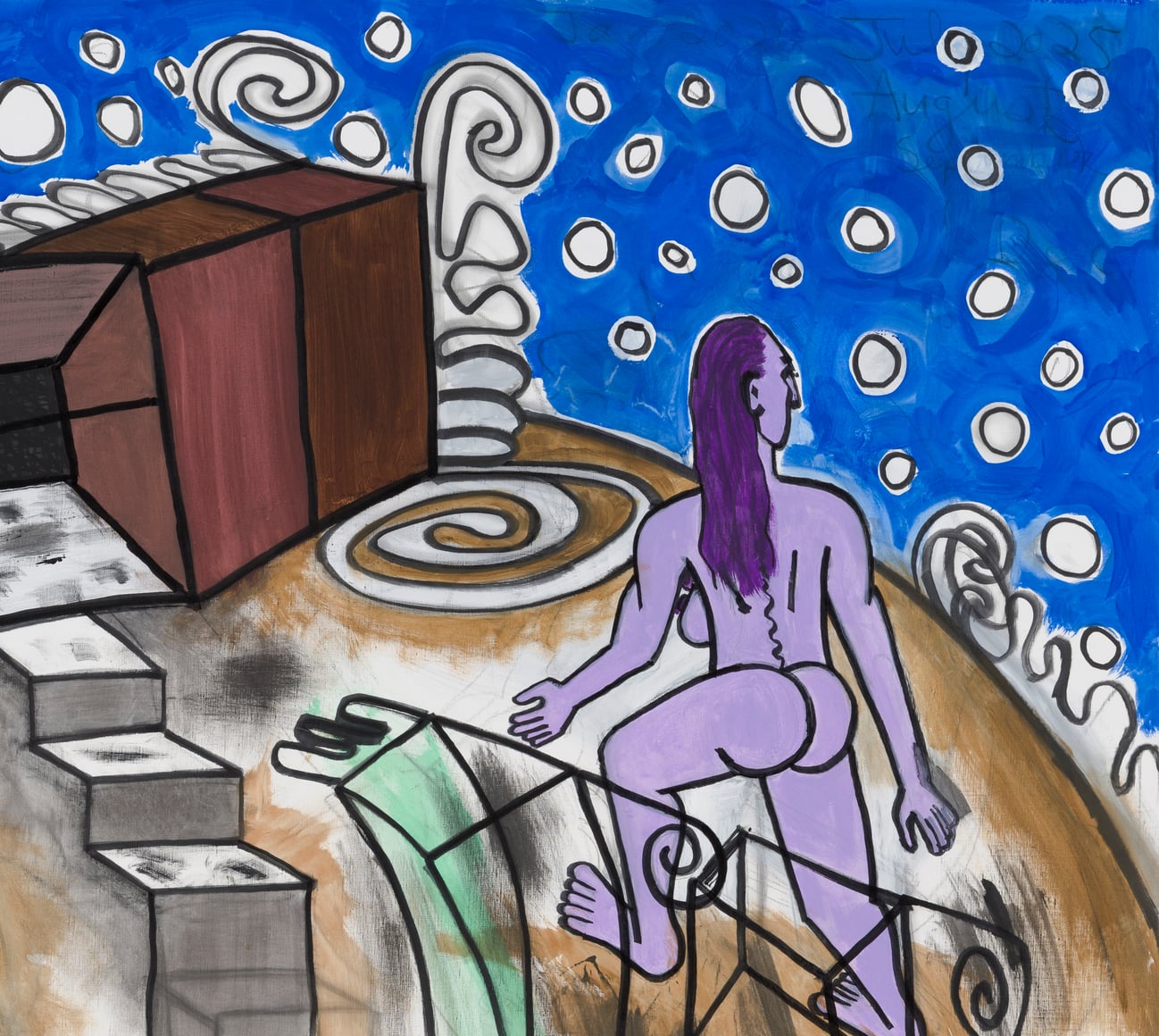
Carroll Dunham never went to art school. He tried studying philosophy at a university in upstate New York, then transferred to a small liberal arts college in Connecticut, where he switched to visual studies. Later in his twenties, when he became an artist, philosophy may not have been an intentional part of his practice, but we can see now that its logic has been there all along: set up the given limitations of an inquiry, then find out what's possible. Conditional thinking led Dunham's practice through "periods," as he calls them, and in each period he investigates a range of human qualities through a single archetype, for example: gunslinger, planet, sun, tree, bather, or wrestler. Whether you study Jungian psychology, read comic books, query Tarot cards, or watch cartoons, the definition of an archetype is the same: a nonpersonal yet universally relatable image. It could be a character: a fool with a beginner's mind wandering the world; or a nonhuman entity: water flowing around obstacles until it gathers enough force to cut through steel. Human or not, an archetype is a shape that gives us a way to see others and, eventually, a way to see ourselves. It was Dunham's Wrestlers period (2016–20) that led him to begin drawing a new character in 2022: a white male sculptor, fed up with his own planet, who emigrates to a world populated by purple people. There, he builds a studio, makes his work, and "feels whole," to quote his notes from that time. From the start, Dunham knew he wanted to focus on an archetypal explorer, one who doesn't harbor colonizing fantasies but simply yearns to opt out of his own culture and find a new home to make his art. Dunham conceived of this body of work, which he calls Studio on Another Planet, in three "chapters." In chapter one, Studio Visit, shown at Gerhardsen Gerner in Oslo in 2024, the fictional artist fashions a grey lump of clay into vaguely modernist forms while, one at a time, the purple people observe him, touch the studio walls, touch themselves. The evolution from drawings into paintings is vivid in this early part of the series: the whiteness of the main character's skin is bare gessoed linen, as are the white edges of the composition, while the background is made up of early graphite and charcoal pentimenti along with rough strokes of grey, brown, purple, and blue paint. Chapter two, Open Studio, shown at Galerie Max Hetzler in London in 2025, introduces a second purple person into the studio space. The two purple characters get a little closer, touching the art, touching the artist, continuing to touch themselves. The surrounding landscape begins to take on more material density: the curvature of a planet, a cerulean night sky, or an aqua daylight darkened by sinister black birds. Matthew Brown Gallery now presents the third and final chapter of Studio on Another Planet. In Carroll Dunham / Paintings — the artist's first painting exhibition in New York in nearly five years, and his first with this gallery — two purple people share space with the sculptor, engaging more aggressively with him and each other. As the final chapter progresses, the world of each composition is even more densely painted. The bare gesso background is gone; we can see the solidity of the brown planet and staticky grey sky. Although the white settler has traveled through space to live and work among the purple people, he seems as indifferent to them as he is to the solitary dog and the murder of black crows who sometimes enter the compositions. Meanwhile, the purple people grow increasingly interested in this alien artist and his work until the chapter reaches its glamorous, if gruesome, conclusion, with four purple people dismembering the sculptor limb by limb. Dunham has created a situation, not a story. Aside from the artist's arrival and tortured end, there are no plot points. His speculative world is less a narrative exercise than a philosophical invitation: create the structure for a scenario and let everything in. The deeper he has gone into painting the purple people, the wilder and weirder they've become. In these latest paintings, a few of the figures have grown spiral and fingerlike protrusions from their skin and exhibit both male and female anatomy. Dunham has described these characters as going through a kind of hormonal estrus caused by their proximity to the alien sculptor: "I was trying to find the thing that made the painting feel right, and the painting was telling me something about the story." Each painting in the exhibition is titled Sharing Space except for the twelve-foot canvas of the sculptor being drawn and quartered (Finished, 2019–25) and Looking for Something, which Dunham began a year ago and completed in June. Here, the white sculptor assumes a submissive posture while a purple woman appears to penetrate him with her hand. His pants lie discarded on the floor, lined with a cartoonish, wavy vibration. I have written previously that "if sex is about desire, Carroll Dunham's paintings are not about sex." Dunham's figures — particularly the latest ones, with their morphing sex traits — use curiosity and humor to examine sex as a biological process: a little cold, a little funny. Writer and cartoonist Lynda Barry once wrote, "We don't create a fantasy world to escape reality, we create it to be able to stay." I've worked closely with Carroll Dunham for a long time, and I've come to understand that he has created fantastical scenarios in every body of work he has made—for almost fifty years—not just to stay inside his reality but to be fully present to it: to examine every wild and treacherous human impulse, from terror to joy, through the field of painting. Which, for Dunham, is the field of imagination. Any narrative conceit raises the question, How much of this is autobiographical? It's a question I assume will be on the audience's mind, particularly as we look at the solitary white sculptor and his desire to escape his conflicted world. If I asked him (I haven't), I imagine he would say, All of it. And none of it. For his sincerity is the throughline in all his work, from the early abstractions to this, his most story-like series. As he recently put it, "Almost to a fault, my work is stupidly blunt. But somehow that just opens it up."