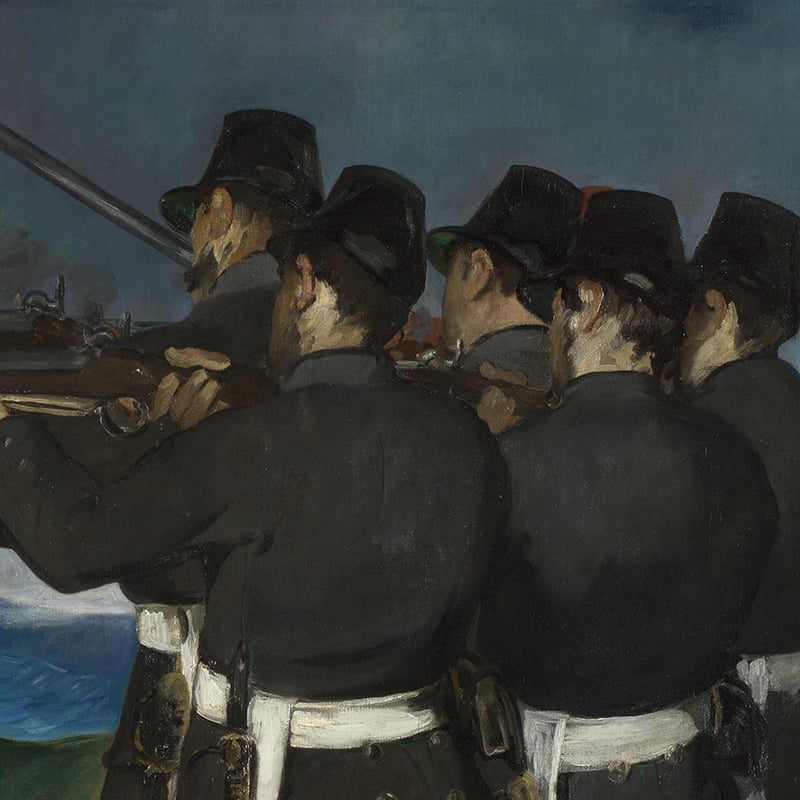
Making History: Manet's "Execution of Maximilian" from the National Gallery, London
Édouard Manet

Norton Simon Museum
411 W. Colorado Blvd., Pasadena, CA 91105
Monday 12:00 - 5:00 p.m., Thursday 12:00 - 5:00 p.m., Friday 12:00 - 7:00 p.m., Saturday 12:00 - 7:00 p.m., Sunday 12:00 - 5:00 p.m.
Admission
Paid Admission
About
Édouard Manet's _The Execution of Maximilian_ (c. 1867–68) is one of the French artist's most ambitious paintings, made all the more curious and compelling by its now-fragmentary condition. The second of five versions that Manet created of this violent 1867 event, the nearly life-size painting depicts the death by firing squad of the short-lived emperor of Mexico, Austrian archduke Ferdinand Maximilian, by forces serving ousted Mexican president Benito Juárez. The execution of the emperor and two of his generals horrified and captivated Europeans, many of whom—like Manet himself—blamed French emperor Napoleon III for Maximilian's demise. Depictions of the participants and aftermath of the event circulated widely, despite strict censorship laws in France. Manet was denied the opportunity to exhibit _The Execution of Maximilian_ during his lifetime, and the painting languished in his studio, where it suffered significant damage. After his death in 1883, his heirs cut up what remained of the composition and sold the pieces as discrete works. It was Manet's longtime friend and fellow painter, Edgar Degas, who recognized the painting's integral importance and dedicated himself to acquiring the fragments and reuniting them on a single canvas. The National Gallery, London acquired the reconstituted painting at Degas's studio sale in 1918. To portray the execution, Manet drew from published news reports, portrait photographs and depictions of wartime brutality by the Spanish artist Francisco de Goya. _Making History: Manet's "Execution of Maximilian"_ considers these sources alongside archival materials that document the French occupation of Mexico in the 1860s and the circulation of images of Maximilian and his associates after their deaths. By viewing Manet's painting amid the broader visual culture of this controversial event, the exhibition reveals the powerful ways in which images—and their afterlives—can shape viewers' understanding and interpretation of volatile political circumstances.