David Alekhuogie
David Alekhuogie
Commonwealth and Council
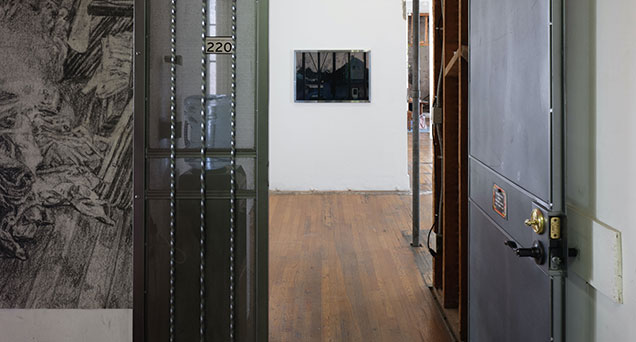
3006 W 7th St #220, Los Angeles, CA 90005
Thursday—Saturday from 10 AM—5 PM
Admission
Free Admission
About
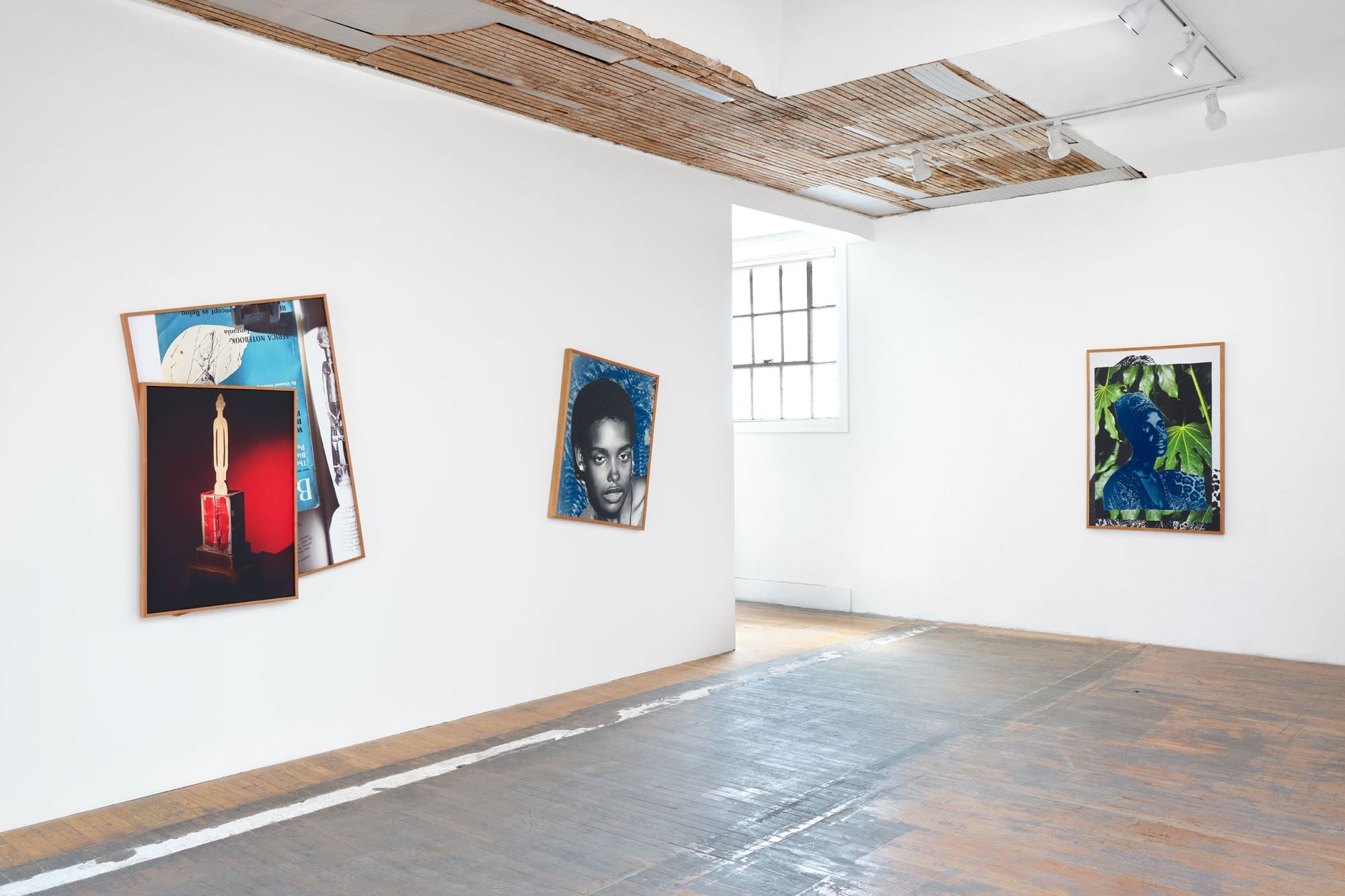
In David Alekhuogie's latest presentation with Commonwealth and Council, the artist gathers a remix of works from A Reprise , a series that co-opts the 1935 Walker Evans commissioned photographs of African sculptures featured in the exhibition African Negro Art at the Museum of Modern Art, New York. Evans is remembered for "documenting" a collection of masks, figurines, fertility dolls—many hailing from West and Central Africa. But "document" is a rather generous term, perhaps even a deceptive descriptor. Evans subjected these objects to a meticulous, almost dispassionate methodology without agency as objects of signification. By privileging a forensic, pseudo-neutral vantage point—frontal, side, rear profiles—and enforcing a claustrophobic crop, I would argue that Evans effectively trapped these African artifacts within the logic of the frame as case studies of Modernism. In some instances, the photo negatives were physically cut, ensuring the sculpture subsumed the entire page. All of this was done in the service of a calculated exaltation of craftsmanship, wherein abstract form and carved detail were heightened so that African objects might be recognized as fine art precisely through the removal of cultural specificity. This misguided translation is just one thread among many informing Alekhuogie's A Reprise —and not even the most troubling one. Evans was hardly working in isolation. In 1906, the Musée du Congo—backed by the genocidal machinery of the Congo Free State—published Notes analytiques sur les collections ethnographiques . Here, hundreds of sculptures were reproduced under the cold gaze of scientific scrutiny: fully lit, shown from multiple perspectives, and calibrated for a taxonomy of scale and type. By 1915, the sometime Dadaist art historian Carl Einstein published Negerplastik , selecting from an existing archive of ethnographic photographs circulating through his artistic network. Einstein, however, refined the methodology of erasure. He favored photographs of sculptures shown frontally, their surfaces stripped of attachments—nails, raffia, paint. By his logic, these were flourishes liable to interfere with the object's appearance as a self-sufficient sculptural form. In putting out Negerplastik , Einstein beat another European to print: the Latvian painter Voldemārs Matvejs, who had spent 1914 traversing Europe to photograph many of the same museum holdings for Iskusstvo Negrov , which would not appear until 1919, after his death. This history precedes Evans. It also does not end with him. Alekhuogie encountered Evans's handiwork through Perfect Documents: Walker Evans and African Art, 1935 , the Metropolitan Museum of Art exhibition mounted in 2000 that returned to his photographs as if their neutrality still held. Alekhougie also learned Sherrie Levine got in on the act—her penchant for appropriation couldn't resist photographing these same African masks Evans had documented. I say all this to underscore a simple point: Western artists and collections have long maintained a fascination with African objects that borders on embarrassment. Why you so obsessed with me? Mariah Carey sings. The West has no satisfying answer. Neither does Alekhougie—but A Reprise is less interested in answering that than in sitting inside the discomfort of the question. I want to believe Alekhuogie has played Carey's "Obsessed" at some point in a set. He often describes himself as a DJ—spinning since he was sixteen. And as someone who uses deejaying to "think through everything," introducing a song felt apt. "Obsessed" is a reprise of sorts: a musical dig that seizes the narrative from an erotomaniac whom Carey never dated. By all accounts, its premise—a fixation on a relationship that may well have been fabricated—doesn't feel far from the questions animating Alekhuogie's practice. From Einstein to Evans to Perfect Documents , the structuring condition of modernist photography as fixed and self-contained has proven anything but. The art historical canon is obsessed with a kind of pictorial narrativity. A Reprise intervenes in this obsession without claiming a clean, oppositional break. Alekhougie works with the knowledge that these African sculptures have been looked at, altered, photographed, re-photographed, and returned to again and again, as if something unresolved might finally settle with each flash of light. But the negatives are forever: burnished on celluloid, photocopied into historical records. If earlier regimes stripped these sculptures down—cropping negatives, eliminating shadows, curtailing spatial context— Guro Bobbin/2 "RE_Construct" finds Alekhougie building them back up, fully aware that direct access to source is foreclosed. The work itself consists of two frames, one stacked atop the other. The frame at the base is askew, tilted to the left. We see the periphery of a black cutting matt. On the top, upright frame, the fruits of the cutting are there to see. Photocopies of Evan's photographs serve as a kind of skin, applied to a plywood maquette that approximates the scale of the original sculpture. Multiple heads protrude, making clear that this is no one-to-one reconstruction. A shadow pools along the right side of the image, its dark contours smudging the yellow-and-black plaid fabric that wraps the background. In this context, the tartan pattern sheds its Scottish associations and nods to the Ghana Must Go bags—a material shorthand for movement, transportation, and displacement. Yet, for all this regained mass, a recursive irony is at play: these three-dimensional afterlives—these attempts to breathe volume back into Evans' flat photographs—are themselves flattened the very instant Alekhougie presses the shutter. The cycle of capture, it seems, is not so easily broken. In another work, Standing Ancestral Figure Drawing 1 (Deconstructed) a magazine bearing the image of W. E. B. Du Bois enters the composition. What we see is not Du Bois himself, but a facsimile: a reproduced likeness printed on a mass-circulated cover of the May 1972 issue of Black World. The black-and-white drawing of Du Bois sits against a field of sky blue. By this point, Du Bois was already dead, having passed in 1963, and is remembered here, in these pages, for his diplomacy in China at a moment when American politicians still kept Communism at arm's length. Alekhuogie re-photographs this sketch of Du Bois, setting the magazine in front of an upside-down page from Evans's photographs. The figure of Du Bois arrives already mediated, then mediated again. This layering—repetition with difference—echoes the fate of the African sculptures themselves: objects translated into photographs, re-photographed, reconstituted as printouts, and photographed once more. But Alekhuogie's choice of orientation and arrangement also matters. That Du Bois is upright while Evans's "perfect documents" are turned upside down and pushed to the rear suggests, however subtly, a different order of regard—one that attends less toward the supposed authority of the photographic archive than toward what historian Joshua Myers has called Black study. Du Bois, interestingly enough, had early inklings of this obsession in photography—or what I have come to understand as a kind of epistemic floundering by the West in the name of science. In his 1905 essay "Sociology Hesitant," he questions the emerging scientific "study of Society" that sought to quantify what exceeds calculation—namely, the "incalculable" rhythms of human action and will. For Du Bois, sociology espoused a methodology that made no space for the chance coursing through the complexity of life; these "indeterminate forces" were reduced to an abstraction: something measurable and discrete. Even though Du Bois was not writing about photography, his critique of this burgeoning science prefigures the tomfoolery of Evans and company. These photographic expeditions, from the early 1900s onward, can be read as a parallel impulse in the visual field: an insistence on making complex cultural forms legible through reduction. Photography, in this sense, does not resolve the problem Du Bois identifies; it becomes another tool in the service of a dubious science that treats its object of study as knowable precisely through simplification. What is incalculable, then, is set aside so that the image may endure as the thing remembered. A Reprise begins in the aftermath of that endurance. There's no pretense in Alekhuogie that the image can be restored to some prior wholeness, nor does he offer the fantasy of an unbroken return. What this selection acknowledges instead is the historical inertia of the photographic frame. Despite the history of photography constraining the visual life of African art, Alekhuogie's work refuses the easy bait of "taking back" or recuperating the past. To reprise is not to restore. To reprise, as I see it, is to contend with the glitchy, iterative nature of the visual culture—a repetition that may be structurally similar yet ontologically different. Alekhougie knows this paradox of the medium. Which is to say, he knows that after the pillage, after the extraction, after the clinical documentation, after the forced abstraction, and now, the remix, the question is no longer how to recover the image. We're now asking what version of the image is even left to us. —Ikechukwu Onyewuenyi