American Artist
American Artist
Commonwealth and Council
3006 W 7th St #220, Los Angeles, CA 90005
Thursday—Saturday from 10 AM—5 PM
Admission
Free Admission
About
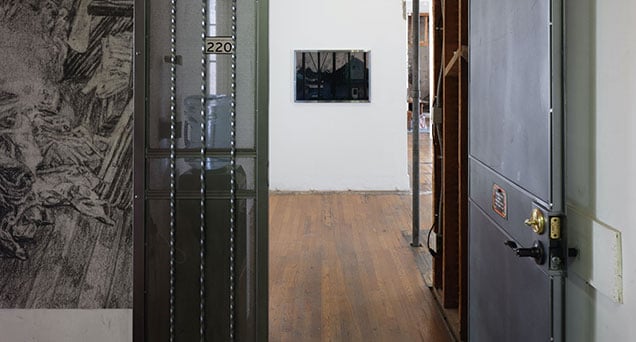
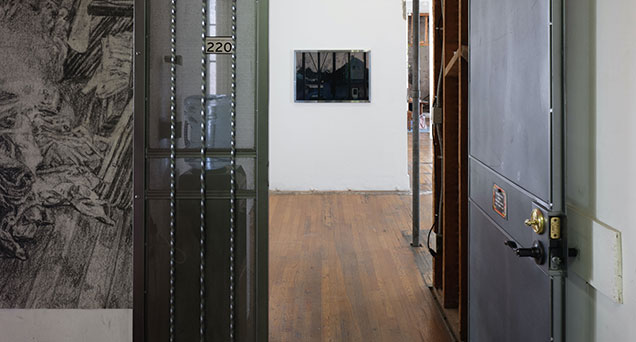
In American Artist's second exhibition with Commonwealth and Council, imagination willfully defies hostile environments. Comprising wall-based and sculptural media, this new body of work affirms the ingenuity of survival and the art of improvising in adverse circumstances regardless of class division and social advantage. To be sure, how comfortably we endure political and economic breakdown depends on our relation to a spectrum of "freedom" and "capture"—or subjection to the mercy of the few who control social benefits intended for the broader denizenry. For African-descended people, captivity is further linked to the state of enslavement and legacies of slavery that continue to hold social mobility at bay. The large-scale wall diagram Power Grid investigates the variable outcomes of these relations. Both in its title and its silvery spraypainted gleam, the work cannily puns on the electrical grid as the invisible network that charges a world structured by racial capitalism and resource extraction. Not unlike the conceptual wall-based charts and murals of Sol Lewitt or Lawrence Weiner, Power Grid imposes a cool, logical approach to forces that often feel out of our control. At the same time, the grid, a mainstay of twentieth-century modernist abstraction, here becomes stretched and recharted into new formations, destabilizing the viewer's perceptual experience beyond the wall. We negotiate our own placement and complicity amid the coordinates, conceived by the artist as variable, ever-changing, and subjective. In this sense, Power Grid lays bare the dynamics of racialization and reclamation that lurk behind the wall-based iconographic silhouettes of Kara Walker, or David Hammons's wall "drawings" of textured Black hair. The wicked humor of American Artist's assemblages echoes that of Hammons, who also rebukes the various workings of capture. Both artists find brilliance in ordinary solutions to spatial and architectural constraint, especially when forged by people confined to the intersection of "poverty" and "capture," as Power Grid relays. Society may recognize the subtle stacking and baling of flattened cardboard boxes as a scourge rather than an invention, but Occupied pays homage to this necessary ingenuity. Like Hammons, American Artist emphasizes slight gestures of self-preservation that have traditionally had no legitimacy as forms of social life, but re-emerge as new forms of agency. And yet, financial catastrophe is not the only impending form of present and future dystopia. Crisis Collector (Louise) comprises a stack of glossy Artforum magazines, decommissioned from the purpose of critical thought and repurposed as a leftist doomsday prepper's hidden go-bag. Elite Capture allegorizes the trap of representation when mobilized toward an agenda that continues to underdevelop communities marginalized by class, race, ethnicity, gender, and/or sexuality, among other factors. Peering out from behind a signed, framed photograph of one-time Democratic presidential candidate Kamala Harris is the recognizable red cover of The Combahee River Collective Statement (1977), containing the first written documentation of the phrase "identity politics." Here identity politics' radical feminist woman-of-color origins are immobilized by the false promises of the first Black and Asian woman president, whose ascendency ignited debates about structures of classism and racism that continue to be replicated in positions of power. These artworks negotiate the shifting patterns of distribution, access, and resources as they crisscross aesthetic and political horizons. Is capture a state of ultimate dehumanization, or ultimate freedom? Where do these states of being end and begin, and who decides? —Abbe Schriber