Oscar CHAN Yik Long: Two Kinds of Protection
Oscar CHAN Yik Long

EXIT 安全口 - Gallery EXIT
3/F, 25 Hing Wo Street, Aberdeen, Hong Kong
Tue–Sat 12pm–6pm (except public holidays or by appointment)
Admission
Free Admission
About
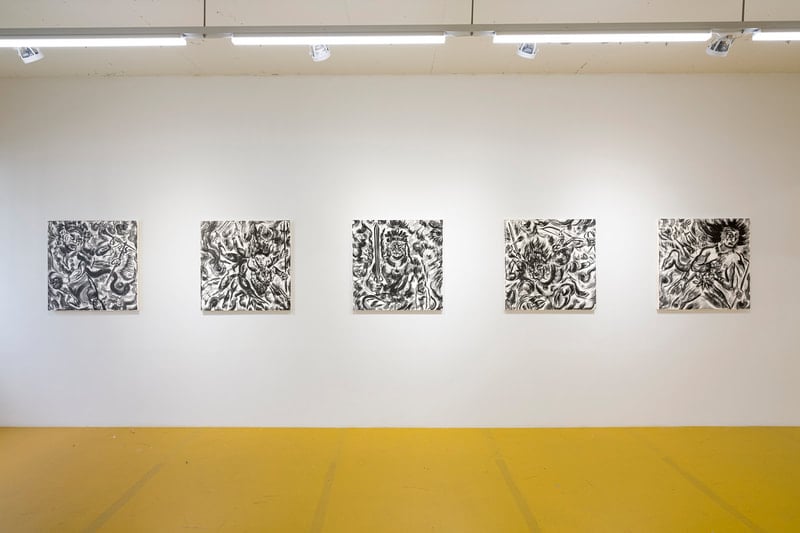
'Two Kinds of Protection' is Oscar CHAN Yik Long's third solo exhibition at Gallery EXIT. Chan doesn't require us to study the research behind his imagery. These ink and oil paintings address us as viewers of pictures rather than as readers of stories. They are visual first and foremost, and the means they employ – figuration, shades of blackness and colour, the juxtaposition of details and sweeping lines – are meant to strengthen them as images. The exhibition does, however, have a title, and it gives us access to the intellectual, emotional and spiritual processes that brought this particular body of work to life. Chan himself speaks of ink painting, a field in which he has been active for more than a decade, as a conduit for 'yin', the 'feminine' and more free-flowing energy, but at the same time as visually sharper than oil painting. To him oil, a technique he started to use only recently, is indicative of 'yang', the 'masculine' and more strategically aware energy. At the same time, he says, it is visually mellower and more blended. Unlike ink, oil allows for corrections but also demands more planning if the artist wishes to make full use of its in-built layering option. For 'Two Kinds of Protection' each technique has been connected to a distinct set of figures, doubling as characters from Eastern (Buddhist) and Western (Abrahamic) religious traditions. Maybe we should just take a moment to consider that 'figure' and 'character' are not the same. Ultimately, the former is a formal category (an appearance) while the latter is a moral one (an appraisal). As the all-seeing creator of his own pictorial universe, Chan assumes the right to pick and choose, mix and match, blend and blur. He has borrowed characters from 1970s and '80s gay pornographic photographs, with their toned bodies and turned-up gazes, as models for his 'Five Archangels' series. In his own words, 'not to depict their lustful side but to highlight a true form of humanity'. These figures portray divine messengers destined to manifest themselves in the corporeal world. Chan uses them to get under the skin of oil painting as a medium for conveying the presence of something under the canvas surface and beyond the brushwork gestures. A soul, perhaps, mirrored through the eyes of a model half a century ago. Just a brief guide to these archangels. 'Michael', (the God-like one), leads the heavenly armies fighting against darkness. He is wielding a sword, his signature colour is blue and he represents the sun. 'Gabriel', whose name means (God is my strength), is the supreme divine messenger. He is associated with lilies, the colour white and the moon. 'Raphael', (the healer), is the angel of restoration and guidance. He may, as here, be represented with a fish or through the colour green or water. 'Uriel', (God is my light), is the bringer of wisdom, light and truth. He is accompanied by flames and his signature colour should be red (although here it is green, by way of contrast). 'Metatron', finally, is not a canonical archangel but rather (the one behind the throne), a human transformed into a gate-keeping angel. Purple, pink and gold are his colours. Metatron's cube, with its 13 interconnected circles, represents him. In the exhibition, these five paintings are hung on top of a mural based on Gustave Doré's illustration of the spheres of Heaven in Dante's 'Divine Comedy'. Chan has also painted a rose-coloured canvas on which the anguished but physically unharmed features of 'Jesus' emerge: a beautified version of his sweaty, bloodied, beaten-up face as captured on the veil of Veronica. Chan uses these two mainstream images of Christian religious identity as a cultural template and visual background against which his own reinterpretations of spiritual thought and practice stand out. The pendant to this haunted face of Christ is the disapprovingly quizzical face of 'Buddha' in ink on canvas. Where Chan's oil technique is largely subtractive (a calculated trajectory of applying the paint and washing or rubbing it away), his ink technique is by necessity additive (a no less controlled combination of traces and washes). In this standalone painting and in the 'Five Wisdom Kings' series, Chan has channelled the fiercely frowning, awe-inspiring faces of these characters of East Asian esoteric Buddhism, which in fact signify the transformation of negative human energy into enlightened wrath with protective properties. The wisdom kings, also known as Vidyārājas or 'Wrathful Deities', are messengers, guardians and wrathful manifestations of various Buddhas. They are, in other words, a bit like archangels, but for another part of the world. In this series Chan shows more concern for three-dimensionality than in his earlier ink paintings. His wisdom kings have bodies, even rather voluminous and muscular ones, and they are engaged in fighting, or at the least in belligerent posturing. They also display some of the attributes and movements that are systematised into an iconography of the Wrathful Deities. Here is a brief guide to the five main ones painted by Chan. 'Acala', (the 'unmoved' or the immovable'), remains steadfast in the face of the world's turmoil. He is the wrathful manifestation of Vairocana Buddha, shown with a sword, and symbolises the central direction. 'Vajrayakṣa' destroys the poison of envy as the angry form of Amoghasiddhi Buddha. He symbolises the northern direction. 'Kundali' is the dispenser of amrita, the celestial nectar of immortality. He is a manifestation of Ratnasambhava and symbolises the southern direction. 'Trailokyavijaya', (conqueror of the three worlds), is the fierce manifestation of the bodhisattva Vajrapani. He symbolises the eastern direction. The last and most wrathful of these wrathful deities is 'Yamantaka', (destroyer of death), who is also the healer of severe illnesses and the vanquisher of the King of Hell. As such he will help us overcome fear. He manifests Manjusri, the bodhisattva of wisdom, or Amithaba Buddha, measureless light. He symbolises the western direction.