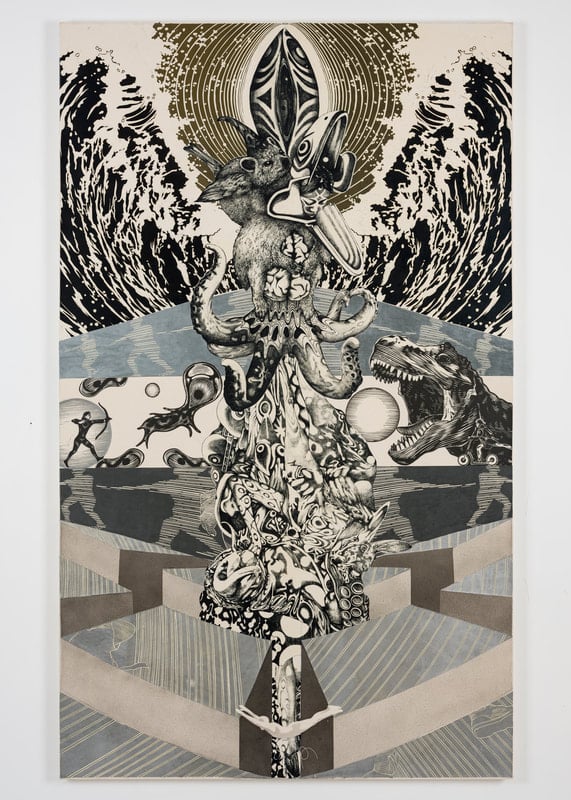
LI Ning 李寧: No Ground
LI Ning

EXIT 安全口 - Gallery EXIT
3/F, 25 Hing Wo Street, Aberdeen, Hong Kong
Tue–Sat 12pm–6pm (except public holidays or by appointment)
Admission
Free Admission
About
In recent years, LI Ning's practice has revolved around memory, its transformation, and the ways in which memories are continuously rewritten over time. This interest took shape amid a series of social, environmental and personal changes, bringing a heightened awareness of collective memory, how facts can be redrawn, and how lived experience can be preserved. As an artist, Li responded by turning to storytelling, transforming personal and collective experiences into fictional and mythological narratives. Over time, however, his understanding of memory shifted. Rather than treating memory as a fixed record to be preserved unchanged, he began to see it as subjective, unstable and constantly evolving with the person who carries it. Memories are influenced by time, new experiences, changing perspectives and imagination; they can be rearranged, combined and even rewritten. What initially felt like a loss of certainty gradually became a form of freedom: if memory is always changing, then reshaping it can also become a conscious creative process. The current body of work extends this evolving world, moving beyond a collection of settings and fragments towards a narrative with greater movement and consequence. Across paintings and video, figures, creatures, objects and environments recur in different forms, as though belonging to the same expanding universe. Jellyfish become carriers of memory, while their encounters suggest that memories can merge and generate something that did not previously exist. In 'Memory Mating', for example, different forms converge towards a moment of hybridisation, suggesting the birth of new memories from existing ones. The works also explore the relationship between inner and outer worlds. 'No Ground' presents a world in which familiar structures have fractured, leaving individuals suspended between what has disappeared and what has yet to emerge. 'Private Weather' turns towards an internal system, where attention, memory and possibility are organised and transformed. 'The Crossing' moves outward again, following figures as they navigate narrow boundaries between divided worlds, searching for new directions in a time of large-scale change. The making of the works follows a similar process. Old and newly carved plates are reworked and printed using relief and intaglio techniques. The resulting prints are collaged into new compositions, with airbrush adding another layer. Fragments from different periods are reintroduced and reorganised, allowing images and meanings to emerge through the process of combination. Rather than beginning with a fully formed narrative, Li often discovers the logic of an image only after it has been made. He then revisits the work through writing, developing it further into the narrative of the video. In this sense, the exhibition is not only about memory, but also about how memory can become material: something that can be revisited, reshaped, combined and carried forward. The stories do not resolve into a single fixed reality. Instead, they continue to expand through encounters between past and present, between one image and another, and between what is remembered and what is newly imagined.