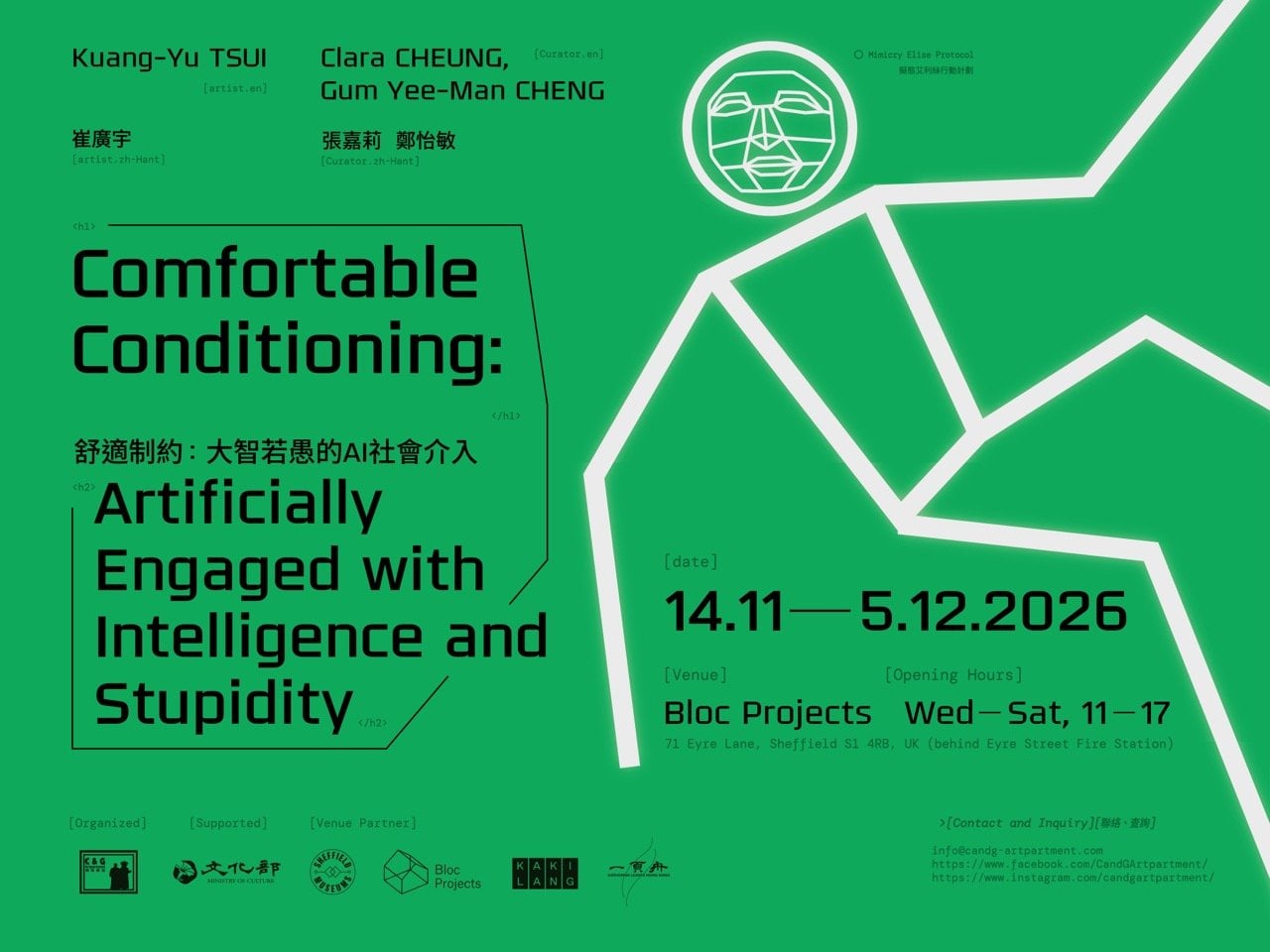
Comfortable Conditioning: Artificially Engaged with Intelligence and Stupidity
Kuang-Yu Tsui

C & G Artpartment
71 Holme Lane, UK, Sheffield S6 4JP
Mon, Thur-Sat: 2:00 - 6:00pm (Close on Public Holiday)
Admission
Free Admission
About
Control and Indulgence In the early video works of Taiwanese artist Kuang-Yu Tsui, we often see a form of unconscious self-indulgence, accompanied by an opposing sense of intense control. Moving through a cityscape, the artist uses his performative body to conduct a series of strange and playful urban experiments. These artworks reflect his pursuit of freedom and release from the pressures of urban life, while also questioning established social values and the expectations that a society places on individuals. The artist amplifies these questions through bold and uninhibited actions, then focuses them into brief moments on short videos, often creating an immediate sense of connection for the audiences. With a closer look, however, it becomes clear that the artist's performative acts were all carefully thought out and tightly controlled. What appears simple and spontaneous is, in fact, executed with remarkable precision. Alongside Kuang-Yu's latest work, "Mimicry Elise Protocol", the current solo exhibition also exhibits three of his earlier video works: "The Welcome Rain Falling from the Sky" (1997), "Eighteen Copper Guardians in Shao-Lin Temple and Penetration: The Perceptive" (2001), and "Invisible City: Liverpool Top 9"(2006). Together, this series of artworks offer audiences a comprehensive understanding of the artist and the development of his practice. Conditioning It seems that Kuang-Yu's continuous engagement with performative video art has gradually, and almost indiscernibly, produced a form of "conditioning." This process begins when a problem emerges in society, prompting the artist to reflect and respond through artistic actions. Over time, through repetition, the responses develop into a mechanism of conditioning: whenever a social problem arises, the artist instinctively responds through art. As problems continue to emerge, so does his practice, creating a cycle that seems impossible to stop. The project of "Mimicry Elise Protocol" began with a form of social conditioning in Taiwan: when Taiwaneses hear the melodies of nineteenth-century classical pieces: "Für Elise" or "The Maiden's Prayer," they automatically queue up to dispose their rubbish at a designated site. As the artist explains, the project "explores how human beings rely on and adapt to the systems of data surveillance, public norms, and social structures." In "Mimicry Elise Protocol," AI agents were invited to adopt both the artist's own style and the perspective of a highly intelligent life form, to interpret the interactions between human beings and the residues of the contemporary society in the public space. The final video piece in the exhibition then invites audiences to re-interpret, from a human perspective, the seemingly stupid yet profoundly intelligent interpretation of humanity itself. Kuang-Yu's current project takes the risk of inviting a computer to reorganise and redefine human social behaviours. It is a risk because of AI's inherent unpredictability: "AI has bugs." Looking at the current trends, AI may eventually be capable of doing almost anything and defining almost anything within the digital world — provided that humans would agree, and that artists would agree. If so, would the artists become overly passive? Could the creative act itself be subject to AI's conditioning? In response, Kuang-Yu attempts to intervene in this process of "conditioning", by creating new possibilities to deliberately construct a series of constraints for his own practice. In other words, the artist attempts to "control" the AI system, while trying to rationally collaborate with it which attempts to imitate his own artistic approach. Together, they explore the gaps between different layers of conditioning as these constraints become entangled with one another, as well as the residues and remnants that are often overlooked within these multilayered spaces. Value Kuang-Yu states: "The production, selection, and interpretation of data often involves deep-seated cultural biases and value judgments." Errors in artificial intelligence can sometimes be understood as mistakes or even malfunctions. Under normal circumstances, they would simply be discarded. In this project, however, the artist attempts to reveal these "residual values" contained in computational response, bringing it into view as something functional and even as a source of creative inspiration. The idea of a "glitch aesthetic" was embraced by artists as early as the Dada and Fluxus movements. It often involved surreal forms of imagination, an engagement with the human subconscious, and attempts to explore what has been forgotten, overlooked, or ignored within it. Early glitch aesthetics were largely expressed through visual images. Nam June Paik, for example, used magnets to distort television signals and produce visual noise, asking why audiences not recognised the "beauty" within the noisy visuals earlier on. In the current collaboration with AI, however, Kuang-Yu goes beyond simply presenting the visual "404 errors." He takes elements within today's big-data systems that are normally regarded as residual or useless, and reimagines them as part of a form of "intelligence." Buddhist philosophy has taught us: "Profound wisdom can sometimes appear foolish; skilful techniques can sometimes appear clumsy." Perhaps this is another way of understanding where intelligence may reside. Living in an age of big data and artificial intelligence, humans and the digital world continuously shape and adapt to each another, but this does not necessarily mean there exists mutual respect between the two. There are blind spots within this relationship, and many fables have already suggested that these blind spots could eventually lead to disastrous conflicts. This exhibition does not intend to demonise the blind spots within the AI systems. Such blind spots of course sometimes are deliberately created, avoided, or concealed. "Mimicry Elise Protocol" reveals the artist's effort to resolve the potential conflicts: by using AI as a creative tool, Kuang-Yu discovers the values of those residuals, that emerged in his creative process of avoiding and resolving the blind spots simultaneously. Shifting away from performing on screen, Kuang-Yu now operates behind the scenes, developing his video works through a project-based framework. It is as if the artist has stepped outside a long-established comfort zone and taken a significant risk to have less control of the creative process. Alongside the AI, his new work continues to draw on the two elements that have long been central to his practice: interaction with the public and social conditioning within the public realm. "Mimicry Elise Protocol" is coming to the UK in autumn 2026. In the new environment, it will continue to interact with human beings and the big-data, allowing the AI to gradually generate a new kind of comfort zone. This "comfort zone" may well conceal numerous blind spots and residual elements, yet when it first takes shape, we may still find ourselves enjoying it. But how long can the artist and audiences remain comfortable within this AI-generated "comfort zone"? How long will it take before we become restless enough to step outside to take another "risk"?