Leah Ke Yi Zheng
Leah Ke Yi Zheng

Antenna Space Hong Kong
19F, 37 Wong Chuk Hang Rd, Hong Kong
Tue–Sat 11am–6:30pm, Sun by appointment
Admission
Free Admission
About
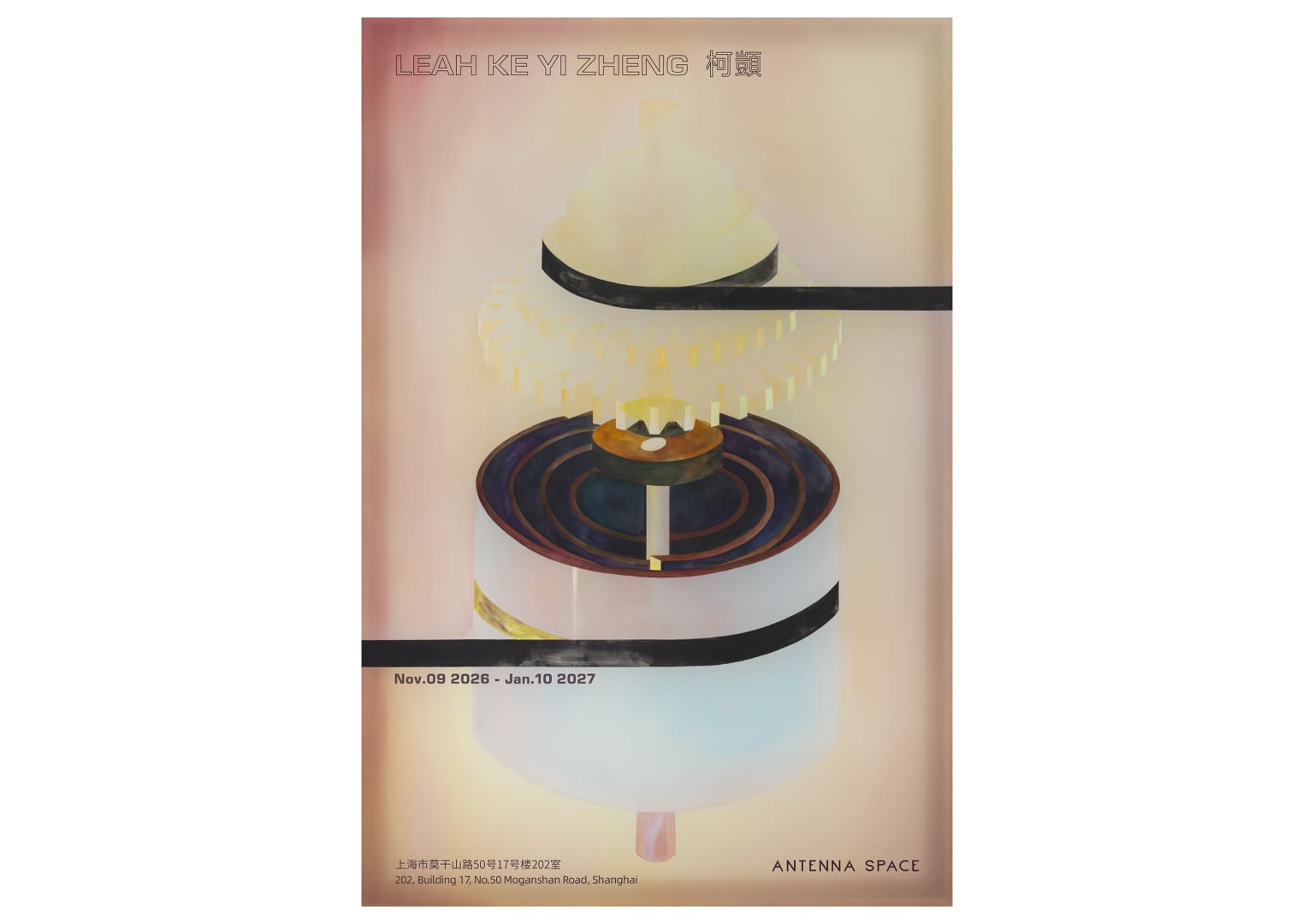
In her new exhibition, Leah Ke Yi Zheng continues the subtle yet potent development of her set of motifs: the machine (including the fusée and stepped reckoner, and a new appearance of a magnetometer) and the I Ching's hexagrams, painted in diluted acrylic on silk stretched over warm-toned wood stretchers. The gallery's architecture, layout, and window dimensions have been altered and tailored to create an interaction between natural light and the paintings. Ke Yi Zheng first approached the boundary as an integral element of her practice in 2018, through irregularly-shaped stretchers hand-crafted in cherry wood or mahogany. Earlier this year, she unveiled her first institutional exhibition at The Renaissance Society in Chicago (the city where she lives and works), which consisted of a single artwork composed of 64 paintings depicting the totality of the I Ching hexagrams. Several interventions in the structure of that gabled hall tuned the space within the 64 paintings toward the winter and spring light of the falling sun in the West. In her return through the insights of continual variation and change, Ke Yi Zheng's machines harbor new asymmetries and secrets of composition. Ke Yi Zheng and her silk surfaces have become translucent membranes that process the interconnecting themes of invention, time, order, and the epiphany of difference in our contemporary industrialized moment. The current exhibition features a prominent new technique in her Wave Paintings: the artist has painted through double-stretched silk and allowed the chance-based moiré pattern to express a dimensional field across the painting, an expression of the forces of being between. The effect is reminiscent of polarization pattern graphs of the Cosmic Microwave Background — In astronomy, these are used to trace primordial gravitational waves. No mistake. In our day-to-day life, we see moiré patterns when screens are doubled, perhaps something the machine is yet to see. In Ke Yi Zheng's process, this fugitive phenomenon or invisible relation becomes visible, and continues to exist as a trace and vibration of energy, and a ground for the precise development of painting. Emotion can reanimate the historical experience of technology. Ke Yi Zheng's three small I Ching paintings operate as a coded phrase; they are "speaking," and yet are restrained. These are text paintings without using language at all, an indefinable position between symbol, image, signification, and abstraction, like Mallarmé. In the artist's calculus, the individual cog, detached and luminous, persists as a balancing act of presence in the stream of overabundant particles. Through self-aware involvement with light's dynamic, Ke Yi Zheng's works challenge the myth of painting as a static object and reveal this movement of consciousness to be an exquisite pleasure.