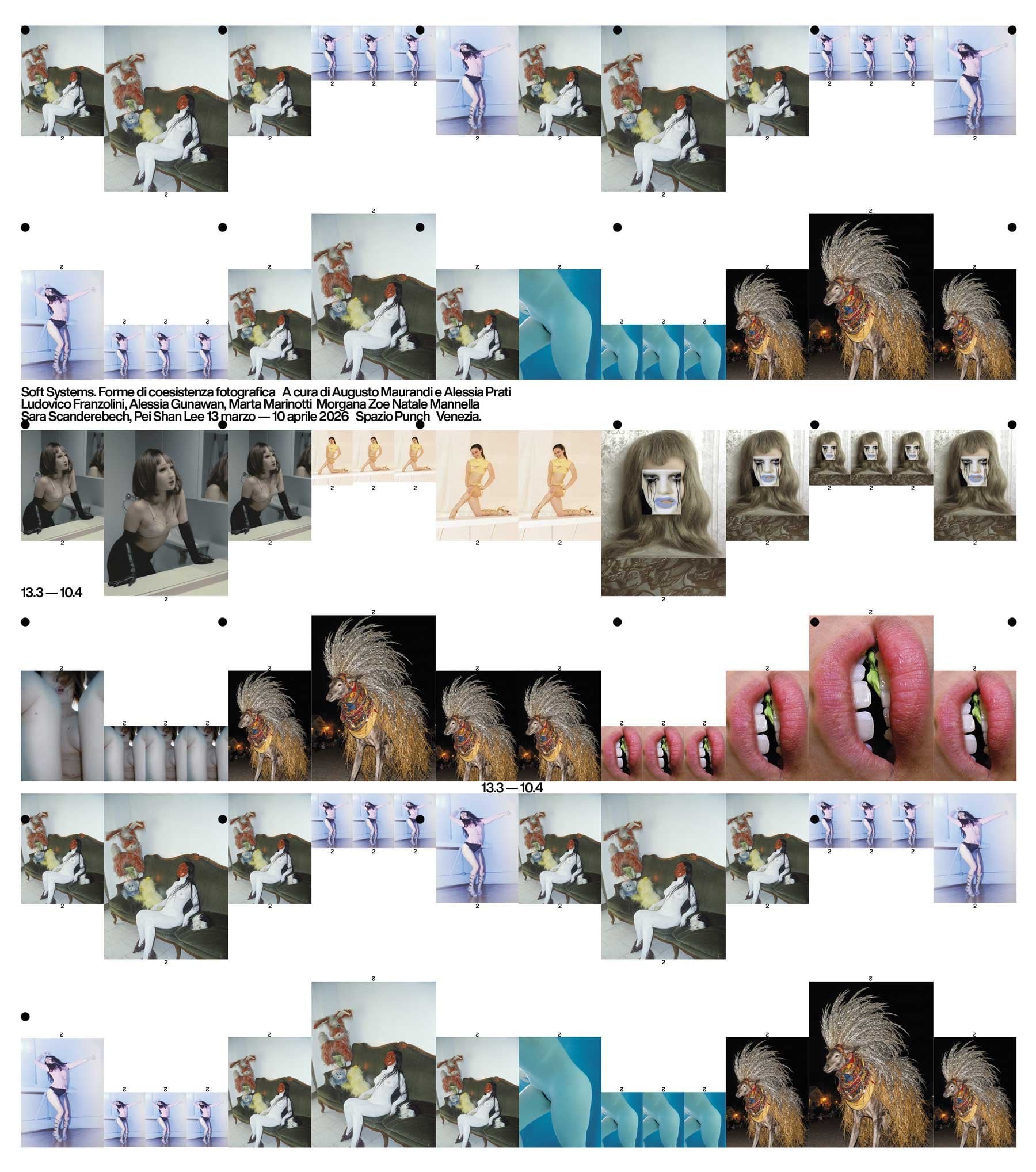
Soft Systems
Ludovico Franzolini, Alessia Gunawan, Marta Marinotti, Morgana, Zoe Natale Mannella, Sara Scanderebech, Pei Shan Lee

Spazio Punch
Fondamenta S. Biagio, 800/o, 30133 30133
Admission
Free Admission
About
What might happen if we began to think of photography as a field of relations? Instead of searching the image for the dominant imprint of a singular gaze, what if we tried to attend to what passes through it, what gathers at its edges — what exceeds the image while also helping to bring it into being? Soft Systems: Forme di coesistenza fotografica emerges from this tension and unfolds through a dialogue between the invited artists. The visual imaginaries and narrative worlds of Ludovico Franzolini, Alessia Gunawan, Marta Marinotti, Morgana, Zoe Natale Mannella, Sara Scanderebech and Pei Shan Lee open onto soft systems and porous structures, traversed by heterogeneous presences, cultural trajectories and shifting geographies. Plural belongings, transnational movements and aesthetic cross-pollinations shape these practices, turning the image into a space where translation and identity negotiation take place. The works presented here operate less as stable objects than as processes — less as finished forms than as temporary configurations that take shape through encounter — first with the various practitioners involved and with the photographed subjects, human and non-human alike, and later with the public. Seen up close, the photographic image no longer appears as an instantaneous gesture. Stretching across a perceptible duration, it becomes shared time — conversation, cooperation — a subtle negotiation between exposure and looking, woven from attentiveness, hesitation, small agreements and responsibilities. In this way the image reflects a relational field. Between what is visible and what it contains, a gap opens up that only the act of looking can activate, turning the image into a threshold. Even when guided by carefully determined choices, the photograph remians the outcome of a situated and shared condition involving those photographed and those who collaborate in its making. Bodies were present; gazes were exchanged; a common space was produced — shaped and complicated by those who inhabited it. What photography retains never settles into a definitive form. It returns, shifts, resynchronises. Each new encounter with the image reopens it, exposing it to new constellations, redefining its context and renewing its potential for meaning. The exhibition does not seek to deny authorship, nor to dissolve the singularity of artistic practices. Rather, it shifts attention away from the myth of solitary vision towards the shared conditions that allow images to emerge. The point is not to replace one paradigm with another, but to widen the perceptual and critical field by bringing into view what often remains out of focus: distributed labour, time spent together, material infrastructures, the circulation of images, and the active presence of those who encounter them. Here, the political is not a theme to be represented, nor a quality that some photographs possess while others do not. It emerges instead in the relational space that opens whenever multiple subjects — knowingly or not — take part in the making and reception of an image. Photography becomes one of the forms through which this space becomes perceptible, not simply because it shows something, but because it registers that something has taken place between people. The works gathered here inhabit this unstable yet fertile terrain, where each image becomes both the trace of a moment spent together and the occasion for another form of togetherness — a soft system: open, negotiable, affective.