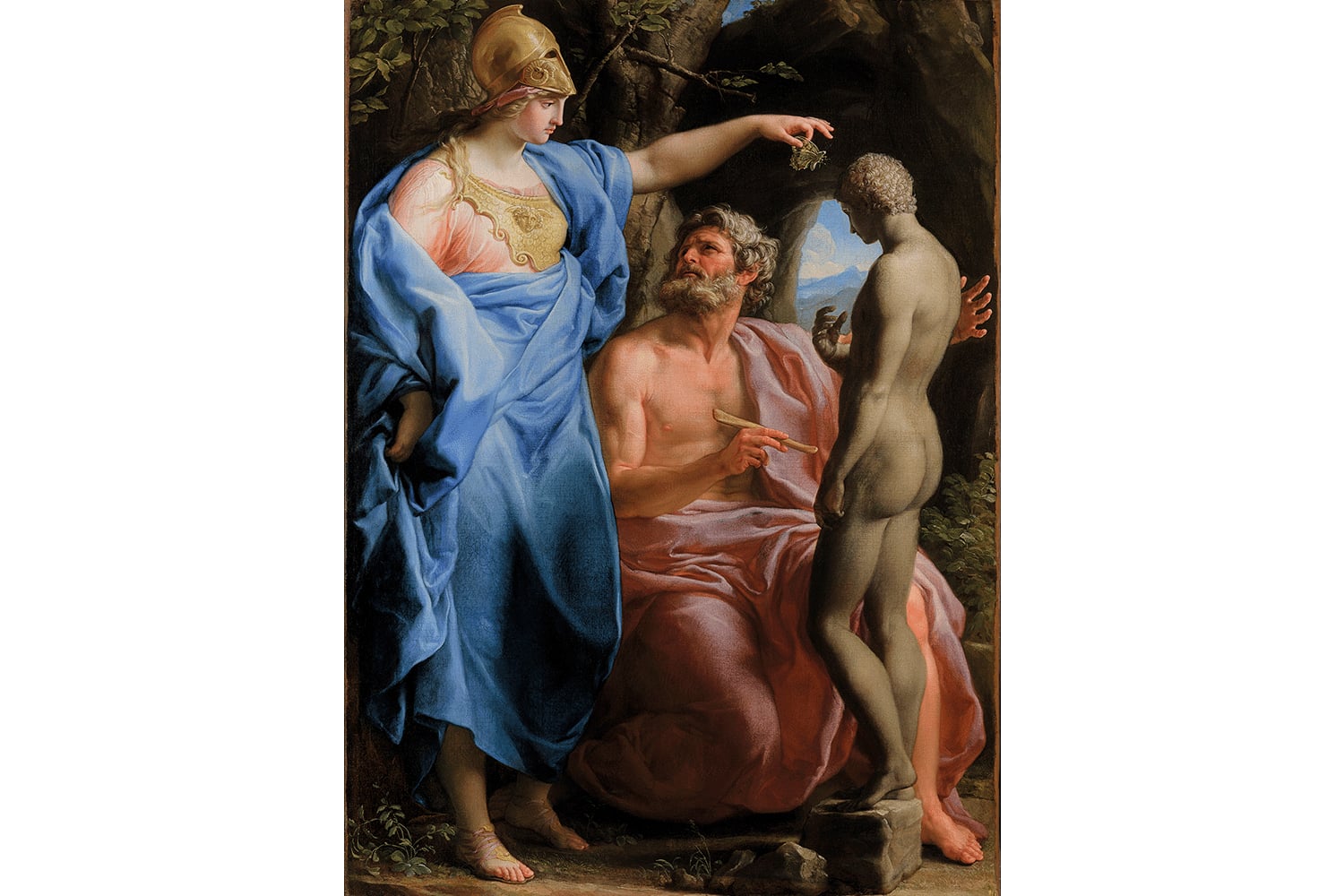
A Guest at the Palace | Minerva Infuses the Soul into the Human Figure Modeled in Clay by Prometheus by Pompeo Batoni
Pompeo Girolamo Batoni
Fondazione Giorgio Cini
Isola di San Giorgio Maggiore 1, Venezia, CA 30124
Admission
Free Admission
Open every day (except Wednesdays) from 11:00 a.m. to 7:00 p.m.
About
On the occasion of the opening season of the Galleria di Palazzo Cini at San Vio, the new "guest at the Palace" is the picture Minerva Infuses the Soul into the Human Figure Modeled in Clay by Prometheus by Pompeo Girolamo Batoni (Lucca, 1708 – Rome, 1787), dating from between 1740 and 1743. The work, which explores the theme of the genesis of life through a subject never before treated in painting, was conceived starting from the classical iconography of a group of Roman sarcophagi depicting the myth of Prometheus. It is the work of one of the most celebrated artists of eighteenth-century Italy, of whom only rare examples exist in Venice, and represents an important testament to Batoni's passion for mythological subjects, as well as a remarkable achievement of his early maturity. The exhibition, organized by the Giorgio Cini Foundation's Institute of Art History, the Cassa di Risparmio di Lucca Foundation, and the Lucca Center for the Arts Foundation, also serves as an opportunity to announce the creation of the future museum space at the Lucca Center for the Arts —a collaboration between the Fondazione Cassa di Risparmio di Lucca and the Fondazione Centro Studi sull'Arte Licia e Carlo Ludovico Ragghianti—where Batoni's painting will be on display starting in 2029. The magnificent painting by Pompeo Batoni, one of the most celebrated artists of the Italian Settecento, stands as a significant testament to his fascination with mythological subjects, as well as a remarkable achievement of his early maturity. Addressing the theme of the genesis of life through a subject never before treated in painting, the work draws upon the classical iconography of a group of Roman sarcophagi depicting the myth of Prometheus. The subject of the picture derives from Metamorphoses (I, 76–88) and, together with the canvas Atalanta Mourning the Death of Meleager, now in the same foundation, was executed for the Marquis Lodovico Sardini during the period in which the artist divided his time between Rome and his native city, to which he remained profoundly attached throughout his life. The Titan Prometheus is depicted in the act of bringing to completion his greatest creation: a young man modelled from clay, embodying the classical ideal of beauty and in all likelihood inspired by the celebrated Hermes Pio-Clementino, then known as the Antinous Belvedere. Beside him, the goddess Minerva—derived from the Minerva Giustiniani and softened according to the canon of grace—advances to breathe life into the figure, offering him a butterfly, the traditional emblem of the soul. The canvas bears witness to the extraordinary level of refinement achieved by Batoni during the first half of the 1740s. Hailed as a "new Raphael," he worked for some of the most eminent figures of his age, from Popes Benedict XIV, Clement XIII and Pius VI to Maria Theresa, Frederick II of Prussia and Catherine II. He was especially renowned for his religious, mythological and historical compositions, as well as for his portraits, many of which were commissioned by wealthy travellers passing through Rome on the Grand Tour.