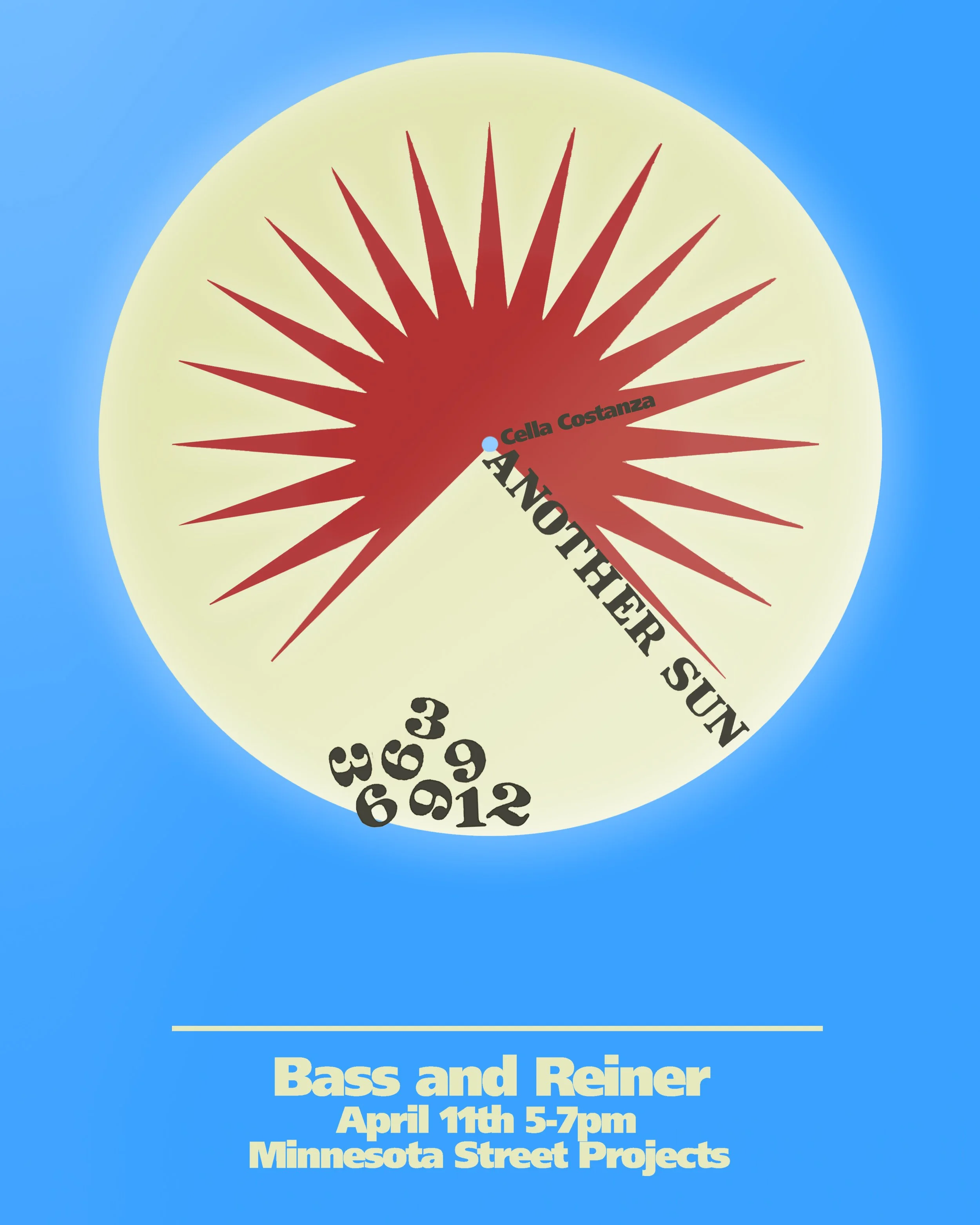
Another Sun
Cella Costanza

Bass & Reiner
1275 Minnesota Street, Suite 207, San Francisco, CA 94107
Wed-Sat 11am-5pm
Admission
Free Admission
About
As deep automation begins crystallizing life's variables into formats and systems that we cannot even access, time gets weird. Time totally lapses or swells into numbing proportions. How long is this supposed to take? Where did the day go? Cella Costanza is keeping track of time. Her show, Another Sun, presents six sculptures carved from different types of stone– banded calcite onyx, brecciated marble, iron stained calcite marble, and ferruginous sandstone. Immediately powerful and refreshing in material technique alone, these forms also serve a philosophy beyond their obvious showcase of skill. Costanza refers to them as "sundials," and while they appear sturdy, ancient, and vaguely functional in the way sundials do, they mimic a form more like a key, or maybe a chair. Perhaps, even a hair comb, which the artist tells me is really just a chair without a seat. Each of the five forms vary from the other, with differing flecks and ridges of strata in each stone, but they all maintain essential shape components. Sequential, maybe evolutionary, and somewhat playful– can these sculptures measure time? These sundials are ultimately problematic, but that is their charm and conceit. Malfunction and misfelt time is what Costanza seeks to call to our attention. Traditional sundials feature a "gnomon," the stationary appendage that works by being consistently inert as the sun moves around it, but Costanza's sundials don't function traditionally. This stone materializes time itself, in the compression, slipping, and shift of earth over millennia. By cutting into it, Costanza has made available the timeline of creation, exposing the mountain building, oceanic mantle shifts, and fluid alternation that has happened over millions of years. If, per the idea of Francis Bacon, great artists are trying to "trap a living fact," it appears that Cella Costanza is doing the opposite, releasing a fact and exposing something living in the stone, its slow and moody history. In Constanza's world anything can be a gnomon, even, and especially, an object that shifts, because for Costanza time might not exist in order to be measured and the world might be transforming too much to hold anything still. A serious refusal of short-lived precision and accuracy is at the unshakeable foundation of Costanza's practice, and this collection of work outlines just that. Information is the product of measuring– we're measuring a lot; we have a lot of information. And while information is obviously useful, it has also obviously become so plenty that it's almost impossible to take in. The pieces yield differently to a metaphorical sun– they rebel against precision so that they can offer less information, and from unexpected and profound sources, not more and not directly. Costanza's practice responds to urgency by sitting and carving the world– a gesture of tracing her own personal time, in communion with raw earth, and remembering pace as something natural and felt. In doing, Costanza's sculptures forge a way out of our collective information hypnosis.