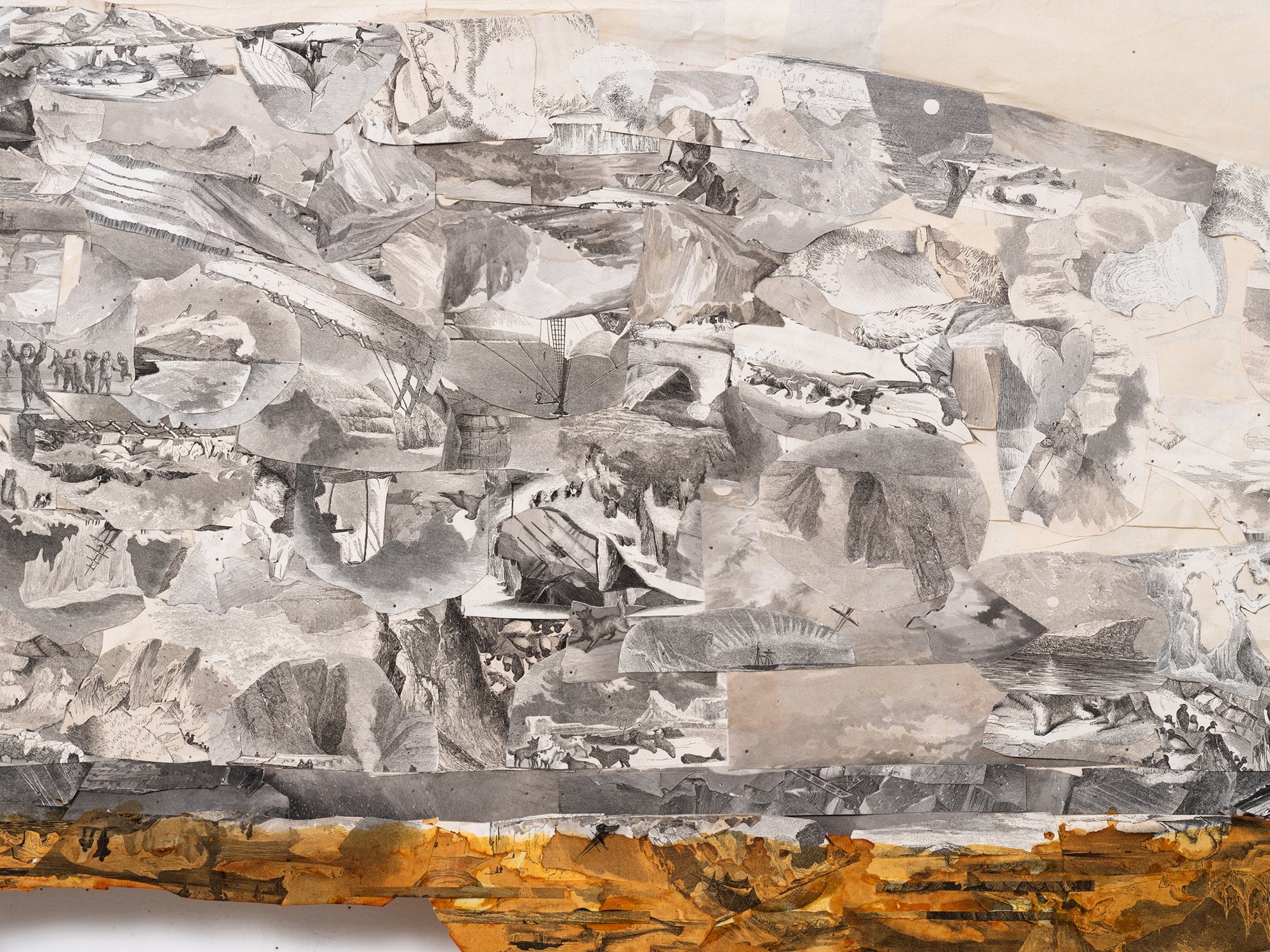
ice-blink
Selena Kimball

Ulterior Gallery
424 Broadway #601, New York, NY 10013
Thu-Sun 12pm-7pm
Admission
Free Admission
About
Ulterior Gallery is pleased to present _ice-blink,_ Selena Kimball's second solo exhibition with the gallery, opening September 10, with a reception from 6 to 8 pm. The artist will be present at the reception. Selena Kimball's work begins with a small act of destruction: cutting into an intact printed image. The material images she uses range from the rare to the everyday, from engravings in a first edition to yesterday's newspaper. In cutting, reassembling and _touching_ these histories, Kimball works with the residue of a physical trace—a quavering line, a deep shadow, and a solid dot—left by whoever recorded the image before her. The works on view are built from thousands individual engravings cut from first editions of Elisha Kent Kane's _Arctic Explorations_, published in 1856. The paper has outlasted the geography the book depicts: The engraver is long dead, and the ice he drew has long since melted. The Arctic Kane's expedition recorded was already an image before it was a place. When the Franklin expedition disappeared in 1846—two ships, 129 men, swallowed by the ice—the popular belief in Britain and America was that the crew had found safety in a tropical sea at the top of the world. Scientists called it the Open Polar Sea. It was marked on explorers' maps as fact. The very edge of Kane's map is blank, except for those three words. Blank spaces on the map have always been sites of projection—of desire, of domination, of hope. As Americans settlers pushed west across the continent, they often carried two books: the Bible, and _Arctic Explorations,_ the most widely read illustrated account of the Arctic at the time. The book was printed near the end of a centuries-long practice of making paper from the discarded clothing of industrial workers, a method produced usually durable cotton and linen rag paper. The Arctic ice pack is now approaching the Open Polar Sea once described as myth. Cutting into the historical material lets Kimball layer the evidence of her own hands over someone else's recording. When the collages were complete, she poured gallons of iodine into a trough and lowered each piece into the dark liquid. Sections came unglued and drooped. Iodice deosn't heal paper—it stains it, permanently, in act of trying. The gesture is about attending to the surface even when there is nothing left to heal.