Absorption
Nivia Hernandez, Daniel Anthony Vasquez, Kristen Jensen

Tiger Strikes Asteroid - NY
1329 Willoughby Ave, Brooklyn, NY 11237
Admission
Free Admission
About
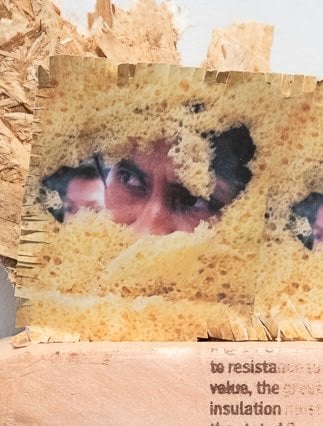
Tiger Strikes Asteroid New York is pleased to present **_Absorption,_** an exhibition by **Nivia Hernandez**, **Daniel Anthony Vasquez**, and **Kristen Jensen**, organized by Mónica Palma. I soaked in water the sea sponge I picked from the shore. I left it on the side of the sink waiting for the water to evaporate. I believe that water comes from the Catskill Mountains; my sea sponge comes from the Mexican Pacific Ocean. I was giving fresh water to a sponge that spent its life submerged in salt water. Nivia told me that the sponges in her work speak to the effort to assimilate that all immigrants face: the never-ending filtration of words, affects, and bureaucratic forms. Like sea sponges, we hold phonemes in our skeletal fibers, ingredients, and dances; and when we arrive in the US, we expel some and sip on what remains of the others. In our Latino communities, the quotidian sea sponge washes dishes, cleans wounds, and bathes babies. The estropajos and loofas integrate particles of skin tissue; they might be the eyes that look at us in her piece Con cada ojo (_With each eye_), a gaze that reminds me of the fierce look in the Zapatista women. In a small town in Mexico, devotees of the Juquila Virgin ask for favors and miracles by gathering clay from the surrounding areas of the Virgin's altar and making figures that represent their wishes. Daniel Anthony's clay is unfired; at every step, the pieces leave dust and silica traces; the shoes and the vase come microscopically undone. He pours water into the vase, knowing it will be absorbed into the clay's molecular structure; visibly, the clay's coloration will change to a darker tone, a camino de piedra, _a rural road,_ at the precise moment the rain arrives. They come apart, but they reaffirm themselves in their vulnerability. The outside of Daniel Anthony's pieces is the inside; the facade is the organ, the sculptures exist with the tripa de fuera, _the guts exposed_. The purpose of the pilgrimage is to come closer to the wound and do it by hand. Years ago, I visited Kristen's studio; on the floor, a series of clay basins were resting on handmade pillows; the pieces were tenderly held by soft bodies made of recycled towels, imbuing them with a heavy, sweet, anthropomorphic feeling. Those sculptures remain—along with a newer series of veil-drawings and rubbings—like chroniclers, narrating an experience of touch and time. The rubbings happily fail to reveal loyal 2D copies of the originals; they get lost in the forest, connecting with the J train Jamaica-bound at the Fulton station. Because they wander, they become maps of their own journey—containers, veils, blueprints that don't obey scale. I see these walls of drawings as the scales and skin, a blown-up microscopic vision of the sea sponge and the clay, a veil that reveals as much as it hides. I was thinking that all these pieces lack reflective surfaces, which means they are _not_ screens; all is porous and brittle here. They would gladly host spider webs, fingerprints, and dust.