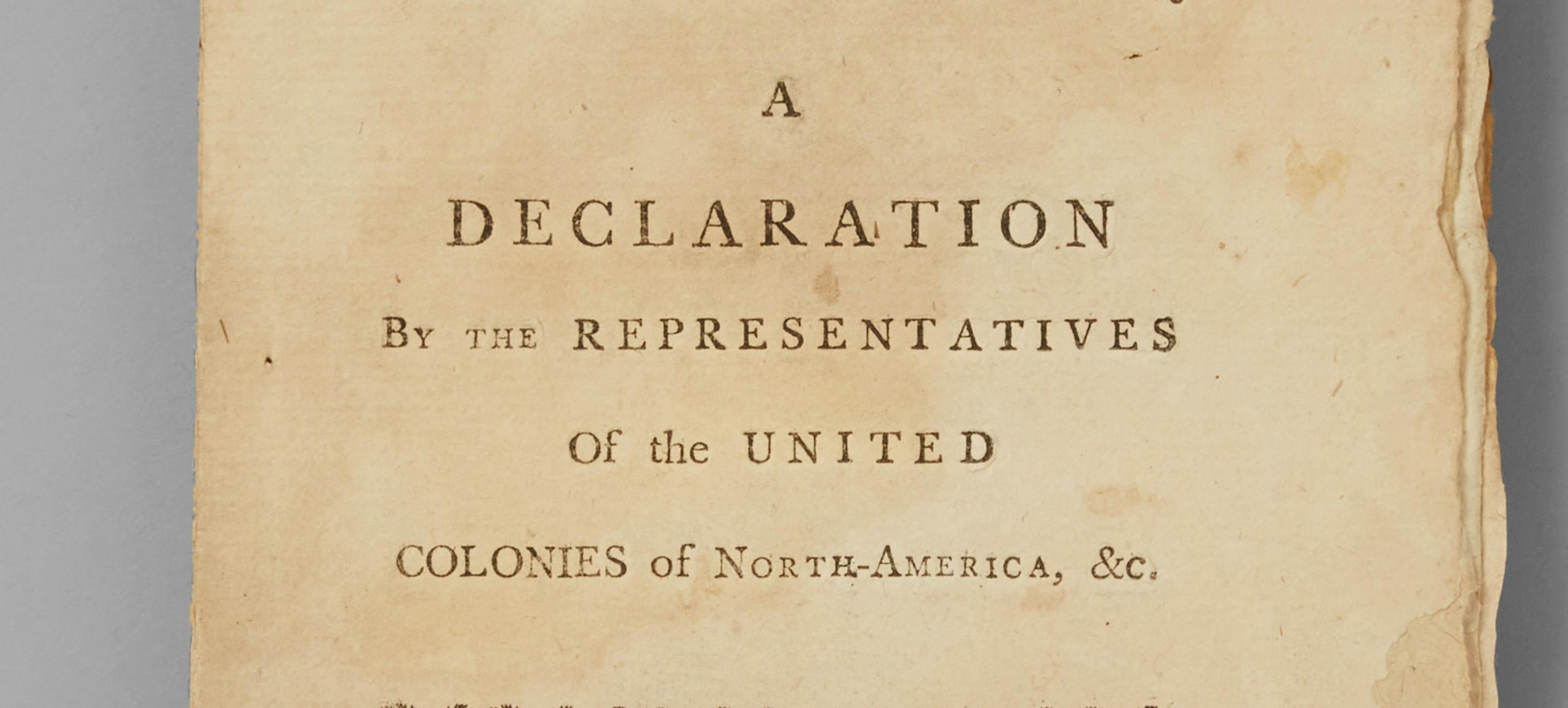
Declaring the Revolution: America's Printed Path to Independence
Benjamin Franklin, Thomas Paine, John Hancock, George Mason, Thomas Jefferson, John Locke, Jean-Jacques Rousseau
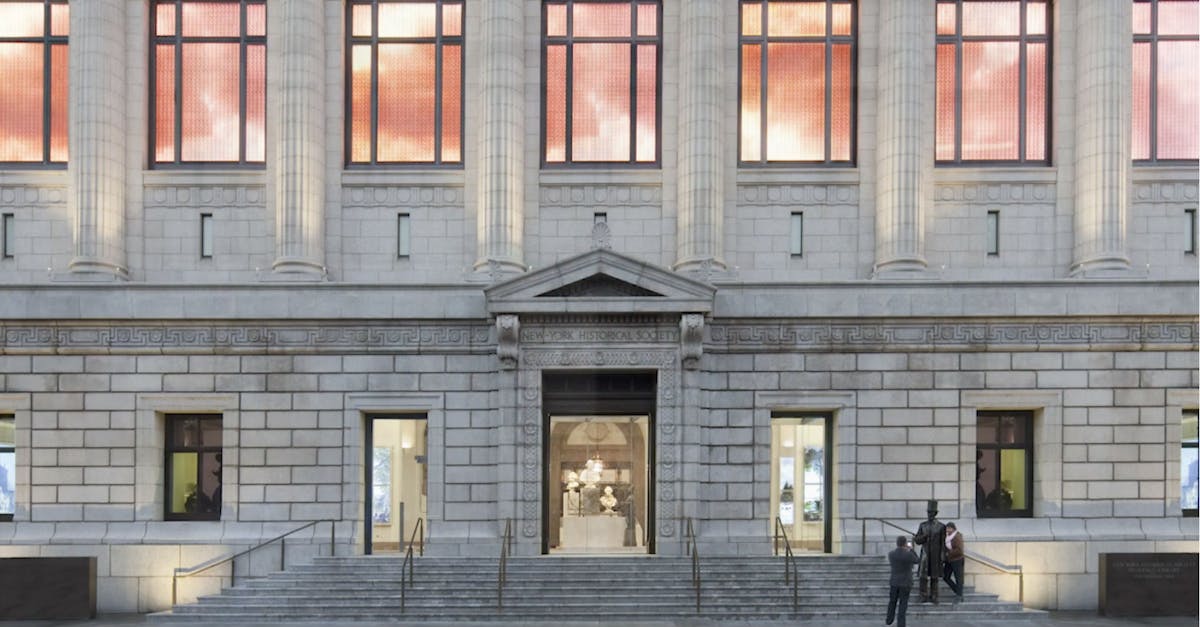
The New York Historical
170 Central Prk W, New York, NY 10024
Tue-Thu 11am-5pm, Fri 11am-8pm, Sat-Sun 11am-5pm, Mon closed
Admission
Paid Admission
Tickets available; specific pricing not shown on page
About
The American Revolution gave rise to the United States not only because the original thirteen colonies separated from Great Britain, but because they did so through joining together for the first time in a union that accorded with their shared democratic values. For this reason, the American Revolution was much more than a series of battles fought across the imperial possessions of the United Kingdom, between Britain's mighty militaries and the improvised, ragtag group of mostly volunteer fighters who joined America's Continental Army and Navy. The "revolution" was also the ideas and beliefs—some long established, some newly emergent—that the colonists shared and thought worth fighting and dying for in the promise of an independent America that adequately represented its citizenry. As John Adams wrote, "The Revolution was in the minds and hearts of the people." Declaring the Revolution is an exhibition about how these ideas and beliefs were developed in the years leading up to the American Revolution, and how their dissemination in the most turbulent days of this colonial civil war both strengthened the political cause for American independence and assisted the military victories of the Continental Army and Navy. This was an age with only one form of mass communication: print. And the printings that furthered the democratic ambitions of Americans—for liberty, equality, and self-determination—were all "declarations" of various sorts. The highest expression of these printed democratic ambitions was the Declaration of Independence, the 250th anniversary of which we celebrate in 2026. It was the culmination of past declarations, or, as its author, Thomas Jefferson, claimed, "it was intended to be an expression of the American mind." Declaring the Revolution portrays the arc of the struggle entirely through original, historical printings, each declaring an aspect of how the colonies achieved independence. The founding generation makes appearances, as in Benjamin Franklin questioning the Stamp Act; Thomas Paine issuing his electric pamphlet, Common Sense ; John Hancock honoring the Boston Massacre; and George Mason conceiving the Virginia Declaration of Rights. The major events of the war are shown, including the Battles of Lexington and Concord, Boston Tea Party, Battle of Brooklyn, Washington's victory at Trenton, and the Sieges of Charleston and Yorktown. Providing the intellectual foundation for the revolution are the key texts that inspired Americans to fight for their fundamental rights: the Magna Carta, English Bill of Rights, and books by John Locke and Jean-Jacques Rousseau, among other philosophers. At the center of the exhibition, thematically and physically, are two extraordinary printings of the Declaration of Independence: its exceedingly rare first newspaper appearance in the Pennsylvania Evening Post , and the gloriously faithful State Department engraving of the original engrossed copy that is now displayed (far less legibly) at the National Archives Museum in Washington, DC. In direct conversation with these works is an unbelievable rarity, a 1773 handbill printed by enslaved persons in Boston, which asked that the language of freedom apply to them, and pointed out the incongruousness of a land with bondage desiring to be liberated. More than any other revolutionary statement, the Declaration of Independence clarified for Americans the grievances that led to war, and the mighty consolations that winning the war would bring: union, independence, democracy, and individual rights. Declaring the Revolution is philanthropist David M. Rubenstein's primary exhibition commemorating the 250th anniversary of the Declaration of Independence's being proclaimed by the Second Continental Congress, the then-governing body of the American colonies. The exhibition is curated by Mazy Boroujerdi, special advisor to the David M. Rubenstein Americana Collection, which mounts non-partisan exhibitions of historically important printings to foster civic engagement and historical understanding. Declaring the Revolution marks the fourth exhibition produced by the collection in conjunction with The New York Historical, where the Semiquincentennial will be celebrated with a yearlong schedule of in-person and online exhibitions and programs. The New York Historical's digital project, called On Our 250th , has a nationwide coalition of history museums inviting Americans to share their hopes for our democracy.