Susan Weil: Moving in Time Space
Susan Weil

Sundaram Tagore Gallery
542 W 26th St, New York, NY 10001
Tue-Sat 10am-6pm
Admission
Free Admission
About
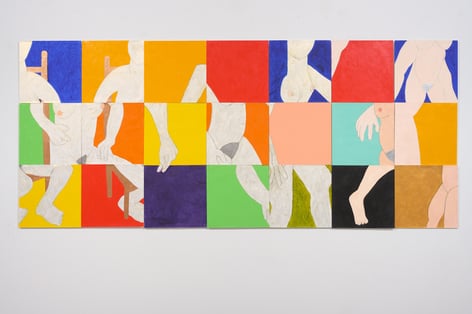
Sundaram Tagore Gallery is pleased to present _Susan Weil: Moving in Time Space_, the gallery's fourteenth solo exhibition of work by the pioneering American artist. The exhibition builds on one of the gallery's longest-standing artist relationships, which began in 2000. Now ninety-six, Weil (b. 1930, New York) continues to work in her Brooklyn studio with the curiosity and inventiveness that have defined her practice for more than seven decades. _Susan Weil: Moving in Time Space_ brings this remarkable history into the present, offering a new opportunity to consider an artist whose lifelong investigations of the human body, movement, time, and space have remained resolutely her own. Susan Weil studied under Josef Albers at Black Mountain College in the late 1940s and came of age at the center of the New York School with its eclectic cultural influences and interdisciplinary experimentation. But unlike her contemporaries, Weil has never been afraid to pursue figuration and reference reality, drawing inspiration from nature, literature, photographs, and her personal history, embracing both serious and playful elements. The works in this exhibition range from 1969 to 2026, including five pieces created in the past two years. The fearless experimentation with new techniques and her use of unconventional materials, both of which have been hallmarks throughout her long career, are well represented. Likewise, the themes she has returned to again and again are on display, including nature, the human figure, geometric forms, and blueprints. But perhaps the most distinctive feature of Weil's visual language is her ability to bring to life the intangible qualities of time and movement, creating multidimensional works in which she fractures the picture plane, deconstructing and reconstructing images. It is the thread that connects most every work in her oeuvre. Weil splinters landscapes into multiple rectangular canvases; slices and dices female nudes into myriad breasts, hands, and feet; and sometimes literally sets images in motion, all of which force the viewer to contemplate numerous perspectives at once. In her skilled hands, the result isn't dissonance and chaos but a playful sense of movement. Her dynamic assemblages hover between the representational and the abstract, and between painting and sculpture. An untitled painting from 2024 includes the mix of materials for which she is known, including cyanotypes, fabric, and acrylic on canvas, all of which are collaged onto a wide, concave rectangle of Masonite that gently pulls you into her idiosyncratic world. _You and Me_, 2025, similarly compels viewer participation thanks to a circular mirror that crowns a trio of geometric canvases jigsawed together, firmly inserting your reflected image into her composition. _Untitled (Parts Afloat)_, 2026, is Weil's most recent exploration of the body, which is not merely fractured but disembodied and draped over separate cubic forms and a canvas laid flat on the floor—a Cubist construction that compels you to move around it in order to reembody the rotund female figure. "Weil's work first gripped me because it lives in the space between precision and humanity. She brings together rigorous geometry and the unpredictable expressiveness of the human body in a way that feels both intellectual and deeply emotional. Looking at her work, I never feel like the systems overwhelm the person—they reveal something essential about being human," says Sundaram Tagore. "I'm also drawn to the way she refuses to be confined by a single medium. Painting, collage, printmaking, sculpture, photography, artist's books—she seemed to follow the idea rather than the discipline. That freedom to move among forms and materials makes her work feel alive, as though experimentation itself is part of the art. "What fascinates me most, however, is how she turned movement into a medium. Instead of simply depicting a body, she records its presence and its passage through space. Her layered drawings and body prints capture traces of motion and time and space, making the artwork feel like a record of a lived moment."