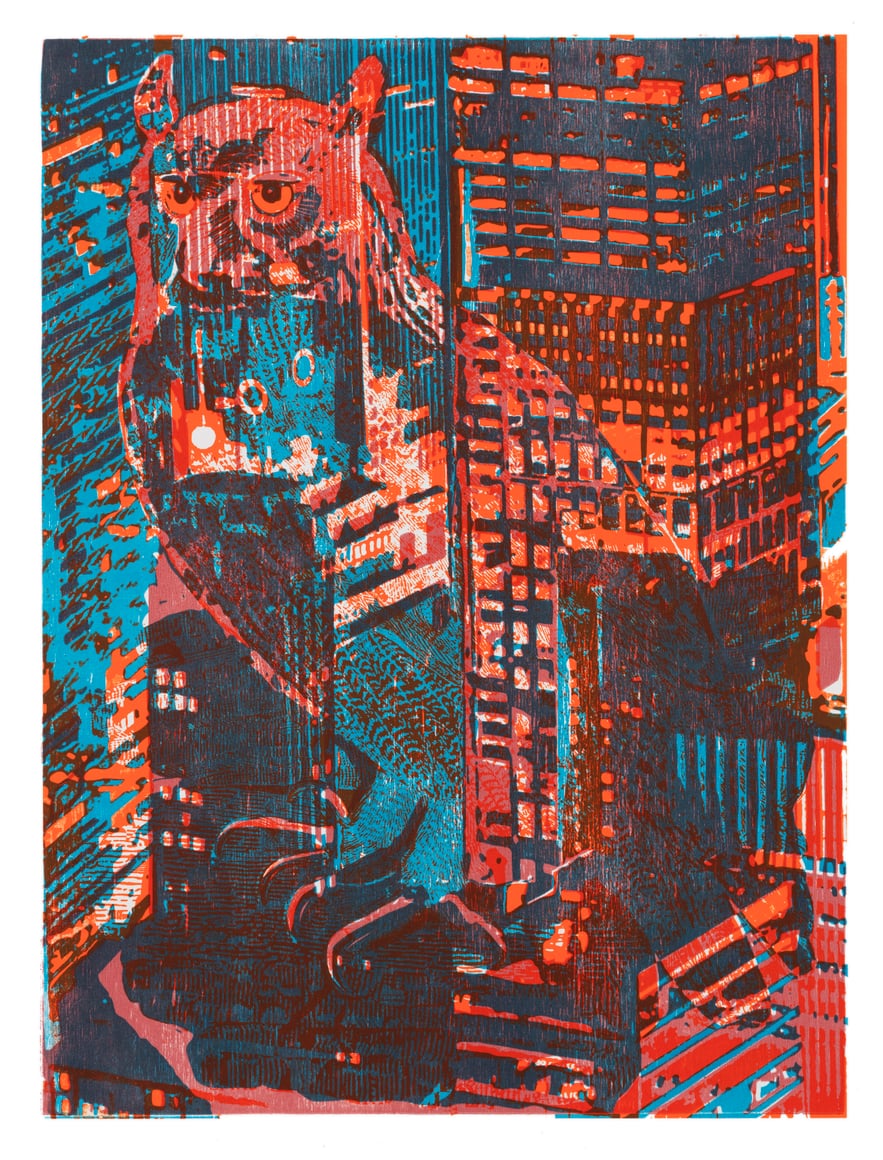
The Viewing Room: Zorawar Sidhu & Rob Swainston
Zorawar Sidhu, Rob Swainston

Petzel Gallery
520 W 25th St, New York, NY 10001
Tue-Sat 10am-6pm
Admission
Free Admission
Gallery is open to the public. Tuesday–Saturday 10:00 AM–6:00 PM
About
Petzel is pleased to present a new series of prints combining woodcut and lithographic processes by artist duo Zorawar Sidhu and Rob Swainston, as part of the gallery's The Viewing Room series on view from April 4 through April 11 at 520 West 25th Street. With exceptional expertise in the history of printmaking and mastery of the woodcut process, Sidhu and Swainston bring a distinctive sensibility to their collaborative practice—their meticulous technique building layers of tonal values into compositions of remarkable complexity and depth. Drawing on historical engraving traditions including the 18th century illustrated natural history volumes of Thomas Bewick, these new prints examine animals within the context of the Anthropocene, exploring the shifting relationships between human industry, animal life, and the visual systems through which "nature" is understood and represented. Sidhu and Swainston depict animals such as pigeons, owls, pigs, rats, and monkeys as they appear within human-made environments, considering the often "unnatural" ways humans interact with animals: as urban cohabitants, scientific test subjects, and food commodities. In Owl, 2026, a great horned owl looms against a backdrop of glowing city towers—evoking Flaco, the beloved Eurasian eagle-owl who escaped from the Central Park Zoo in 2023 and became a symbol of wildness persisting within the urban grid. In another print, Pig, 2026, a pig's head oscillates between farm animal and a political caricature of a U.S. Immigration and Customs Enforcement (ICE) agent, referencing a long history of protest imagery in which the pig has served as a critique of power and authority. Across these layered compositions, the artists examine how urbanization reshapes animal habitats while revealing how animals circulate through culture as symbols as much as through ecosystems as living beings. Central to the series is an engagement with inherited visual histories of nature. Sidhu and Swainston reference the engravings of Thomas Bewick, whose illustrated volumes such as History of Quadrupeds (1790) and History of British Birds (1797–1804) helped establish enduring visual conventions for representing animals. Adapting engraving techniques associated with Bewick's innovations, the artists layer historical imagery with contemporary references, reflecting on how our understanding of the natural world is mediated through books, zoos, cities, and screens rather than direct encounters with the wild. In this context, animals appear suspended between scientific illustration and spectacle—figures encountered as images and symbols as much as living creatures. The artists' material choices further reinforce these themes. Their use of plywood—derived from trees but reconstituted through industrial production—serves as a material analogue for the broader transformations of the Anthropocene, mirroring the ways animals are shaped by systems of agribusiness, scientific testing, and spectacle. Building on strategies developed in earlier bodies of work, Sidhu and Swainston continue to examine printmaking's historical role in the circulation of images, information, and political ideas, revealing a world in which the boundaries between the natural and the constructed have become increasingly indistinct.