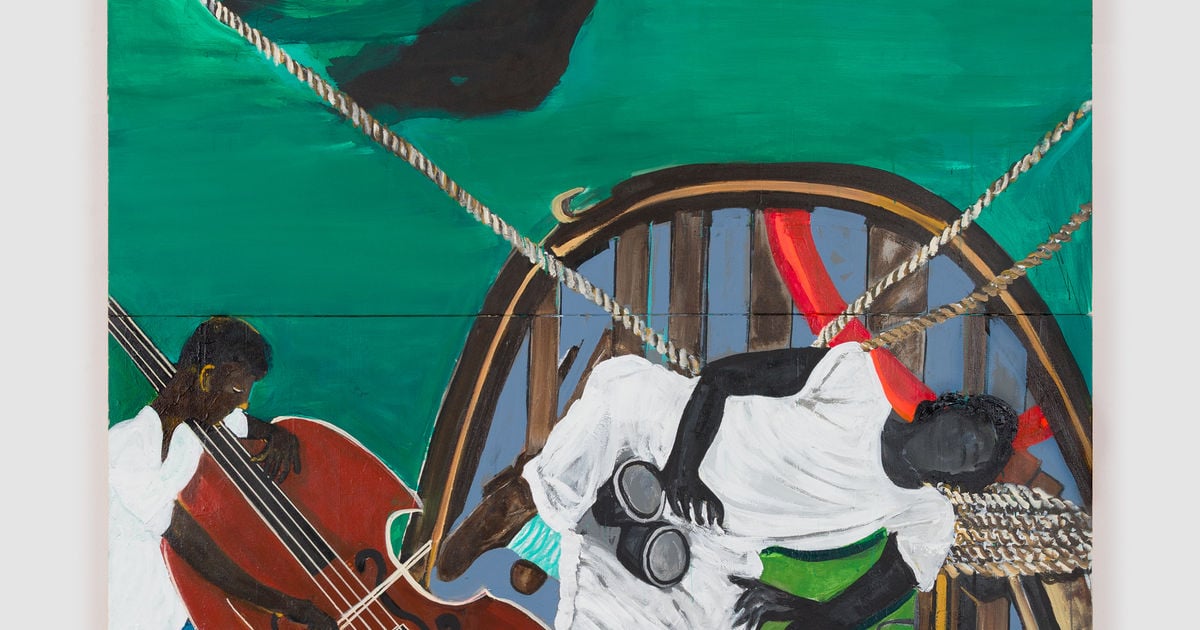
Arjan Martins: 40° 39′ 40″ N, 73° 56′ 38″ W
Arjan Martins

Olney Gleason
509 W 27th St, New York, NY 10001
Tue-Sat 10am-6pm
Admission
Free Admission
About
In his landmark first U.S. solo exhibition, Brazilian painter Arjan Martins (b. 1960, Rio de Janeiro) presents new figure paintings and portraits on canvas and found wood. One of the most vital voices in contemporary Brazilian art, Martins has spent more than three decades developing a singular pictorial language that employs images from collective memory to conjure a reality that transcends linear time. The exhibition anticipates an upcoming solo presentation at ICA Milano, on view from June 11 to July 24, 2026. Martins' work navigates the "Black Atlantic", a term associated with theorist Paul Gilroy, invoking symbols of maritime expansion to reflect on the historical triangular trade system and chart the ongoing influences of the Black diaspora. His distinctive, hybrid environments merge the urban, the domestic, and the oceanic to form spaces of dynamic cultural exchange. Music recurs across the exhibition as both image and subject, evoking the circuits by which jazz and the broader traditions of Black American music have traveled and been transformed. Pianists, a double bass player, guitarists, and a trumpeter appear across concert halls and subway cars. These settings repeatedly coexist with open water; Martins' figures share the picture plane with nautical elements including a ship deck, rope, or the silhouette of a coastline. The same deep teal that Martins uses for the ocean surface recurs as stage curtain, window light, and piano lid, connecting the work's aquatic and musical registers. Central to the exhibition is the artist's sustained engagement with the photographic image. Found photographs, sourced from flea markets and secondhand bookshops in Rio de Janeiro, frequently serve as the basis for Martins' figurative works. The artist has described finding these source images and being drawn to their subjects' resemblance to his own relatives and ancestors. Where the photograph fixes a moment, Martins' paint reopens it. The exhibition features a new portrait of Frederick Douglass, a historical subject to whom Martins has returned – including recently as part of a curatorial intervention at the 34th Bienal de São Paulo in 2021. Martins uses Douglass' portrait as an emblem for the political possibilities of the image, referencing the abolitionists' use of photography as a tool for Black emancipation. These social and political concerns are echoed in Martins' depiction of a yellow school bus: another recurring motif that emphasizes the importance of educational and artistic opportunities in our society. Martins constructs his paintings through layered accumulation. He begins with watercolor washes, building up through drawing and successive applications of acrylic over weeks and months so that earlier layers of warm earth tones remain visible beneath cooler blues and greens. His paint handling moves between figurative rendering and near-abstraction within a single canvas, with his largest compositions painted across multiple joined panels – the seams and the texture of the support left exposed.