Dora Jeridi | A Burnt Child Loves the Fire
Dora Jeridi

Marianne Boesky Gallery
507-509 West 24th Street, New York, NY 10011
Tue–Sat 10am–6pm
Admission
Free Admission
About
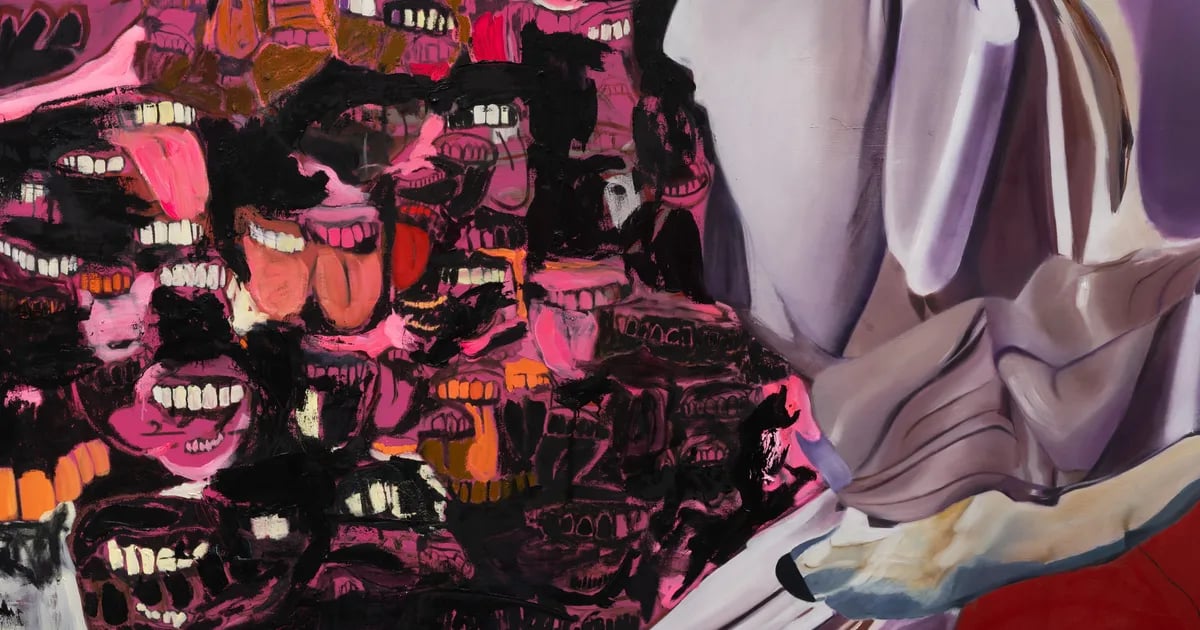
Boesky Gallery is pleased to present _A Burnt Child Loves the Fire_, an exhibition of new paintings by Dora Jeridi (b. 1988; Paris, France). For her debut solo exhibition with the gallery, Jeridi draws on memory and cultural heritage to examine the intricacies and anxieties of human relationships. Throughout her explosive, large-scale paintings, Jeridi layers various modes of mark-making to compose theatrical settings for playful examinations of the drama and tragedy that characterize the human experience. With the new work in _A Burnt Child Loves the Fire_, Jeridi conjures refined, domestic interiors—loosely inspired by the artist's memories of her grandmother's Parisian home—furnished with plush leather sofas, elegant wooden dining sets, and ornately framed oil portraits. Disrupting any sense of warm domesticity, the artist collapses her meticulous scenes, remixing the surfaces with art historical quotations—notably, Picasso's infamous screaming _Guernica_ (1937) horse head—mounds of exquisite drapery, and broad tracts of cross hatching and tar-like black. _A Burnt Child Loves the Fire_ comes at a time of reckoning—both personal and cultural—for the artist. Jeridi, who was born and raised in France, moved to New York three years ago for the International Studio & Curatorial Program residency—which prompted Jeridi to examine the French cultural assumptions she had long taken for granted. Trained as an academic historian, Jeridi sought understanding in the same place any good researcher would: the archives. Examining a host of vintage garments and historic garments—primarily from Dior's Galliano era—in the archives of the iconic French fashion house, Jeridi found that the luxurious textiles and intricate designs took on an aesthetic significance, speaking to a particular French opulence—the grandiosity of the Bourbon monarchs, the drama of Baroque painting, the elegance of Parisian runways. Throughout _A Burnt Child Loves the Fire__,_ Jeridi immerses viewers in an explosion of sweeping, lustrous drapery rendered in regal purples, golds, and reds. Enveloping fragmented figures and spilling across furniture and rugs, drapery engulfs Jeridi's scenes—a nearly geological force flooding through her gentle domesticity. Drapery, of course, occupies a notorious position in the history of Western painting. From antiquity, drapery—in both painting and sculpture—served as emphasis for significant figures as well as a mechanism for artists demonstrating their particular skill. For Jeridi, drapery holds a multitude of histories and associations—luxury, opulence, indulgence, decadence. Drapery also bears profound abstract and expressionistic potential. "Centuries before the idea of abstract art had even been dreamed of," art historian Andrew Graham-Dixon argues, "the flow and the rhythm of drapery offered figurative painters expressive possibilities akin to those promised by abstraction." The paintings in _A Burnt Child Loves the Fire_ hum with narrative—even theatrical—potential. The artist meticulously stages her scenes: figures and furnishings alike allude to stories unfolding across canvas. But Jeridi never allows these narratives to be revealed—instead, she drowns the scenes in waves of mysterious occurrences—abstracted billowing fabric and recurring swaths of oppressive, oily black. This darkness seeps into the paintings' crevices, devouring their narratives, and evoking the spread of flammable liquid, burning potential threatening to engulf entire scenes in flames. _A Burnt Child Loves the Fire_ takes its title from Oscar Wilde's subversion of a 14th century proverb, in which "the burnt child dreads the fire." If Jeridi's infinite drapery speaks to a certain elegance and sophistication, the overlying patches of darkness speak to the propulsive, seductive forces of darkness and tragedy that sustains the artist's practice. Compulsively revisiting the sites of her own history—the playfulness of childhood memories, the archives of an academic education, and the dark abyss into which we all must gaze—Jeridi turns around and ravages the surfaces the paintings, insolently frees herself from becoming guardian of any particular heritage. Imbuing her work with ancient tragedy, supple elegance, and sly humor, Jeridi embarks on search for that which is entirely her own—a burning odyssey of self-discovery amidst a circumscribed history.