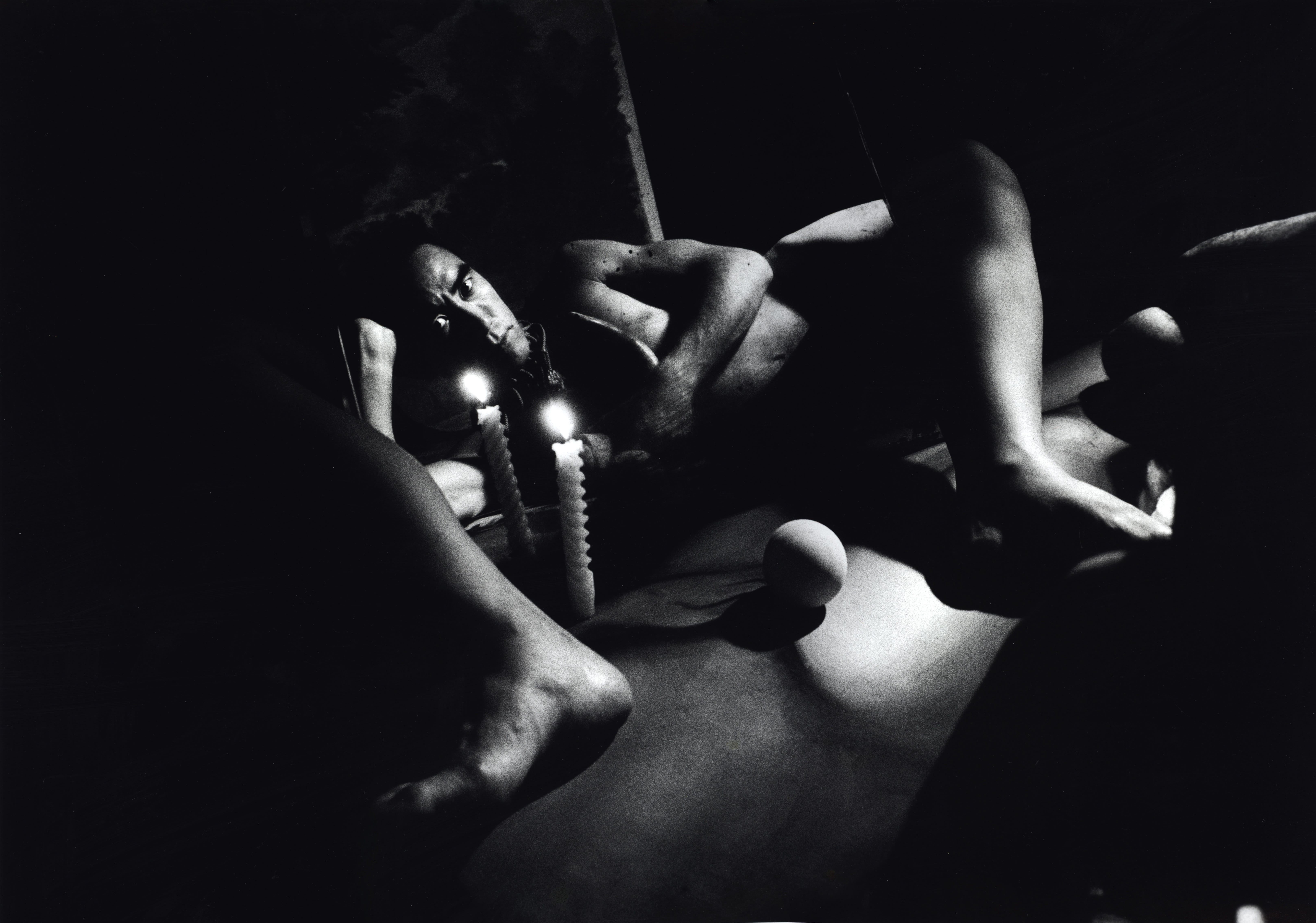
PROPS from Barakei: Eikoh Hosoe and Jason Wee
Eikoh Hosoe, Jason Wee, Yukio Mishima

Leslie-Lohman Museum of Art
26 Wooster St, New York, NY 10013
Wed 12-5pm, Thu-Sun 12-6pm. Closed Mon-Tue
Admission
Suggested Donation
The suggested donation to visit the museum is $10. You may make a donation upon arrival or make a donation online before you visit.
About
This exhibition presents artist Jason Wee's new conceptual sculptural installation and performance, commissioned by the Museum and conceived in response to the series _Barakei_ (_Ordeal by Roses_) by the Japanese photographer Eikoh Hosoe (1933–2024). Between autumn 1961 and spring 1962, Hosoe staged images of the novelist Yukio Mishima (1925–1970) in Tokyo, primarily at the author's Spanish colonial–style home. Wee's work focuses on the props—a garden hose, a mallet, a candle, a painterly backdrop accentuating Mishima's muscular body—that imbue Hosoe's photographs with an ambiguous symbolism reflective of art historical and sexual narratives. The installation incorporates metal and fabric prints of similar props, mounted within a spiral of rope and suspended on a fragmented wall frame. The rope's pattern is based on an encoded version of a lecture script by Wee (audible on headphones within the exhibition); it speaks to and activates the historical photographs, many of which are from the Museum's collection. Hosoe's collaboration with Mishima yielded the landmark photobook _Barakei_, published in 1963. Its images reveal the volatility of the era: the daring work of Japanese postwar artists; student protests in response to the 1960 Japan–US Security Treaty, the economic miracle, and the American War in Vietnam; and reactionary desires to return to prewar traditional values. Before Hosoe's camera, Mishima performed as directed, and he later remarked that "neither my spirit nor my psyche was required ... the experience made my heart dance." He felt Hosoe's photographs let him inhabit a "grotesque, barbaric, and dissipated" inner world shot through with "a pure undercurrent of lyricism"; in Hosoe's recollection, "Mishima allowed me to act on my own discretion, including wrapping a rubber hose around his body or inserting a closeup of his eye in Botticelli's _The Birth of Venus_." References to the martyrdom of Saint Sebastian give Hosoe's high-contrast photographs an especially dark and decadent mood. Less than a decade later, in November 1970, Mishima would commit ritualistic _seppuku_. The exhibition also traces Hosoe's photographs across three editions of the photobook, designed by Kohei Sugiura (1963), Tadanori Yokoo (1971), and Kiyoshi Awazu (1984). Wee's installation accentuates the continuing resonance of this historic collaboration. Curated by Yasufumi Nakamori.