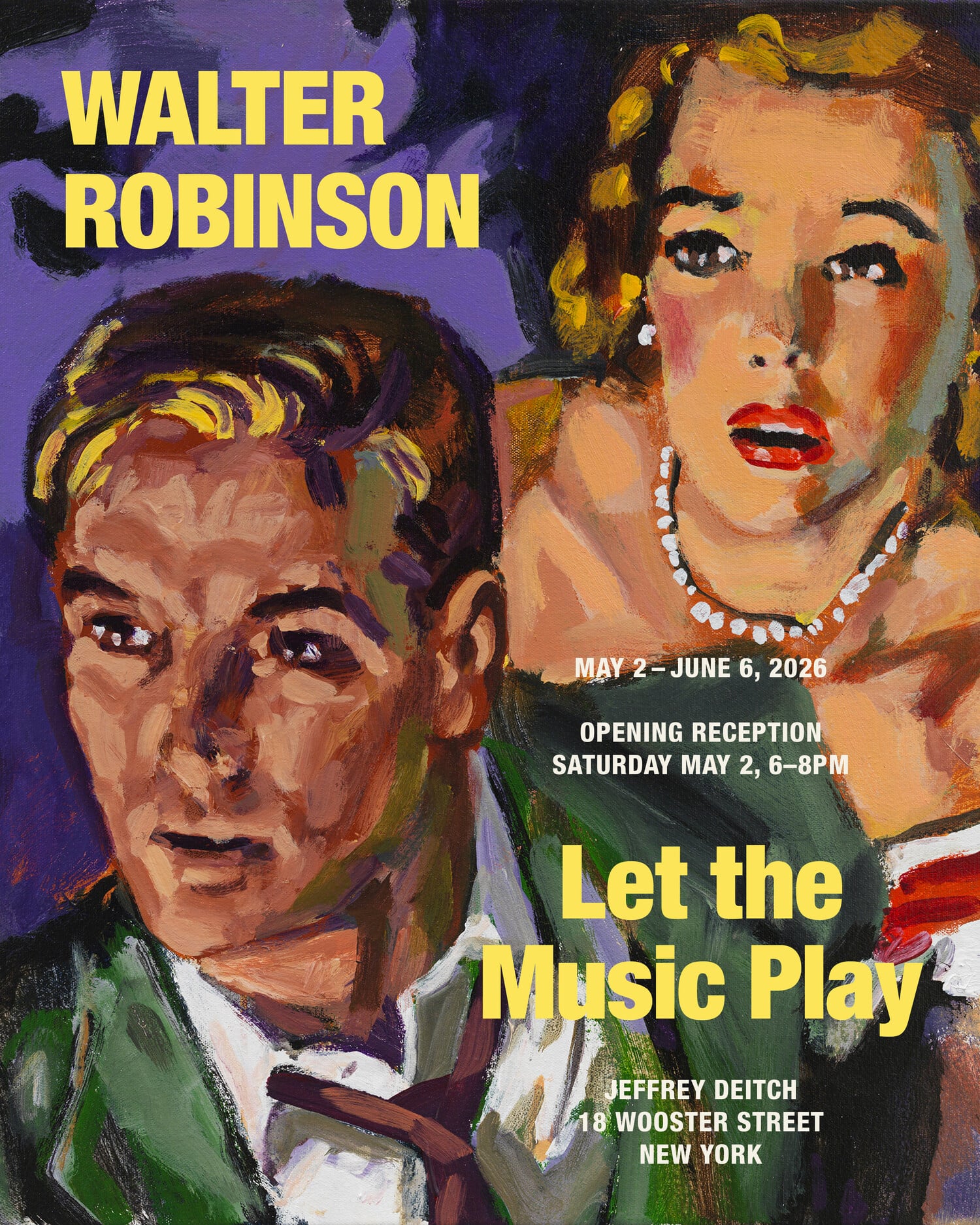
Walter Robinson: Let the Music Play
Walter Robinson

Jeffrey Deitch
18 Wooster St, New York, NY 10013
Admission
Free Admission
Gallery, no explicit admission mentioned
About
We may be known for what we do in life, or even for what we do not do, but to measure those things we do, even when we know better not to, is how we truly understand ourselves. That understanding, almost an empathy in Walter Robinson’s (1950-2025) art, is a rare wisdom. Call them guilty pleasures, simple joys or cheap thrills, their superfluous folly is not so much a lapse of judgement but a suspension of it. Perhaps all the indulgences and excesses that constitute our pleasure-economy are bad for us, dulling our wits, slackening our resolve and polluting our body, but to willfully enter this field of numbing distraction, and to stay there vigilantly alert as if before a grander sublimity, is a kind of deviant medicine. Wickedly smart yet struck with a trickster’s lunacy, Robinson channels so much of what is besetting the human condition into a contemplative sensory reverie, harnessing all that clutters our mind into a radically subversive instrument to probe our desires. In a consumer society where identity is store bought and branded, Robinson’s parsing of products as pleasures has proffered a more psychologically charged kind of late capital commodity art. He translates our collective ambivalence towards corporate banality and short-term seductions into an aesthetic ambiguity in which the celebratory tone of Pop Art and the critique of Pictures Generation oddly coexist as emotionally and intellectually whole contradictions. Like a beguiled and befuddled shopper lost in the market aisles of a surplus surfeit store of superficial indulgences, Walter knows just what grabs our attention and the myriad ways in which a look becomes an insidious form of entertainment. Competing against those same forces- what we might call the manufacture of desire- many artists have resorted to the spectacular to stand out in this attention deficit economy. Robinson rather has chosen to inhabit the society of the spectacle itself as a citizen outsider, to contemplate the attention deficit as a meditation object itself, to focus on the distraction as a material fact. Look, he tells us, what is normal is what will make you feel special and what is special is that which makes us feel normal, which is, after all, the comfort we seek most from our disposable possessions. In this consumer society, he reminds us, we are what we eat, and healthy or sustainable are just different options on a menu of exhausting excess. There will be more, because there is never enough. There’s no telling why Robinson decided to become a great painter, why he worked so hard at it or if he even foreknew he had the talent for such a remarkable touch, perhaps it was an abiding love of the medium and those who plied it or maybe he just recognized that certain painterly flourishes offer an allure, like an intimate caress or a whispered nothing, that can beguile and enchant in seemingly effortless fashion. He’s a conceptual painter who understood that his ideas could be far more subversive if they could be conveyed in a less cerebral fashion. What, we must wonder, could be more problematic than sugar-coating our problems? His visual confections, all the more dangerous for their deliciousness, are all come-on and tease, titillations launched as distractions and lodged as precognitive mind-mines of careful what you wish for prescience. Too good to be true, they are ultimately as troubling as they are satisfying, deceptions that are completely honest. Robinson’s art was conceived in the critical language that emerged in the wake of Modernism, as part of the wider critique of pictures, of media, of reproduction and of commodities that distinguished the most important artists of his generation. His art retained many of these concerns throughout his career but whereas so many leaned into the dry and reductive reasoning of theory, Robinson plunged into a slippery wet expansivity of libidinous sensuality. Feigning a casual effortlessness, the too-easiness of his art is what makes it so very challenging. Right up to the end Robinson conceptually centered his work in problematic processes that for all their seriousness were deliberately hard to take seriously. From lurid genre-infested dime store paperback cover illustrations and the supersized kitsch of his kitten paintings to his mock-sublime spin art, commercial product still lives, juicy lingering hamburgers or insipid normcore fashions, nothing seems now quite as arch as Robinson’s late experiments in Artificial Intelligence painting- those that he used as visual cues for his own paintings and a number that he actually outsourced to cheap overseas production, both featured in this exhibition. Going so far as to rob his art of its defining characteristic- his remarkably facile painting style- he reverts to a pure idea art, in which narrative tropes serve as representational prompts. All along the way Robinson has made art that confounds and challenges the bounds of good taste, often in ways that seemed like career suicide before eventually finding their audience and advocates in younger generations. Predicting what his last AI paintings will ultimately mean in years to come is to speculate on a future we cannot even imagine now, but how the fears and fantasies they invoke along the fault lines of authorship and creativity are provocations very much of this moment. -Carlo McCormick