FATEMEH BURNES | The Eighth Veil
Fatemeh Burnes

High Noon Gallery
68 Reade Street, New York, NY 10007
Admission
Free Admission
Commercial gallery - no admission fee mentioned
About
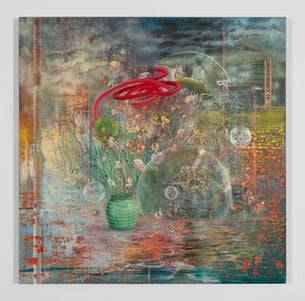
High Noon is pleased to present The Eighth Veil, the gallery's third exhibition with Los Angeles-based artist Fatemeh Burnes. The title draws from Salomé, in which Oscar Wilde invokes the seventh veil as the final unveiling of truth in human character. In Burnes's interpretation, however, there is another layer beyond this threshold. The eighth veil points to what has become most urgent in her work. As she states, "Beyond the complexity of human character— the ways we construct, destroy, rebuild, and contradict ourselves— the deeper revelation is the absence of compassion. That absence, once uncovered, becomes the most significant truth." In Salomé , "The Dance of the Seven Veils" stages a symbolic unveiling of particular expressions of human nature: desire, obsession, power, and domination, revealing how, when left unexamined, they can tend toward collapse. Yet human nature extends beyond these manifestations, carrying with it the capacity to create as well as destroy. Beneath them lies a more fundamental inquiry of the ground from which all human expression arises. The Eighth Veil begins here. It neither refutes nor moralizes Wilde's vision, but shifts focus to that underlying ground of human connection. In Burnes's new body of work, love emerges not as sentiment or ideal, but as the condition that makes relation and recognition possible. Compassion emerges alongside it, not as virtue, but perception; the capacity to recognize one's self in another. Burnes develops a visual language deeply connected to art historical narrative and formal content with roots in Classicism, Surrealism, Persian miniature painting, etc., tracing her own lived experience across cultures and continents. Boundaries between systems— organic and constructed, internal and external, individual and collective— are rendered permeable. Rather than depicting discrete subjects, she stages environments of relation, where elements coexist in various systems of exchange. Forms appear to emerge, dissolve, and reconfigure within a shared field, suggesting that separation is a provisional condition rather than a fixed one. With a razor-sharp compositional sensibility, Burnes shows in a single picture plane how disjunction, opacity, and excess do not negate continuity, only complicate how it is perceived. Within these shifting fields, connection is not presented as harmony or resolution, but as a condition that underlies and proliferates through moments of fragmentation. What appears divided remains structurally entangled. In works such as En-Trance (2021-2026), continuity is expressed through a porous, dreamlike landscape which dissolves distinctions between organism and environment. Connection is not imposed, but ambient. A central opening that is both bodily and architectural acts as both a passage and a rupture, while the scattering of animal figures and geometric frames operates less as narrative than as a space of simultaneity. Pastoral imagery mingles with science fiction, Jean Honoré Fragonard with Yves Tanguy. In Inter-Section (2024-2026), this relational field becomes more tensile. Branching, vascular forms intersect with linear scaffolds and angular planes, producing a dynamic between growth and construction. These elements appear interdependent, as if each system requires the other to become legible. Passages (2025-2026), takes on a heightened atmospheric intensity. A dense, storm-like mass gathers across the upper register, subtly emitting from a Brutalist silhouette and pressing downward upon a punctured terrain. Here, connection is neither seamless nor immediately accessible, suggesting a reconfiguration under pressure. In Burnes's work, fragmentation is not an endpoint but a condition through which connection persists and becomes perceptible. Complexity does not undo shared being, and what appears as fracture is held within a larger field of relation where contrasting visual logic remain in constant flux, resisting fixed hierarchy. The Eighth Veil is not another layer to be removed; rather, it is a movement inward—an invitation to reorient attention from resisting human nature to understanding its source. Burnes proposes that connection precedes division, and that compassion restores continuity through recognition rather than repair.