Savannah Claudia Levin: Swimming a Witch
Savannah Claudia Levin
Harkawik
88 Walker St, New York, NY 10013
New York: Tues-Sat 11am-6pm | Los Angeles: Wed-Sat 11am-6pm
Admission
Free Admission
About
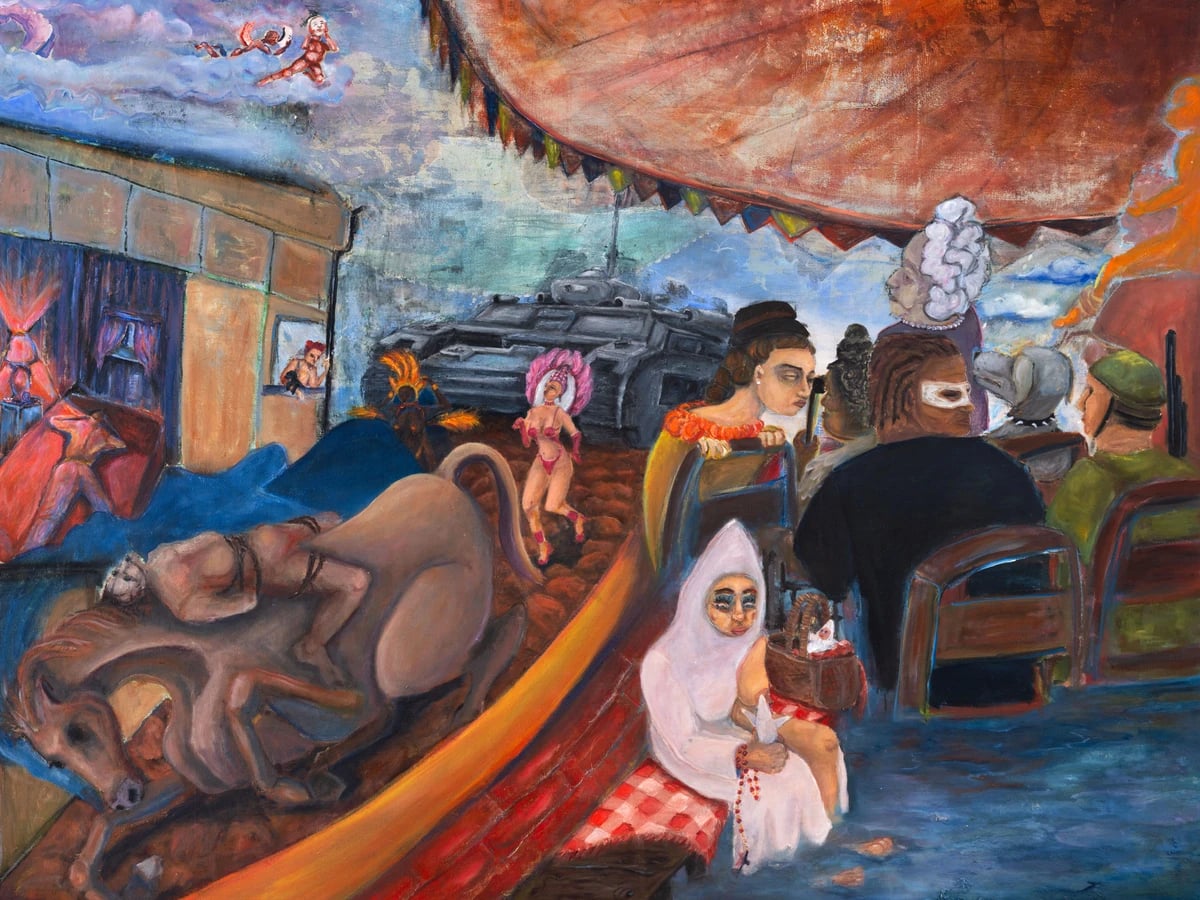
Harkawik is pleased to present _Swimming a Witch_, Savannah Claudia Levin's second solo exhibition with the gallery. The exhibition's title borrows from 16th and 17th century "swimming tests." These trials-by-water were once used to prosecute women accused of witchcraft: bound and thrown into water, a woman who floated was judged guilty, one who sank was innocent but risked drowning to prove it, a test that was impassable by design. In six new paintings, Levin explores a world of judgment and mirroring, victimhood and vengeance, liberation and consumption, myth and trial. The women are bound and tried, but also, at turns, do the binding and the trying themselves. Violence moves in a circuit rather than a straight line. It passes hand-to-hand between women who are alternately its target and its author. Levin builds these paintings from found and salvaged canvas, so surfaces already carry a history of use. Paint accumulates in dense, unresolved layers, closer to a record of time than a finished picture, and text keeps surfacing at the edges of the canvases, titles, fragments, single scrawled words, as if language were one more layer the paint hasn't fully covered. That same refusal to settle runs through the water in these paintings, which works as equal parts verdict and mirror: the same element that judges a woman also reflects her back to herself, never holding her still long enough to be pinned down as one thing. Masks recur as a related trial, some letting their wearer look freely out at the world without being seen in return, others hardening into an identity, a role, a costume, a face, that can't be taken off. Levin works closer to the first kind herself. The painter becomes a kind of jester, with the privilege of a mask, permitted to stand at the edge and say what those inside cannot. It's a strange vantage point to hold: watching women bound and tried while being, herself, unmistakably one of them. The mask doesn't undo that. It just gives her a place to stand while she watches. This world lets us draw our own conclusions about where the judgment in them actually lands, and who, in the end, is doing the judging.