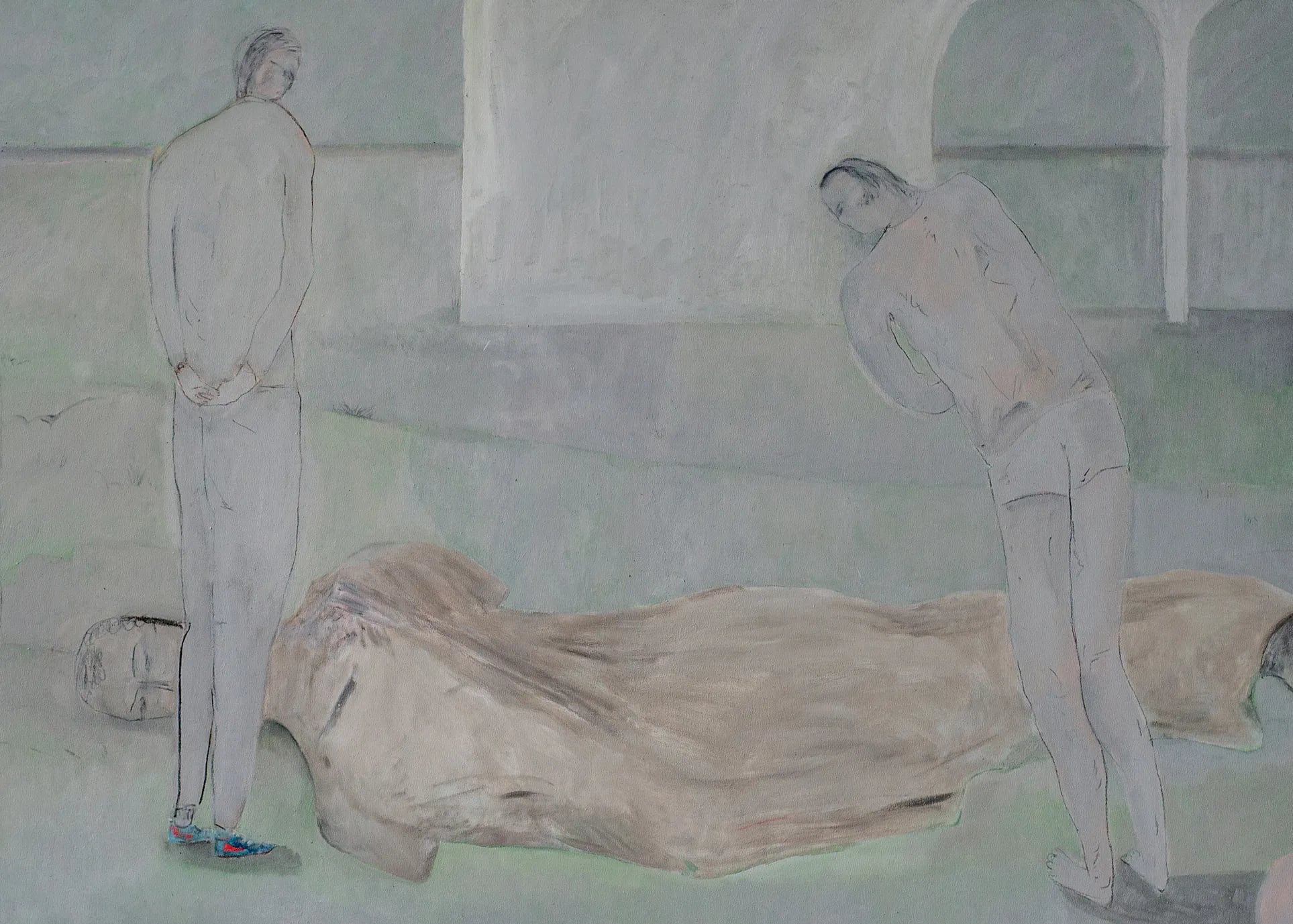
Volker Hüller: Angelus Novus
Volker Hüller

GRIMM - NY
54 White St, New York, NY 10013
Tue-Sat 11am-6pm
Admission
Free Admission
About
GRIMM is pleased to present _Angelus Novus_, a solo exhibition of new works by German-born, Brooklyn-based artist Volker Hüller (b. 1976) at the New York gallery from September 9 through October 31, 2026. This is the artist's third solo exhibition at the gallery's New York location. _Angelus Novus_ is Hüller's first exhibition focusing purely on figuration, in a career that has encompassed both abstraction and figuration across painting, collage, etching, drawing and sculpture. New small formats are combined with large scale canvases in which a number of motifs recur throughout the paintings presented in _Angelus Novus_, each of which starts as a drawing that may have as its referent a specific place or moment that is then allowed to drift: A toppled stone torso appears across a number of the works, often subject to various onlookers that engage with the stone fragment in different ways. The same helpless, recumbent fragmented figure from the torso also appears as a merman, curiously washed up on the seashore and gazed at mockingly by a crowd of figures. The fragment of figurative stone, strewn across the ground, becomes a stand-in for a fallen empire and the end of a political system, both from the time of its conception and for the present day, and thereby alluding to the possibility for change. Often Hüller's scenes take place within an indeterminate space that, like the stone sculptures, are drawn from antiquity – Roman columns sit in the foreground, with arched passageways towards the back. Figures are woven into the environment creating an interplay between the subjects and the features of the worlds they inhabit. There is often a sense of desolation to both figure and ground, yet imbued with a sense that the disconnection between these individuals and society can only lead to a desire to find something real. Throughout, Hüller's figures are presented in different states and with intentions that veer from the menacing to the despondent. Pilgrims prostrate themselves at the altarpiece of a church, their torsos sprawled across the step, while in another work a group of men are seen to be taking care of a reclining man, it remaining unclear whether he is sick, drunk or even alive. The exhibition takes its title from _Angelus Novus_, Paul Klee's celebrated painting, but its conceptual framework is drawn more directly from Walter Benjamin's influential reading of the work. In his essay _On the Concept of History_, Benjamin imagines Klee's angel as the "angel of history": a figure facing the accumulating wreckage of the past while being propelled inexorably toward the future by the storm of progress. It is this tension between memory, catastrophe, and historical movement that informs the exhibition. The scenes presented in _Angelus Novus_ are inherently social, existing in a world where the drive towards figuration has imbued each moment with a sense of narrative than unfolds itself across each canvas.