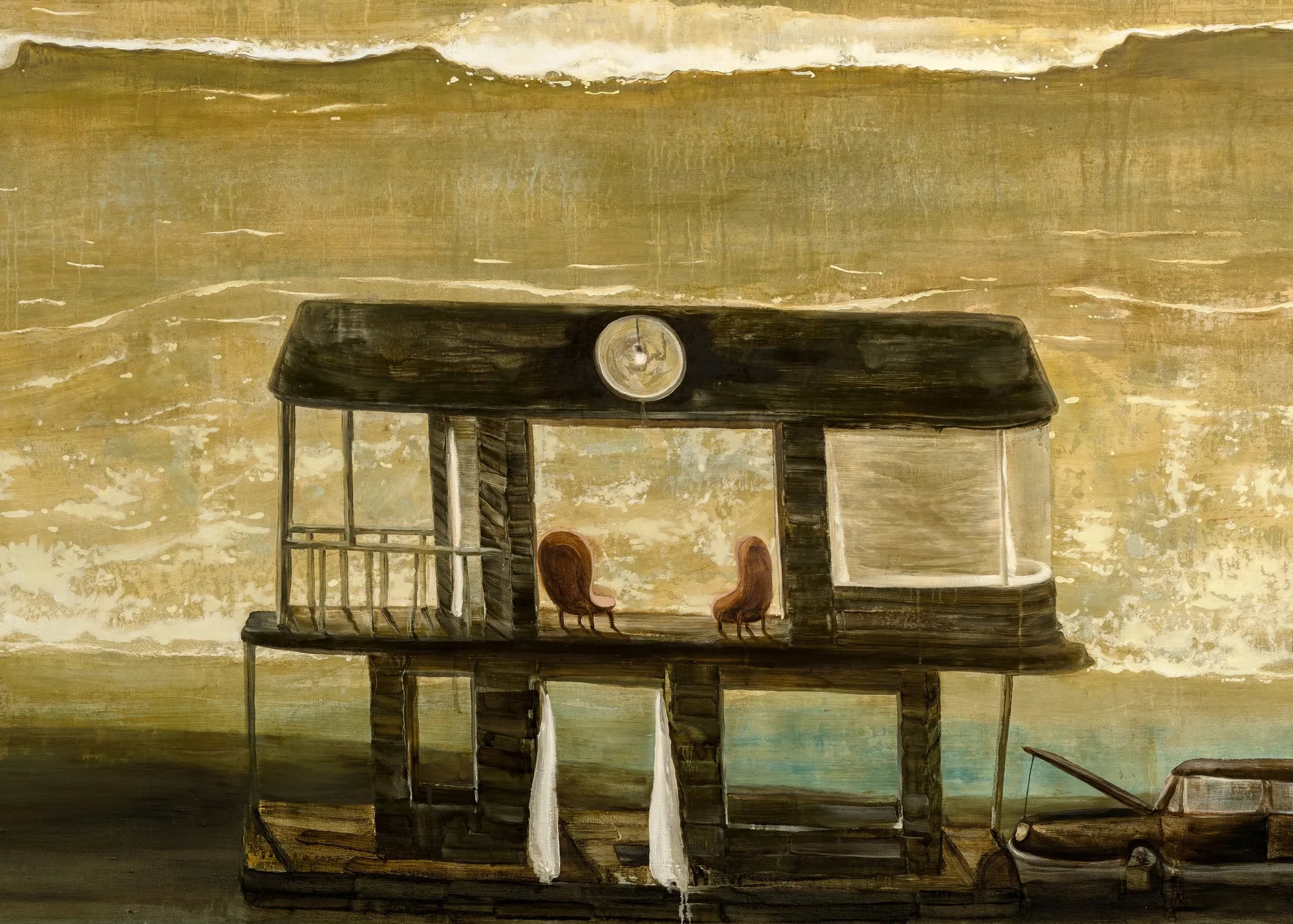
Matthias Franz: die dünne Haut der Zivilisation
Matthias Franz

GRIMM - NY
54 White St, New York, NY 10013
Tue-Sat 11am-6pm
Admission
Free Admission
About
GRIMM is pleased to announce _die dünne Haut der_ _Zivilisation_, a solo exhibition of new works by German artist Matthias Franz (b. 1984, Ilmenau, DE) on view at the New York gallery from September 9 – October 31, 2026. In these new works, Matthias Franz returns to nostalgia as a means of storytelling. With _die dünne Haut der Zivilisation,_ Franz gestures towards the ways and means by which nostalgia – contained within our understanding of the past - might be rendered as a way of comprehending our present. The exhibition title, which translates to _'the thin skin of civilization',_ points to Franz's investigation into the principles and ideals behind civilized society. Drawing upon various literary and textual sources, he uses painting as a tool to visualize and question the world around us. Ambiguous landscapes and enigmatic interiors feature in many of Franz's paintings. They are scenes, unstated, where subjects contest for focus. Within these uncanny spaces, figures we would often see in normal civilized environments are displaced, drifting across vast succumbing oceans or situated amongst mysterious jungle foliage. In _die Aufklärung_, cloaked figures are depicted floating on a yellow ocean; hues of turquoise and burnt umber patinate the canvas, as they clutch hold of lights guiding their way in a multitude of directions. In the center, above an archaic-looking passenger boat, a hovering figure dressed in a Napoleonic uniform salutes upwards, levitating in the air as if suspended in some kind of cosmic veneration. The title, which translates as _'Enlightenment'_, stands in tension with the autocratic figure who embodies military expansion. Through this paradox, Franz alludes to the power dynamics that have shaped the past and suggests a broader sense of societal disenchantment that remains unsettlingly relevant today. Vestiges of the past continue to populate Franz's works. _Luddite Kids Club_ depicts a dominant architectural tower or viewing platform that loosely takes the form of an abandoned bandstand. Onlooking children gaze upwards at an uninhabited platform crowded with instruments. Referencing the Luddite movement, a 19th-century rebellion of English textile workers who protested against the Industrial Revolution, Franz disputes the common misconceptions of the workers who were believed to be opposed to all technological progress. The Luddites rather endorsed technological progress and objected to the government's exploitation of skilled labor. In the painting, the tower appears to be space for communal gathering, creation or performance, and yet is abandoned and inaccessible, hinting at a larger inscrutable tension between humanity and technological progression. Here, Franz prompts us to question the linearity between past and present, reflecting the continuing artistic struggle for creative autonomy. For Franz, paintings act as portals, opening up the space to connect things, whilst questioning what we already know. In _Hamlet_, a typewriter perched upon a table with a piece of paper flopping comically over the top alludes to questions of creative authorship. A reference to the famous 16th-century play written by English playwright William Shakespeare, Franz selects his most feigned and mad character, Hamlet, brandishing his name as an apparent logo on the typewriter. Fraught with revenge, Hamlet's perceived madness gave him a free rein to speak truths that would be otherwise heavily scrutinized were he visibly sane. In a comical play on this, the almost broken typewriter embellished with the name of Hamlet illustrates how truths can emerge in madness and visual translation, generally speaking, as both a creative and literary process, inevitably distorts meanings. The question that arises, then, is how painting can serve as a means of generating a relational search for that which connects seemingly disparate things. Franz's paintings thrive on the collision of opposing motifs and emotional states, distinguished by their ability to propel us back and forth between past and present, and into a surreal dreamscape where nothing is ever quite as it seems.