Spotlight: Ryan Mrozowski
Ryan Mrozowski, Courtenay Finn

FLAG Art Foundation
545 W 25th St #9, New York, NY 10001
Wed-Sat 11am-5pm, Summer (Jul-Aug) Tue-Fri 11am-5pm
Admission
Free Admission
About
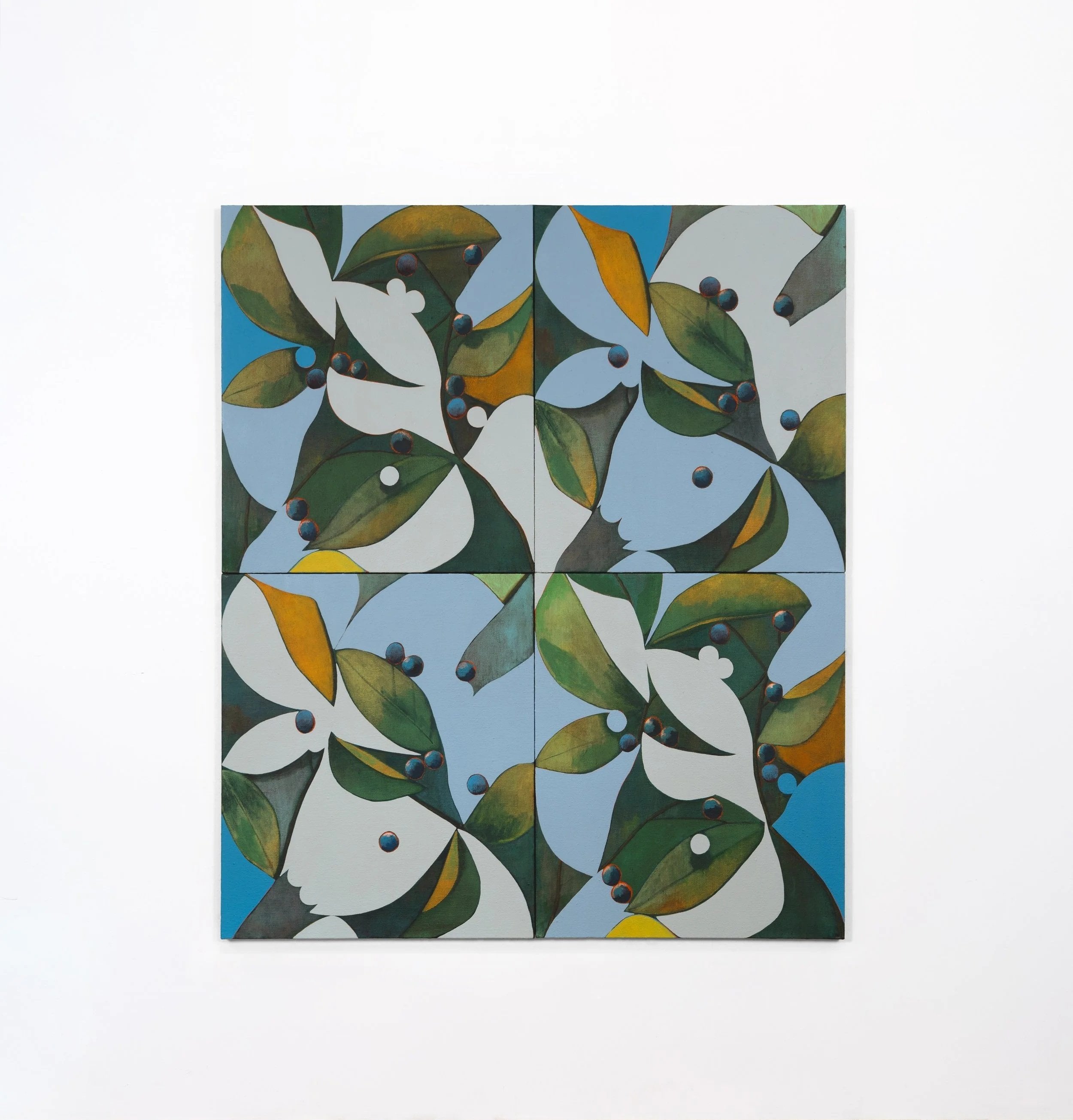
The Spotlight series includes a new or never-before-exhibited artwork paired with a commissioned piece of writing, creating focused and thoughtful conversations between the visual arts and authors, critics, poets, peers, scholars, and beyond. In this iteration, the Spotlight features Ryan Mrozowski's Untitled (Split Quartet), 2026. A text by curator Courtenay Finn accompanies the presentation. Fourfold: A Quartet for Ryan Mrozowski By Courtenay Finn Performers: Mark Rothko, Beethoven via the Hagen Quartet, T.S. Eliot, and the 2026 World Cup A Quartet 1. a musical composition for four instruments or voices 2. : a group or set of four Especially: the performers of a quartet Fourfold. Four dance moves, choreographies through time and space. Four ways to pose the question, what does it mean to stay attuned to a pluralistic world? Four propositions for a painting. I: Cynosure A painting as a cynosure. Can a painting be a north star, a center of attraction or attention, and can this be a form of navigation? A guide of sorts? If in the past the philosopher was the one who operated as our mediator, interpreter, and arbiter, can this role today be occupied by a painting? Imagine a conversation between four Mark Rothko paintings. Untitled (1957), which resides currently at the Menil Collection in Houston, the canvas full of bright and deep reds, blocks of color that sway, vibrating like a story stumbling excitedly out of one's mouth. White Center (1957), whose home is the Los Angeles County Museum of Art, a composition of washy reds and oranges, fading in and out of the light, a center band of white holding the flow of conversation steady. No.73 (1952) at the High Museum in Atlanta, a bar of expressive yellow radiating above an orange ground, a purple band pushing forward, edging in with questions, asking for more details. And last, but by no means, least, No. 37/No. 19 (Slate Blue and Brown on Plum) (1958), who holds court at the Museum of Modern Art in New York, a serious muted set of burgundy, grey and brown, holding the conversation to task, reminding us of the weight of language. Four paintings in four distinct locations, a conversation in and out of form. A conversation in and out of time. Painting is nothing if not a language. II: Collective Effervescence During his lifetime, acclaimed composer Ludwig van Beethoven wrote 16 string quartets. The Hagen Quartet's interpretation of Beethoven's String Quartet No.14 in C-sharp Minor, Op. 131 starts softly, but with a firm presence. It builds, tenderly declarative, knowing the weight of the journey it embarks upon—like a solitary figure returning home from the end of the world. Built from divergent harmonic directions and vastly different time scales within each, the composition leaves itself open to experimental interpretation, inviting musicians in, asking for it to be completed together, built upon, expanded outward. Upon hearing String Quartet No.14 in C-sharp Minor, Op. 131 performed for the first time, composer Franz Schubert apparently exclaimed, "After this, what is left for us to write?" The Hagen Quartet began as siblings; the four children of Austrian violist Oskar Hagen, growing up and playing music together. The ensemble, now 43 years later, continues as three siblings and a friend. They communicate through their instruments. Two violins, one viola, and one cello. Extensions of their body that overcome language. Distinct individual expressions that come together as an ensemble, forging something unique in their togetherness. What does it mean to assemble, to be an ensemble? What does it mean to be part of a larger whole? The great Brazilian soccer player Pelé popularized the phrase "the beautiful game" to capture not just the beauty inherent in the game's athleticism, but the synergy, spirit, and collective harmony that the sport creates. A stadium becomes a collective dancing body. We erupt in cheer, cry and sing alongside strangers, jumping up and down as if our momentum could impact what happens on the field. A sense of electricity, of magical thinking, our emotions entangled with countless others, a shared experience—collective effervescence. As North America hosts the 2026 World Cup, we have a country playing for the first time (Cape Verde), a country returning after 53 years (DR Congo), and a team battling on and off the field with the weight of war and politics (Iran). In a world of collapsing systems, of perpetual violence, of fragmentation and othering, the longing to feel part of a greater whole persists. We still seek the company of others. III: Stillness as the move In "East Coker" the second of his acclaimed Four Quartets, poet T.S. Eliot writes, "so the darkness shall be the light, and the stillness the dancing." Stillness as a movement. In our current moment, one saturated and defined by an endless scroll of images, what does it mean to make a painting? To produce a still image? In a time of darkness, can a painting, like a poem, help reframe the shadow as a space for brilliance? Published over a six-year period during World War II, Eliot's Four Quartets operate like an echo. The four poems are collectively about a culture, and a world, under severe threat. Eliot's intentional use of repetition, his insistence that we relook and revisit, is his call to remember. It is this echo that grounds the poem beyond the singular, weaving together a shared experience to create an ensemble of memories—not just me, not just you, but us together. At the end of "East Coker" Eliot writes, "Love is most nearly itself When here and now cease to matter. Old men ought to be explorers Here and there does not matter We must be still and still moving Into another intensity For a further union, a deeper communion" Be still and still moving. IV: Assembly Perhaps we are just waiting. Waiting silently. Embracing both the silence and stillness, by which I mean, reminding ourselves that things take time. Sometime perhaps, time is the only cure. "Silence is so accurate," Rothko once wrote in his notebook. Silence, after all, need not be an absence, but rather a presence of something beyond the weight of words. A different space of communion. A painting can show us who we are, what we can be, and what we might offer to one another, especially at moments when we think there is nothing left to give. It can spill outward from the canvas into the world, holding court as a memory, as a moment, or as a north star. It waits for us—the audience after all, is part of the assembly, part of the ensemble—reminding us that a still image is itself also a living picture of time.