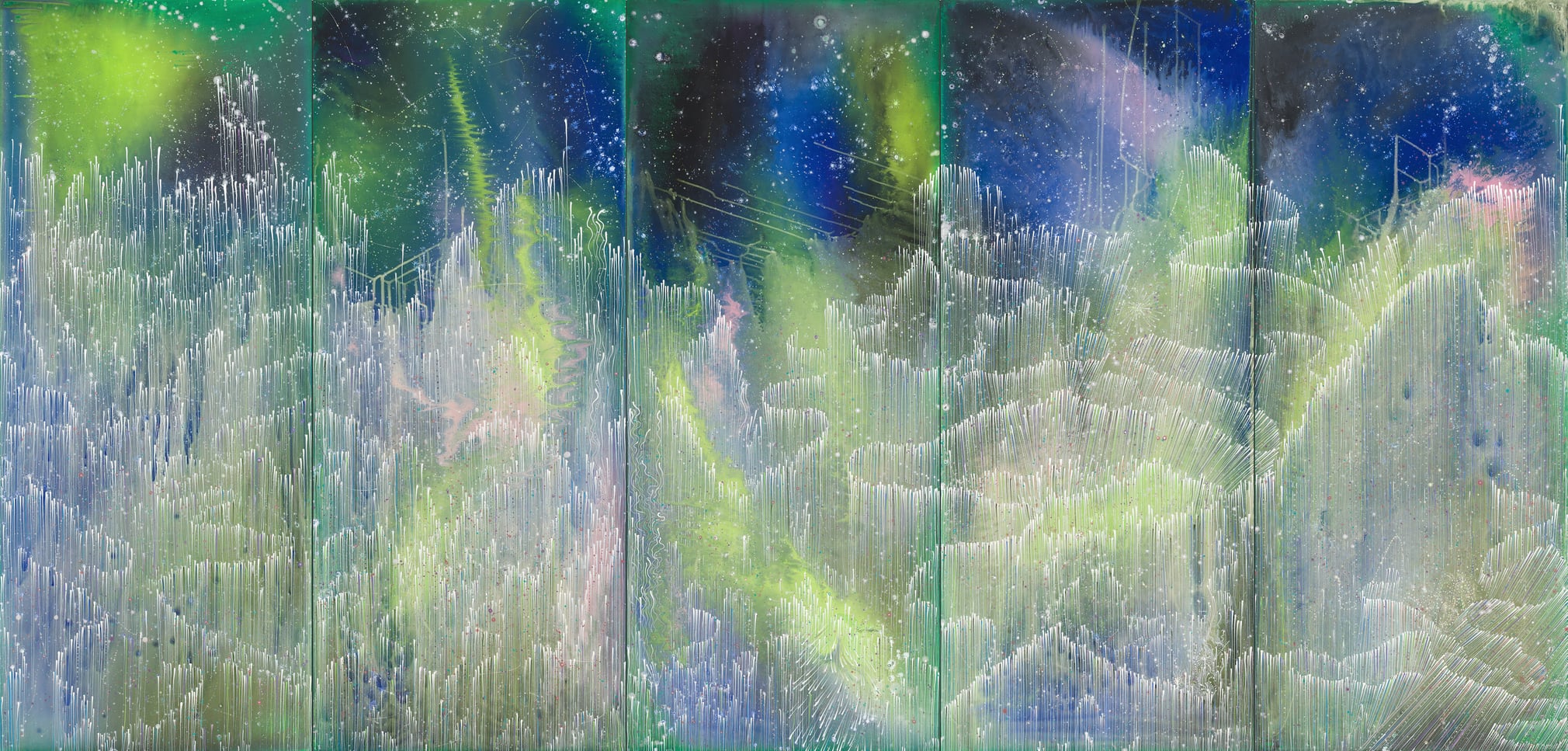
Barbara Takenaga: Parallax
Barbara Takenaga

DC Moore Gallery
535 W 22nd St 2nd Floor, New York, NY 10011
Tue-Sat 10am-6pm
Admission
Free Admission
Commercial gallery - no admission fee stated
About
Barbara Takenaga: Parallax takes its title from the parallax effect–– the displacement of an object as seen from two points, particularly in astronomy or optics where the location of an object appears to shift based on different positions. This concept carries throughout the work as Takenaga navigates a visual ambiguity, images that can appear differently based on the viewer's perspective. Barbara Takenaga has developed an open-ended painting process that merges meticulous structure with chance operations, resulting in carefully constructed compositions that can be read as cosmic views, imagined landscapes, or microscopic organisms. In this exhibition, Takenaga opens portals oscillating between fluidity and stillness, flatness and deep space, familiar and unknown beings. Incorporating a new color palette and visual language, the works evoke a unique musicality, with melodic sweeps and jangling bursts of color. In earlier paintings, Takenaga determined her compositional structure through the process of a paint pour, allowing the physical forces of gravity to create patterns as the paint settled. In her recent work, Takenaga locates this structure by manipulating external sources, reducing images to formal terms and recontextualizing them within explosive paint pours and brushwork. Many of the new paintings feature an exuberant color palette, bringing forth surprising harmonies and juxtapositions. Over celestial or fiery backgrounds, Takenaga articulates bright ribbons of neon green, turquoise, hot pink, and violet. A web of bright red lines contains these bursting forms, imposing a kind of order. These shapes are derived from images of mushrooms at the farmer's market or kimonos in Japanese woodblock prints, which Takenaga rotates, mirrors, and distorts into her own abstracted systems. Takenaga plays with the idea of seriality in several diptychs and triptychs, repeating an outlined structure of forms with varied color, paint pours, and brushwork, the central image shifting with these alterations.