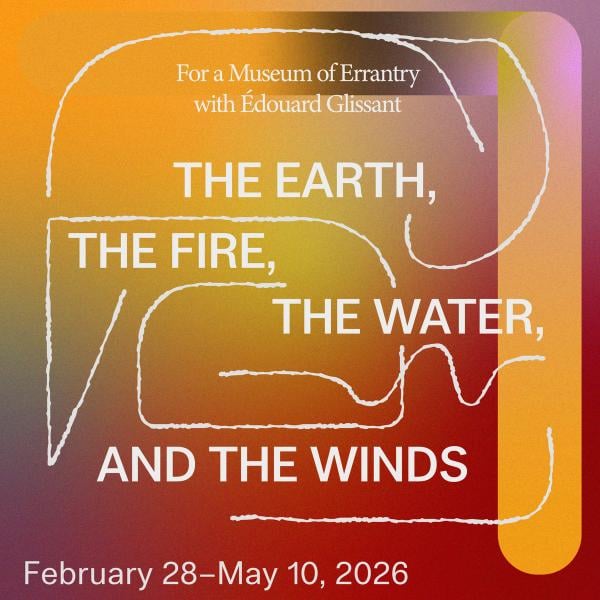
The Earth, the Fire, the Water, and the Winds: For a Museum of Errantry with Édouard Glissant
Victor Anicet, Victor Brauner, Ernest Breleur, Agustín Cárdenas, Gerardo Chávez, Manthia Diawara, Melvin Edwards, M. Emile, Öyvind Fahlström, José Gamarra, Sylvie Séma Glissant, Serge Hélénon, Wifredo Lam, Roberto Matta, Paul Mayer, Gabriela Morawetz, Irving Petlin, Cesare Peverelli, Pancho Quilici, Antonio Seguí, Eduardo Zamora, Enrique Zañartu

Center for Art, Research and Alliances
225 W 13th St, New York, NY 10011
Wed-Sat 11am-6pm, Sun 12pm-6pm
Admission
Free Admission
Free and Open to the Public
About
This spring, CARA presents The Earth, the Fire, the Water, and the Winds: For a Museum of Errantry with Édouard Glissant —the first US exhibition of the Martinican poet and philosopher Édouard Glissant's (1928–2011) personal art collection . Traveling from Instituto Tomie Ohtake in São Paulo, Brazil, The Earth, the Fire, the Water, and the Winds reveals a lesser-known dimension of Glissant's life: his vision for a museum. He conceived of it not as a monument, but as a space capable of holding art, memories, and intertwined histories without reducing them to colonial frameworks. Errantry, central to Glissant's thinking and this vision for a museum, is movement, encounter, and reinvention. It unfolds through the crossing of borders—geographic, linguistic, and historic—and resists the pull toward singular origins or stories. Glissant imagined both the world and the museum as an archipelago: a constellation of islands that live side by side, exchanging while remaining distinct. Assembled across six decades, Glissant's personal art collection traces both the beginnings of this museum and the breadth of his intellectual friendships and collaborations. In post-occupation France, particularly through the Surrealist scene and Galerie du Dragon (1955–1995), Glissant encountered artists from Africa, Europe, and the Americas who approached art as a journey of displacement, renewal, and solidarity. He gathered these works not for ownership, but in the spirit of the commons, imagining them as the beginnings of a living archive attentive to relation and difference.