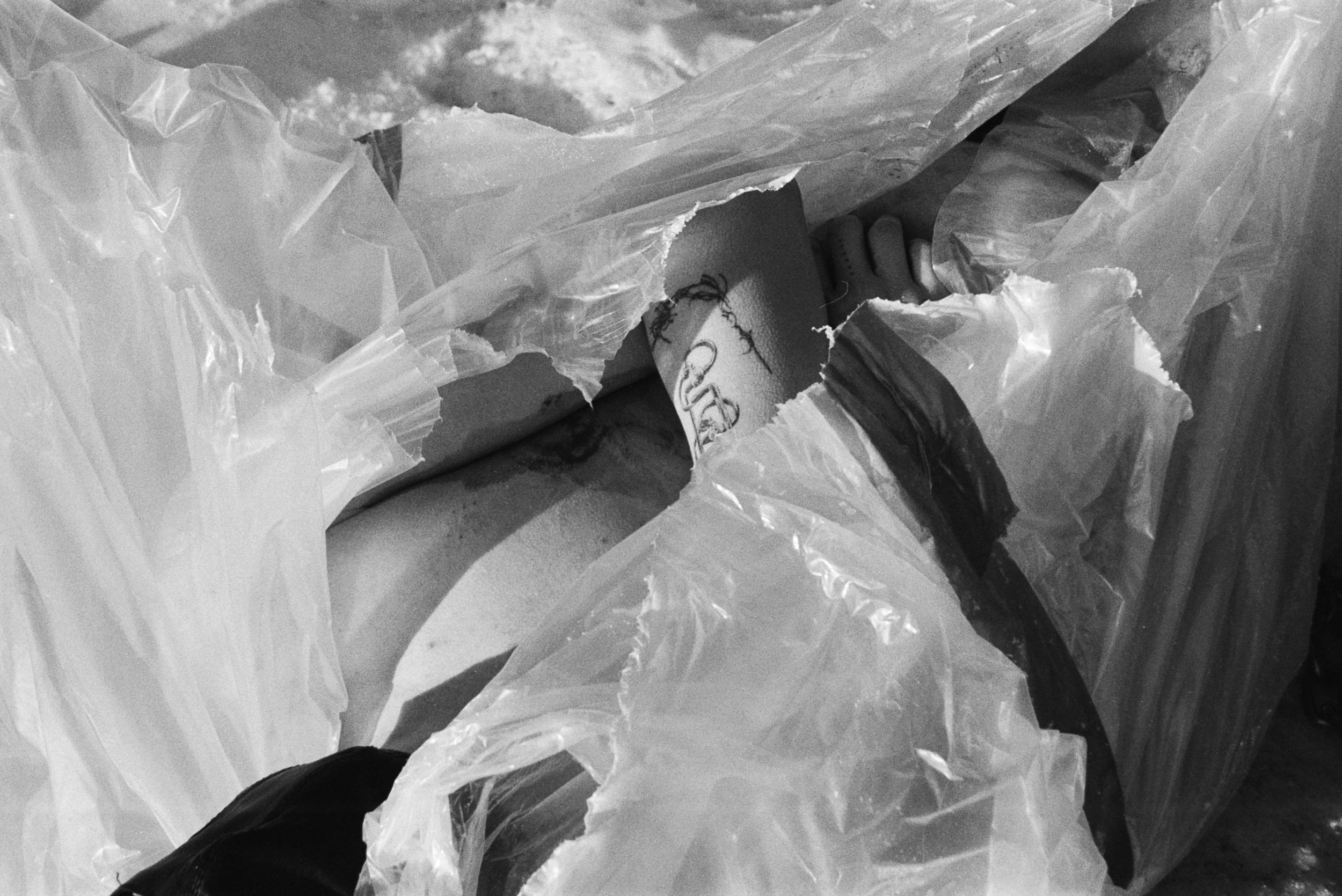
between the skin and flesh, a thing
Mae Howard

A.I.R. Gallery
155 Plymouth St, Brooklyn, NY 11201
Wed–Sun 12–6pm
Admission
Free Admission
About
In Mae Howard's inaugural solo show, the objects on display invite visitors to consider: How can ritualized pain and pleasure, reckoning with hauntological skin and flesh stories, offer a means of interdependent relation? Working with a collective of leather practitioners for over five years, Howard exhibits a series of hides printed with photographs documenting BDSM scenes in which they are both subject and co-author, keeping at the center the collaborative processes that produced the stills. These relational authorships reshape notions of kin and interdependence. Wielding sutures and scalpels—instruments repurposed from medical contexts—collaborators M. Celeste, Fluent, and Jess Dayan move in and out of the images as gloved hands, strict boots, and as architects of the predicaments that contain Howard's form. Tops take turns behind the camera; photographers and present witnesses Gabriella N. Báez and blue are active contributors to the ritual interventions that challenge and reshape Howard's flesh and spirit. Refuting the idea of individual authorship, Howard offers their body and the stewardship of it as an intermutual project, seemingly saying: this body is all of ours, we share in its responsibility. Though inescapably corporeal, the images in the exhibition call to mind a construction project that contends lovingly with the surrounding terrain: something of the earth, emerging as part and parcel of the elements. A chain drapes over knees mottled by river gravel; snow covers the ground beneath a sheathed form. Rather than becoming a gory encasement, a plastic tarp is torn open with precision, as if something precious is packaged inside. The scenes are a burial and erection all at once, building a body that eschews monumentality in favor of slipperiness and shadow. If the distant horizon offers a perceptual limit, the blurred closeness of the body provides a limitlessness. More alive than mere surface, the leather hides bear evidence of reanimation, taking on pigment and fluid through the photographic printing process, which leaves a veined texture across the grain of leather as if the image were subcutaneously injected. The medical tools used in the documented scenes haunt the final images even as they evade being pictured in them, confronting us with the cuts and impressions they've left. In the exhibition space, a leather scent formulated by agustine zegers thickens the room with a heady miasma, an air that threatens to infect visitors by transgressing their bounded bodies as they breathe. In medical contexts, one is often asked to describe their experience along a pain scale, measuring discomfort on a scale of one to ten. Howard's disabled erotics refuses the reduction of pain to a unit of measurement, maintaining the immeasurable body as a site of ecstatic belonging both despite and because of pain experience. Here is a care that subverts our ideas of softness and healing, and a process of transformation that exceeds quantifiable midpoints or palatable milestones. Instead, Howard and their collaborators offer catharsis that is at once bloody, trembling, and durational, bound in a tended relational system. -Tamara Santibañez