Toda coisa que vive é um relâmpago
Ana Prata

Travesía Cuatro
C. de San Mateo, 16, CA 28004
Tue-Fri 11:00-19:00, Sat 11:00-14:30
Admission
Free Admission
About
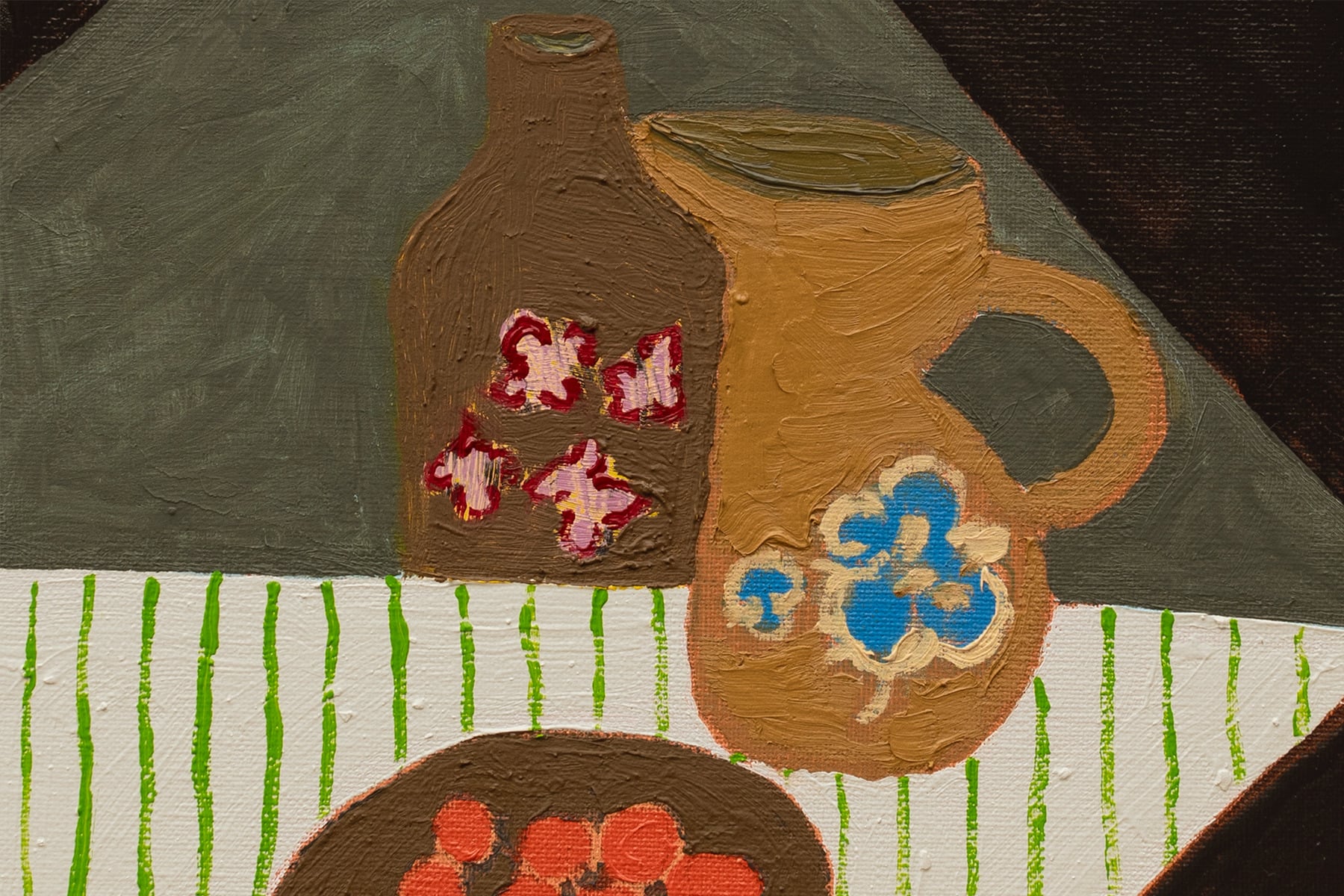
As Ana Prata's practice has developed, it has grown ever more puzzled, curious about the idea of space and its pictorial intricacies—the potential of unusual spatial relationships that modernism blew wide open and that to this day remains fertile ground. This is what seemingly guides her obstinacy around the genre of natures mortes, which enact the tensions of objects behaving, inhabiting, but also distorting and transforming space: What can an arrangement of objects show us about pictorial space and its infinite possibilities? The recurrence of the still-life, for Prata, offers an extremely rich grid to showcase the answers to that question, and thus she keeps the rest of it quite simple: it is color and texture who lead the way—and that might just be Prata's signature, in a long-standing practice that is known for containing multitudes. Variety is laser-focused on transformation: of the objects within it, and of the space that contains them inside and outside the bounds of her (often non-traditional) canvases. The genre of natures mortes also feels quite accessible, most of us can think of at least one or two examples of them. To Prata, that is part of their charm, of their allure, they invite us into domesticity, into recognizable experiences with art and with the well-worn knowledge of the objects around us. We imagine the intimate life of a painter: Giorgio Morandi, economically delineating the same pretty bottle over and over, or Eleonore Koch arranging and re-arranging vases and flowers. But Prata's versions play a little trick on our expectations, she paints from memory and experience, of course, but her objects are not observed nor handpicked from her immediate surroundings, they are all grabbed from different moments of art history. The domesticity depicted in her works is not the result of a lived-in relation to her tables, vases, flowers and fruits, in fact, they were all 'stolen'—although taken from such extremely famous past painters that the act produces no guilt in Prata, she wants the viewer to feel a glimmer of recognition, of identification. They are also not meant to be direct quotes or burdensome references, she just wanted to grab at those images, as if real objects, to try them, to figure out the spell they cast on her: a healthy mix of 'let me figure it out', of good-spirited envy, and the firm belief, that in art, as in culture everything is social and has always had a previous touching point. No feeling, affect or image of it, no matter how intimate it feels, belongs exclusively to us. Prata thus realizes that all painting is always in dialog with all the painting that came before and that new forms are built in relation to what others previously did, plus a generous sprinkling of one's experience. Her work feels egalitarian in that way and also in its being broadly welcoming to its audience, almost yearning for a meaningful encounter. But it is also egalitarian within itself: in her equally restless and playful arrangements of space, Prata is careful that symbol, color and brush stroke are always in an even-handed, equitable relation with one another, each one as essential to the final result—to the interaction with the viewer—as are the others. This enactment of space, of testing its possibilities in relation to painting, is also reflected in the gallery space. The way Prata works is not by chasing after deadlines or the completeness of a specific body of work, but through the quotidian labor of painting out of which entire families of related works organically emerge. The way she tells it, once an exhibition appears in the horizon, they start to come together through their coincidences and divergences in terms of color, size, composition and feel, a very formal affinity that is not yet linked to the conceptual. What works in the studio doesn't necessarily work at the gallery and as the pieces seem to assert themselves and their agency in space, they tend to re-organize. In a way, they are always doing exactly that: Prata paints several of them simultaneously. All of them vying for her time, each one different, connected to the rest but entirely singular. She cycles through them, once one of them is exhausted, she gives it time to replenish and moves on to another one. This gives Prata's work a sense of spontaneity, an unmistakable liveliness that comes from the fact that she doesn't push through the struggle. She knows well that everything that happens in the workshop will show up on the surfaces, and to her an overworked painting is as bad as overworked dough. So she stays nimble, moving on and repositioning herself, re-kindling her relation with her paintings as if seeing them for the first time, in an intuitive process that continuously breathes oxygen into all of them, as she thinks and works on one, the solution that another one called for will also come into view. Because of that process, Prata's paintings allow themselves to be seen as material experiments, as presences more than ideas, bodies to interact with more than they are images. They are corporeal, textured, tactile. Their embodiment is somewhat shared, co-formed, co-incarnated by the viewer: they are animated by their wonderment, their wondering, 'how did paint, brush and material collaborate in order to become this?' In that sense, Prata's paintings reject the image-form—with its backlit flatness and scroll-by readiness—, they demand instead in-person attention. They ask to be seen in the flesh, offering themselves as a surprise. After all, how can a nature morte even exist without human presence: their attempt at order, their fruits and blossoms are there to remind us about our own finitude, the advent of entropy and the fate that unites us all. They offer a chance to ponder our being in the world. In Prata's work, however, 'lives' are never too 'still', nature not quite dead. As she describes it: "like a lightning illuminating what appears to be still or inert, and briefly but surely animating it, that's the kind of still lives I make".