Aloges
Laia Estruch

Travesía Cuatro
Travesía Cuatro CDMX Calle de Valladolid 35, Roma Norte, CDMX 06700
Tue-Fri 11:00-19:00, Sat 11:00-14:30
Admission
Free Admission
Commercial gallery, no explicit admission fee mentioned.
About
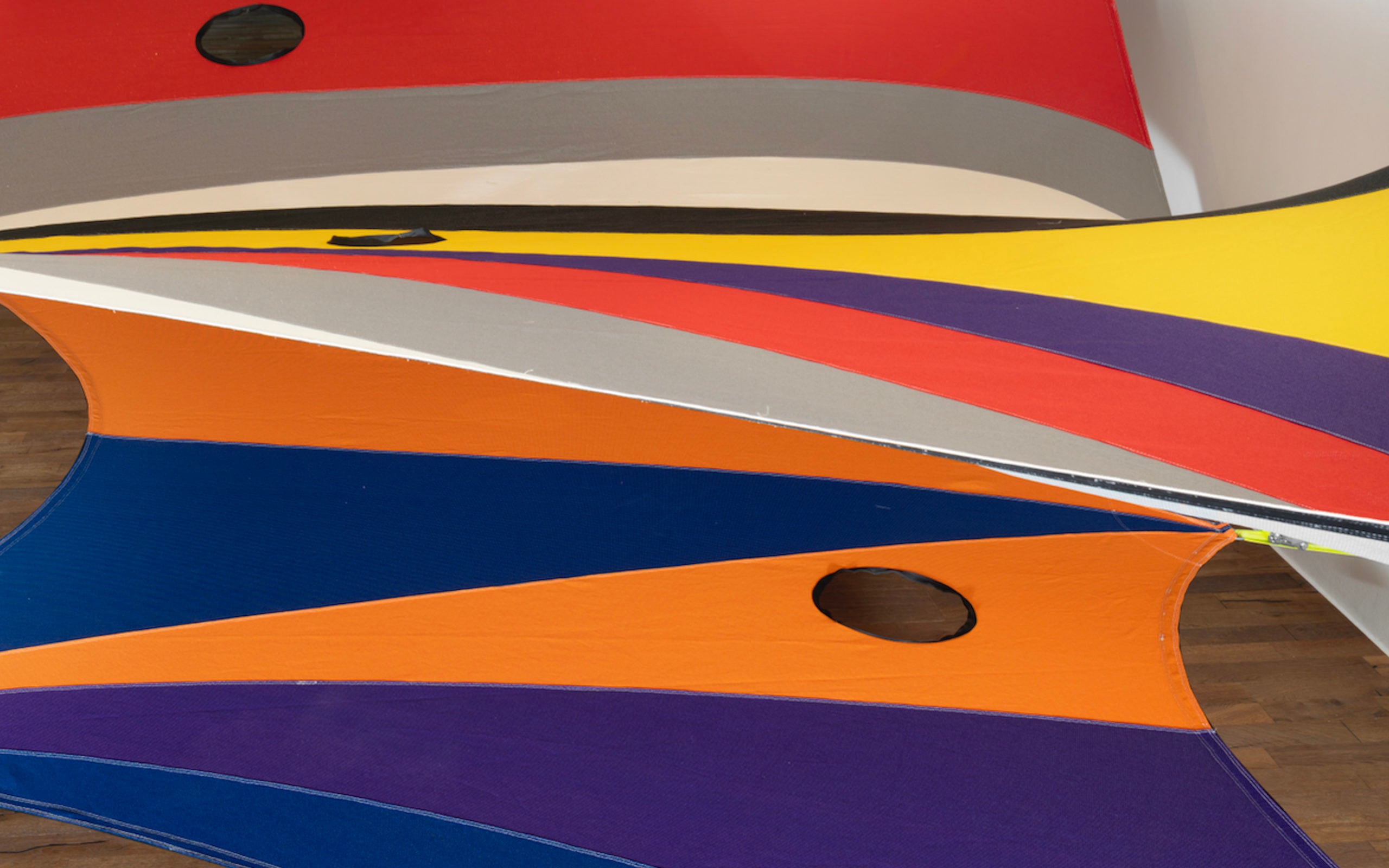
In Catalan mythological tradition, the aloges — water women — are beings that inhabit the thresholds of the physical world, among wells, rivers, and various bodies of water. Their ethereal bodies sway across reflective surfaces and vanish into the currents just as someone believes they have caught a glimpse of them. Almost imperceptible in form, their presence is felt more as a tantalizing echo, a song, or a vertiginous movement. The liminal space inhabited by the aloges , that temporary and liquid boundary between the mythical and the symbolic or between the physical and the real, is the very same space that gives meaning to the practice of Laia Estruch (Barcelona, 1981). In her performative and sculptural research, the artist uses her body as a vehicle to connect the natural world with the spiritual world, examining the sculptural potential of sound while creating surfaces that allow her to understand the relationship with material space from different perspectives. Body, voice, and sculpture are the three elements activated in an unrepeatable way in each performance: ritual spaces in which Estruch takes a liquid yet conscious form, fully aware of her movement through the place. From her body, a series of gestures emanate, transforming into sound, an intangible and ephemeral substance arising from her vocal tract—the space inhabited by an unlit archive from which fragments of animal, human, aquatic, or any other imaginable voice can be intuitively drawn—pushing her bodily capacity to its limits in order to discover new auditory horizons, to the point of a scream or thunder. The artist takes the voice and transforms it into a plastic medium, intangible in the air yet, rich in textures and tonal nuances. In Aloges, the latent presence of movement and sound is ever-present: they traverse the gallery, taking on different tones and forms. Estruch seeks to capture the soundscape created by the wind — what the air proclaims — in works such as Kite 5 (2022), a pair of multicolored textile panels. Thus, the voice is transformed not only into sound, but into a claim upon space. From the outside, the gallery acquires a striking presence through the artist’s work: one of the two panels that constitutes Kite 5 dominates the façade through color, foreshadowing that something atypical is about to happen inside the space. The second panel closes the temporal parenthesis created between the two parts of the piece, taking over the courtyard and ultimately painting the surroundings in iridescent shadows. Within the gallery space, the correlation between sculptural form, anatomical body, and the archive expands and releases itself into other pursuits — whether in Laia’s performative acts or in the material quality of the monumental tongues of plastic canvas that inhabit the architectural space with their own currents: those of time and of possibility. The colored modules used to assemble the tongues accentuate their material quality, and in some of them images from Estruch’s artistic career are revealed, encouraging us to rethink words, language song, speech, and the relationship we build with nature, while reconnecting us with the oral and musical tradition of the peasant communities along coasts of Catalonia and the Balearic Islands. The scenic space generated by this series of soft bodies also fosters the discovery of new phonetics found in the relationship between sculpture and body, transforming the malleable material into an instrument. However, the stage is not merely a space for action, but also for documentation: the sculptures serve both as the physical archive of the performance that takes place there and as the potential archive of the actions and reflections that the object might, at another time, trigger. Thus, the synthesis of the artist’s bodily movements, the ephemeral nature of her actions, and the physical sculptures that lie within the gallery are, as Estruch calls them, open-ended experiments. Every sound that emanates from her throat or mouth in a primal impulse, every atypical movement of her body, and every intervention in the space through sculpture becomes an incentive to the audience to question the logical systems in which we live. The aloges sing, provoke, disappear. Laia’s audible and material structures sing, provoke the audience to understand active listening and material possibilities from other latitudes, and ultimately disappear. Both seem to belong to an intermediate realm, in which not everything is apprehensible, yet they serve as catalysts for reflections on how to understand space and its boundaries. – Valeria Flores López–Araiza * The artistic practice of Laia Estruch (Barcelona, 1981) delves into the language of the body and the voice, on the threshold between sculpture and performance. The artist understands the voice as an extension of the body, an instrument to develop her project sand synthesize issues related to language, speech, gender or social structures. In her most recent work, the artist has investigated how urban spaces and their physical structures play an important role in everyday life. Using the ‘spoken word’, songs, objects and publications, her projects analyse the emotive possibilities of the a cappella voice and the undramatized body, opening a space of reflection in relation to the performative character of language, sound recording and its oral archive. She studied Fine Arts at Universitat de Barcelona and The Cooper Union University in New York (2010). Her work has been shown at Reina Sofía Museum (2025); Galería Ehrhardt Flórez, Madrid (2026, 2024, 2022, 2021); Travesía Cuatro GDL, México (2024); Tabakalera, Donostia (2024); Terrassa (2024); Triënnale Kortrijk, Bélgica (2024); MNAC, Barcelona (2024); Centro Cultural Conde Duque, Madrid (2023); Casal Solleric de Palma, Mallorca (2023); Hauser & Wirth, Menorca (2023); TEA, Tenerife (2023); MACBA, Barcelona (2023); Fundación Joan Brossa, Barcelona (2020/21), La Virreina Centre de la imatge, Barcelona (2020), Festival Grec / Creació i Museus (2020), Festival Poesia i + a Caldes d’Estrac (2020), Festival Sâlmon de Barcelona (2020), Museu de Valls, Tarragona, Spain (2019); Fundación Joan Miró, Espai13, Barcelona (2019), CentroCentro, Madrid (2019), Fundación Botín, Córdoba (2018), Museo Picasso, Barcelona (2018), CA2M, Madrid (2017), Chapelle des Beaux-Arts, Paris (2017), Antic Teatre, Barcelona (2016), Teatro Pradillo, Madrid (2016), Centro Párraga, Murcia (2016), Fundación Antoni Tàpies, Barcelona (2014) or MACBA, Barcelona (2012), among others. She lives and works in Barcelona.