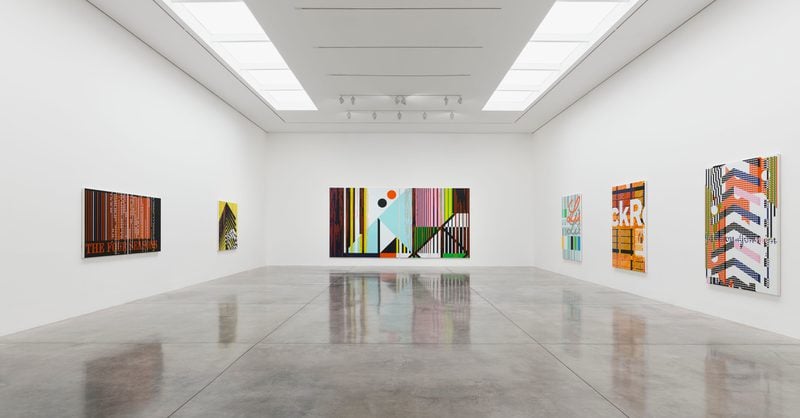
Sarah Morris, Mason's Yard (2026)
Sarah Morris

White Cube Mason's Yard
25-26 Masons Yard, London SW1Y 6BU, UK SW1Y 6BU
Wed-Thu 10am-6pm, Fri-Sun Closed, Mon-Tue Closed
Admission
Free Admission
About
Since the start of her practice, Sarah Morris has examined the infrastructures, networks and formations that condition the contemporary landscape, developing serial, diagrammatic matrices that distil and index the systems of power in which we are implicated. In 'Snow Leopards and Skyscrapers', the artist's new series of paintings takes the corporate entities of multinational conglomerates as its point of departure: pharmaceutical corporations, data analytics firms and transnational financial institutions – simultaneously abstracting and representing the elusive powers that preside over, project and regulate the present moment. Alongside the paintings, two film works, Midtown (1998) and Chris Rock (2025), frame Morris's earliest and most recent engagements with the medium, articulating her preoccupations with the architectures, subjectivities and atmospheres that these systems manifest. Conceived and filmed in 1998, at the outset of what now spans 30 years of collaboration between the gallery and Morris, the artist's debut film Midtown , first shown at Museum Ludwig in Cologne, unfolds as an immersive and fragmentary depiction of Midtown Manhattan. Shot over the course of a single day, the film maps the coordinates surrounding the artist's first studio on 42nd Street – a corridor that sits wedged between the vertiginous ranks of Midtown's corporate towers, the lingering marquees of its infamous pre-digital pornography hub, and the relentless, hyper-illuminated address of Times Square. Morris's films are all set to a unique score by Liam Gillick, composed independently of the image with modular units and later placed alongside the footage. Driven by an insistent tempo, Midtown lingers on surfaces, lights and anonymous passers-by, coalescing into something of a visual manifesto for the artist. Drawing on the same index that informed Morris's early series of 'Midtown' paintings (1998–2001), the film cuts between light-flooded billboards, the imposing facades of JPMorgan Chase, Revlon, Viacom, the Seagram Building and Lever House, and the steady stream of people on the street – 'characters' who, under the camera's gaze, become momentarily legible as they pass through the frame. Described by the artist in 1999 as a 'condensed manifesto' of both her work to date and future productions, the film consolidates many of Morris's enduring concerns, foregrounding her unique methodology of non-linear assemblage: of situations and places as they exist in time. As Morris remarked, 'I compile a fragmented view of the urban world. Not the aesthetic of high modernism, but the fragmentary experience that results'. Her paintings claim no singular orientation or straightforward fidelity to the subjects their titles identify: Black Rock (2025), The Four Seasons (2026), Johnson & Johnson (2025), Palantir (2026), JP Morgan (2025). In their precise geometric configurations and hyper-saturated palettes, they extend the Capitalist Realism associated with Gerhard Richter, as well as the work of Andy Warhol and Donald Judd, artists with whom Morris has long felt an aesthetic and conceptual affinity. Much as Warhol interrogated the commodity form through repetition and serial display, in Morris's practice each series generates the next to form a self-reflexive network that echoes the self-perpetuating visual economies of corporate branding, institutional architecture and commercial display. Throughout her paintings, Morris has remained committed to readymade gloss paint as her primary medium: a choice that serves to underscore the objective gesture of the commercial form. The finished surfaces are accordingly sleek, uniform and seemingly machinic in their appearance, their meticulous sequencing of dots, dashes, shards and parallelograms reinforcing an impression of mechanical reproduction, commercial manufacture and language itself. This apparent immediacy nevertheless belies the truth of the labour embedded within each work, which are in fact the outcome of the artist's slow, exacting and rigorous production. In this respect, Morris's paintings recall, too, Francis Picabia and his wry mobilisation of the machine as a form of portraiture. Where, in Picabia's work, mechanical diagrams served as unlikely proxies for human character, Morris adopts a comparable strategy. Her paintings are not portraits of institutions as such, but of the networks and ideologies they represent. Playing a form of monopoly with her paintings, Morris introduces a subtle inversion of power, contending with and 'avatarising' structures long coded as male. It is within this framework that the artist situates her practice alongside a broader lineage of institutional critique associated with artists such as Hans Haacke. Morris's most recent film, Chris Rock (2025), offers a personal, behind-the-scenes portrait of the American stand-up comedian, actor, writer and producer, moving between Baltimore's Hippodrome Theatre and his loft in Downtown New York. An exchange between the artist and Rock, the work stands within a long line of filmic portraits in which the artist has turned her attention to individuals within their cities and the prospective nature of their work, including Robert Towne, Alexander Kluge and Dr Georg Sieber. In Chris Rock , the comedian reflects on his early career and the various influences that inform his voice – from the American rapper Ice Cube to the televangelist Joel Osteen – weaving these reflections alongside a series of anecdotes and glimpses of the city. Throughout, the film moves between the rehearsed and the improvised: phone calls from fellow comedians and celebrities interrupt conversations; moments of candour sit alongside gestures of self-conscious display. One particular anecdote concerns his grandfather, a preacher who would rehearse his weekly sermons while driving his cab, prompting Rock to liken the sermon to stand-up. The story resurfaces later in the film, repeated with the same impromptu delivery. The performative nature of the works in this exhibition, and of Morris's oeuvre more broadly, constitutes an examination of significations and spectacle, and of how individuals and environments alike mediate, rehearse and circulate their own image. Through these surfaces, the viewer is confronted with the vast organisational systems regulating the spaces we inhabit – the corporations, institutions and networks that, though perceived as distant or abstract, govern the terms of our existence.