Chun Kwang Young: Aggregation | The Memory of Paper and Time
Chun Kwang Young

Sundaram Tagore Gallery - London
27 Pall Mall, London, UK SW1Y 5LP
10 am – 6 pm Tu – Sat
Admission
Free Admission
About
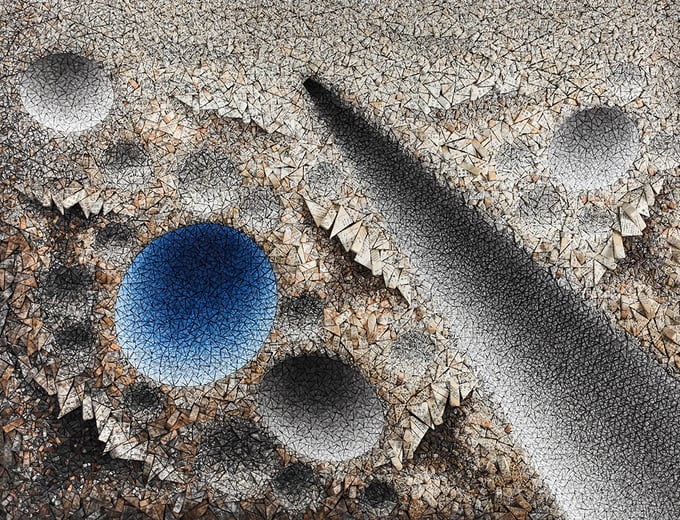
Opening on Hangul Day, October 9, the Korean national holiday celebrating the creation of the Korean alphabet, _Aggregation: The Memory of Paper & Time_ presents new and recent works by Chun Kwang Young (b. 1944, South Korea). The exhibition marks a significant evolution in the artist's decades-long exploration of memory, history, and time, with a new group of works created specifically for London incorporating Hangul, Korea's modern writing system and a powerful symbol of Korean culture. Chun Kwang Young is internationally recognized for his _Aggregations_, sculptural installations and wall reliefs comprising thousands of triangular forms wrapped in carefully folded and dyed pages of text printed on traditional Korean mulberry paper. Each form embodies fragments of distinct human experience thanks to the words that envelop them. Chun's abstract compositions are at once organic and architectural, evoking landscapes that appear both ancient and otherworldly. The exhibition includes more than a dozen new _Aggregations_ that signal a departure from Chun's longstanding use of paper primarily sourced from antique Korean books printed in Classical Chinese characters, or Hanja. The new works shift the emphasis toward Hangul, the Korean alphabet developed in the fifteenth century. Before Hangul, Korean government, scholarly, and literary texts were largely written using Classical Chinese characters, a complex system that did not align with the Korean spoken language and was understood only by those with a formal education. In 1446, King Sejong the Great introduced _Hunminjeongeum_, the new Korean alphabet, now known as Hangul. The simple, scientific system was designed to promote literacy across Korea by making reading and writing more accessible to ordinary people. The principles behind Hangul's creation were documented in historical texts, and in his new works, Chun incorporates these important texts, printing them onto traditional Korean mulberry paper, also known as _hanji_, handcrafted by a _hanji_ artisan. By giving greater prominence to Hangul, Chun imbues a layer of contemporary Korean identity into his _Aggregations_ while retaining language as a formal element. "This is not simply a change of text," he says. "It's a conceptual shift from accumulating the records of the past toward creating and accumulating the living time of the present."