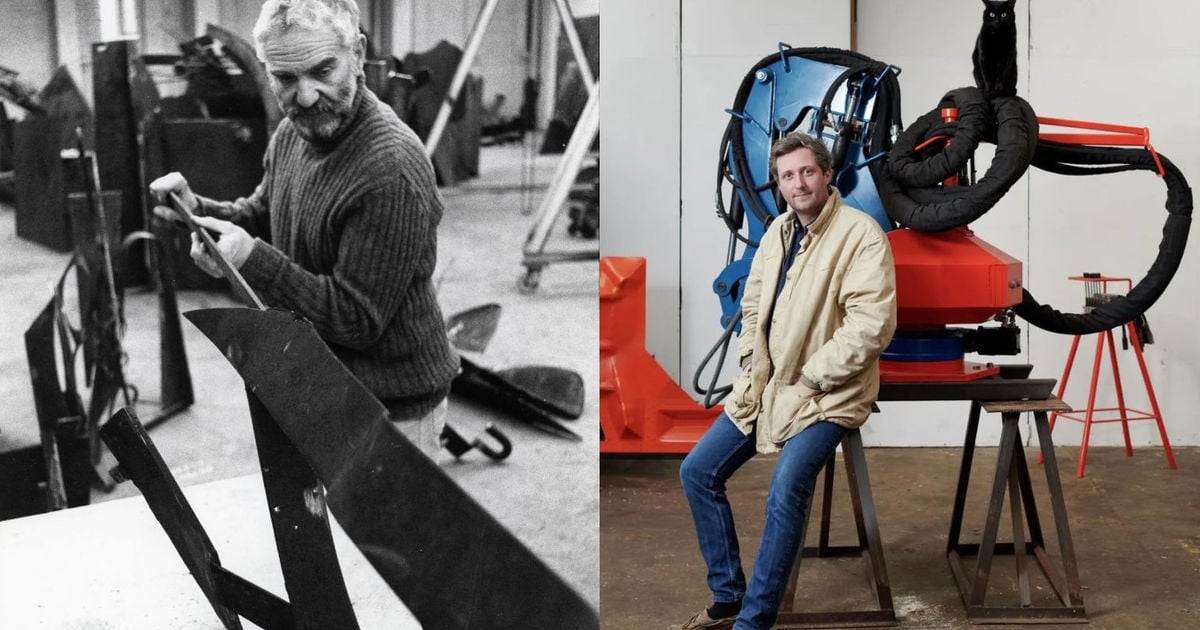
Heavy Metal : Anthony Caro & James Capper
Anthony Caro, James Capper
Albion Jeune
W1W, 16-17 Little Portland St, UK W1W 8BP
Mon-Fri 10am-6pm, Sat 11am-5pm
Admission
Free Admission
No admission fee mentioned on the page.
About
Heavy Metal brings together the seminal works by Anthony Caro (1924–2013) with the pioneering practice of James Capper (b. 1987) . The exhibition explores a cross-generational dialogue, tracing the evolution of British sculpture from the abstract revolution of the 1960s, to Capper’s mechanical age. Caro’s return to the UK in 1959 marked a fundamental shift in the landscape of modern art. After encountering the work of David Smith in the United States, he began constructing large abstract sculptures that disregarded existing artistic conventions. Caro’s North American travels enabled him to transcend the rule-breaking dynamism of his transatlantic contemporaries. Heavy Metal features four of Caro’s iconic tabletop works, demonstrating his mastery of an industrial vocabulary that rejected traditional bronze in favour of raw, welded steel and block colour . By painting these sculptural works in gloss paint, Caro unified varied elements into a singular cohesive unit. These sculptures, works of pure abstraction, reclaim the shape of the table as a participant in the artistic process, cascading over the edge of the tabletop like fluid elements. Not only did he meet Caro, but Capper was able to exhibit the movement of one of his early hydraulic sculptures before him. This critical moment serves as a benchmark from which the development of his practice can be explored. Since then, Capper has worked with industrial materials on a small and large scale . Capper’s Rotary series — painted by hydraulic - powered rotary machines that were constructed by the artist —index es the various areas that his practice explores . This includ es his interest in the use of colour, the potential for hydraulic engineering to m imic innate biological movement, and the appro priation of industrial materials in the artistic process. Exhibiting two Rotary paintings grounds the sculpture presented in Heavy Metal by offering a visual depiction of the fundamental interests continually explored throughout Capper's diverse output. Heavy Metal further presents four Nipper sculptures alongside Caro’s tabletop works. This family of sculpture epitomise s Capper’s creative inquiry, being designed with a mechanical intent emerging from Capper's fascination with biomimicry while simultaneously adopting a visual and material language established by Caro . This can be seen through the use of orange industrial paint and powder coated steel. When powered, these objects transition from a static state to a living extension of the artist’s practice, connecting the divide between fine art and heavy indus try. T he Nipper works present four different designs for teeth that can be used, given the hydraulic element of each sculpture, to cut through materials. Trained as a welder, Capper’s work ex ists at the intersection of engineering and biology. Emulating teeth and talons, R IPPER and ATLAS TINES explore how sculptural engineering might draw from nature to achieve practical results through a detailed design process . Capper stands at the forefront of sculptural practice today, bringing a visual language that was developed by Caro towards a new mechanical age, one hydraulic step at a time . The presentation at Albion Jeune will be followed by a large-scale presentation of indoor and outdoor sculpture, opening at Albion Barn in Oxfordshire , in June 2026. The Albion Barn opening will be accompanied by a publication exploring Anthony Caro’s enduring legacy and his continued influence on James Capper’s own artistic practice. The publication will also include an academic essay written by Deyan Sudjic , writer and former director of the Design Museum , which further draws out the significance of this dual presentation.