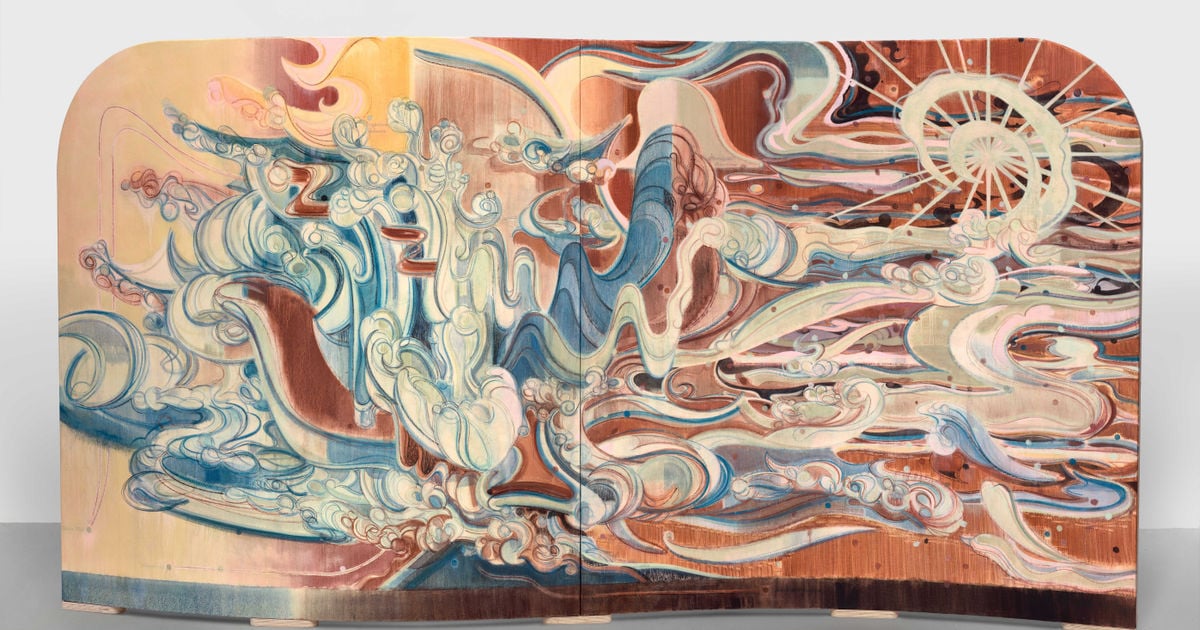
Afterstone : Su Yu-Xin
Su Yu-Xin

Albion Jeune
W1W, 16-17 Little Portland St, UK W1W 8BP
Mon-Fri 10am-6pm, Sat 11am-5pm
Admission
Free Admission
Admission is free for this commercial gallery.
About
Text by Mark Rappolt , Editor-in-Chief of ArtReview: Ex nihilo, nihil fit There’s a philosophical principle, generally thought to have originated in the mind of the pre-Socratic thinker known as Parmenides, stating that nothing comes from nothing. That absence cannot bring about presence. That everything has a cause. That there’s no such thing as ‘new’ in any kind of absolute sense. In the West this is normally introduced as part of the birth of rational (as opposed to mythological) thought. But Los Angeles-based, Taiwan-born artist Su Yu-Xin’s painting The Birth of a New Color (Mount St. Helens, Washington State) (2026) would seem to reject all that. The new colour in question comes from Helenite, an artificial glass, originally created (by accident) from rock dust spat out when the titular mountain erupted in 1980 that was superheated during the recovery operation that followed. Helenite gemstones are now sold as souvenirs to those hiking across the site of the natural disaster (as well as being used more broadly across the jewellery industry), and the artist picked some up when she did just that. Helenite is a greenish colour. And of course, when we see a painting, that’s normally where it ends. Greenish. Colour. We see the colour and we leave it behind, getting on with the ‘intellectual’ business of interpreting it: grass; foliage; nature – that kind of thing. Although when she and I discuss the painting, the artist describes this particular shade as ‘lime’. Which of course it can’t be. Because, like the title of the painting tells us, it’s new. The painting itself is a rectangular wooden panel, shaped into an S-curve, on which is depicted a tempest of curving wave or mountain forms. Or maybe they are billowing gas clouds. Their exact status is uncertain; but perhaps we can call them an eruption. There’s a giant starburst in the top right and a gradual background fade from light to dark as your eye reads the painting left to right. You get the sense of an origin story. You do that, of course, because you’re trained, by Bibles (‘let there be light’) and numerous other texts and myths, to interpret the contrast of light and dark and stellar flares in this way. Just as you might think that this painting, with its S-curve, sitting on the floor, balanced on top of wood blocks, is reminiscent, in form, of a room divider. Of the traditional Chinese or Japanese variety, often painted with a natural scene. “I like the history and the philosophical thinking behind the crafting of the room divider,” the artist says, acknowledging this particular reference. “This very old and very beautiful idea of bringing the outdoor indoor and using this piece of landscape that doesn't have a frame or edge and putting it inside of this structure and then placing it indoors.” Perhaps, even, seen in these terms, The Birth of a New Color is really a sculpture. But more to the point is the way that Su’s art leans into this kind of interpretational ambiguity; even encourages it: outsides become insides; paintings become sculptures; mineral facts become interpretational possibilities. That’s how storytelling begins. What’s intriguing, though, is the manner in which she makes us conscious of these generally unconscious processes. In Taiwan Su trained in traditional Chinese and Japanese Nihonga-style painting (the latter developed during the Meji restoration and prominently featuring mineral pigments). In Los Angeles (after a further period of study in London) she performs this revelatory act by highlighting the materiality of her painting: its physical presence . More straightforwardly she grinds her own pigments out of materials collected (much of the time on her travels) from around the world, and advertises whatever it is they were extracted from in the captions that accompany her works. Cloud Casting (Volcanic Rocks) (2026), for example, is made up of ‘red volcanic rock, helenite, sea glass, DuPont titanium dioxide, lapis lazuli, concrete dye mixed into soil, white crystal and other handmade pigments, and pastels. Which we might summarise as various components of the Earth’s crust and some products of human intervention in it. Indeed, the materials themselves tell their own stories, even before Su has arranged them into a pictorial narrative. The fashionable among you might call this an acknowledgement of the artist’s nonhuman collaborators. But maybe we can acknowledge, in a more pragmatic fashion, that this is simply what pigments are. As for Su herself, she prefers to see it in terms of its extractivist or colonialist resonances: “The material I used to paint my painting was not made to make the painting,” she acknowledges. “They always came from something else. They have other purpose in their own cycle of life. Then I think I’m borrowing it from them.” And perhaps these kinds of narratives will only be enhanced when Su’s works are shown in Venice, historically a nexus of trade between East and West and a port through which many of the minerals that went on to make up the colour palettes of Western art were trafficked. And whose airport is named after the Venetian merchant who travelled East and brought to Europe many Chinese technologies for the first time. If Cloud Casting is borrowed from the land, then Jewels and Bones #3 (2026) is largely borrowed from the sea: ‘Green soil, glauconite, sea urchin test (skeleton), lepidolite, muscovite, pearl powder, iwa-enogu, Crinoidea fossils (sea lilies and feather stars fossils), ochre, purple varnish clam ( Nuttallia obscurata ), tube coral ( Tubipora musica ), ceramic fragments, and other handmade pigments’. Which you, could believe, might not be far off the list of exhibits in a marine biology or paleoceanography display. But this too is part of the play Su sets in motion. The materials are both true to what they are and transformed, allowing each work to be both a story of endurance and emergence. Which might be one way of reading the title of this exhibition: Afterstone . At times the provenance of the materials Su harnesses to make her paintings seem to generate their subject (as in The Birth of a New Color ); at other times a more straightforward interpretative narrative takes over ( Day for Night , 2026, for example). The point perhaps is that neither process is the only way through which to read Su’s work. It admits both and plays with that. False Weather on the Moon (2026), for example, comprises a series of rounded curves against a reddish background. The painting came about when the artist tried to imagine the landscape on the moon, a landscape that exists in a place with no atmosphere. “It means it doesn’t have wind,” the artist explains. “If it doesn’t have wind, you don’t see any rounded rocks on the moon. Everything is sharp like a blade. That’s a fascinating landscape to imagine because we never experienced anything like that.” If that feels like a contradiction to all the rounded forms, then the iron oxide that provides the reddish colour is a similar hint at something the moon does not have – an oxygenated atmosphere. But it’s true too that the Earth itself is playing this game even before Su’s interventions. As she points out, salt crystals are what’s left of the vaporised water of the oceans, just as sea shells are formed by the extraction of calcium and carbonates from the water surrounding a soft-bodied organism. And then those shells themselves are later harvested and repurposed in the building materials of cities such as Venice, which protect the soft bodies of humans. It’s a cycle of reuse or reincarnation that’s both potentially endless and intricately, if temporarily, linked to human circulation via processes of migration or trade. We of course, are made of these minerals just as is everything else. Su’s work is a play with the balance of certainty and uncertainty, assertion and denial. Grounding that is the notion that a painting’s contents can be reduced to a list of its contents versus the idea that a painting communicates something that cannot be listed or verbalised. And that’s a dynamic that might, in turn, speak to the identitarianism and identity politics of our current age. In which the relative ease and often unpleasant necessity of global migration have produced a more diverse planet, at the same time as our national and nationalist politics are dictating one that is ever more segregated. People are being told they don’t fit in or belong. It’s a factor that’s not lost on the artist herself, a migrant and a traveller, who concedes that one way of looking at her work is as a search for roots. “I think the reason I started to work this way, a lot of that came from the fact that I want to know what am I made of. I think it’s comforting to find order in chaos. Because I think that’s how people find the way to relate to each other.” For all the overt emphasis on rocks and minerals, the root of this art is human too. In the mix of cultural traditions of East and West, the code switches from fact to fiction and from the painterly to the sculptural are excavations that consistently suggest that we are part of, not apart from, this Earth. Su Yu-Xin (b. 1991, Hualien) considers painting as a place where multiple disciplines and various perceptual capacities intersect. Painters have always played a vital role in the visual art industry, and the medium of painting reflects the discovery and re-invention of the material world. Hence, paintings bear witness to the history of the exchange between cultures and nature and project the painter\'s role through wars and migrations; they manifest territorial invasions, restitutions, the exploitation of pigments and their trades. While the history of painting often emphasizes the stylistic evolution of image production, the technology of colour pigments also evolves contemporaneously. Su Yu-Xin collects, studies, and processes these color substances scattered on the earth\'s crust. From there, she invents a new order on the painting surface through drawing, compression, and accumulation. For her, such landscape painting is a geological practice of rearranging plants, minerals, organic and synthetic matters. Su Yu-Xin holds an MFA degree from Slade School of Fine Art, UCL, and a BA in Ink Painting from Taipei National University of Arts. Recent solo exhibitions have been held at Orange County Museum of Art, USA (2025); Albion Jeune, UK (2024), Longlati Foundation, Shanghai (2023); and KuanDu Museum of Fine Art, Taipei (2019). Su has shown internationally in numerous group exhibitions including at Gagosian, Hong Kong (2023); Blum & Poe, Tokyo (2023); Beijing Biennial 2022, Beijing; Perrotin, Shanghai (2023); UCCA Dune, Beidaihe, (2021-2022); UCCA, Beijing (2020); and National Taiwan Museum of Fine Arts, Taichung (2018), among others. In 2020, Su received the Huayu Youth Award Nomination, China. Her work forms part of several public collections, including Orange Country Museum of Art (Costa Mesa, California), Longlati Foundation (Hong Kong), Domus Collection (Beijing), and Long Museum (Shanghai). To accompany her solo exhibition at Albion Jeune in 2024, Albion Publishing produced the monograph, Precious .