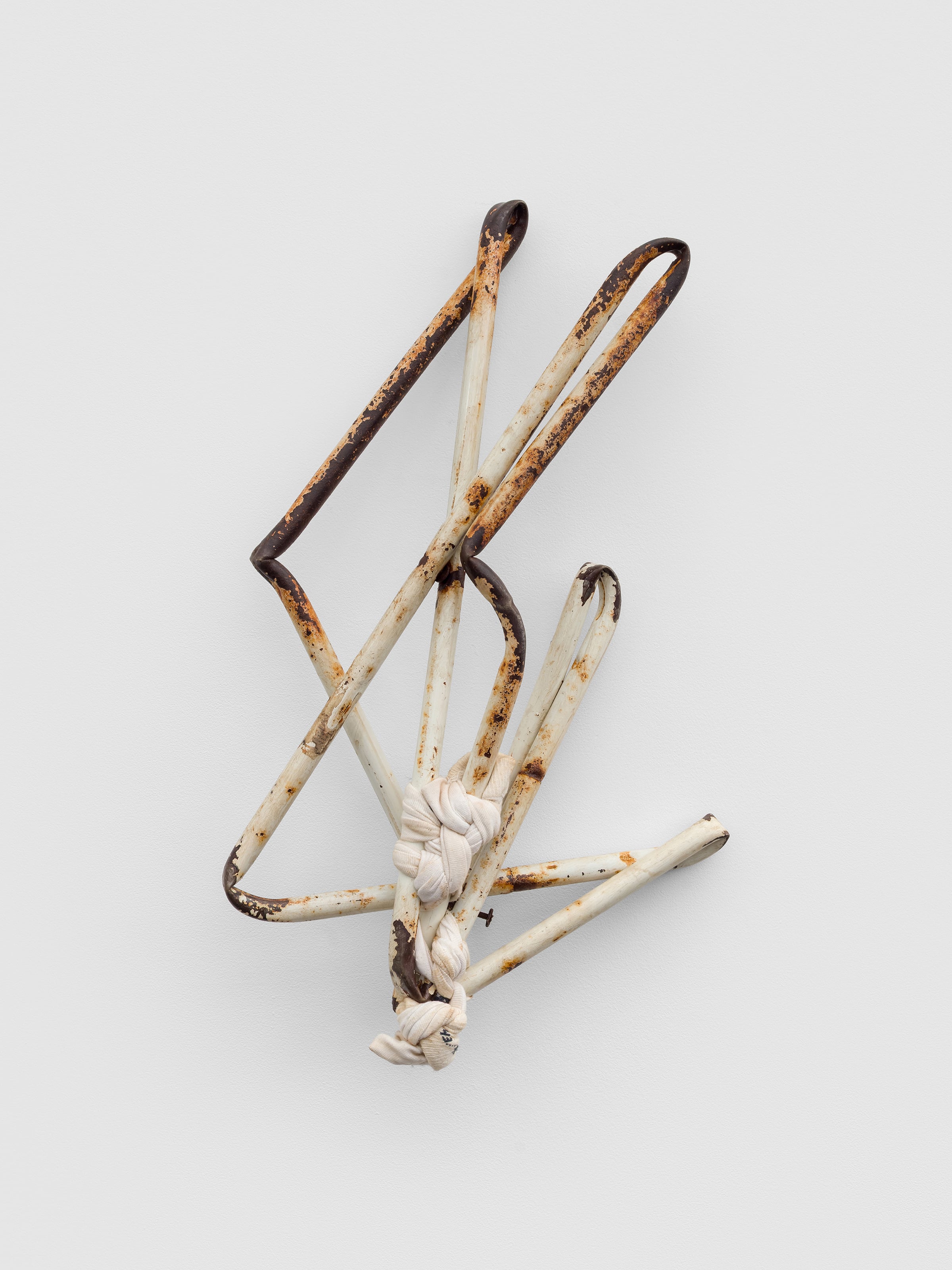
Franco Bellucci Works (c. 2010–2018)
Franco Bellucci
a. SQUIRE
3 Princeton St, London WC1R 4AX, UK WC1R 4AX
Wed–Sat 11am–6pm
Admission
Free Admission
Commercial gallery - no admission fees mentioned
About
Franco Bellucci's sculptures are made of humble, predominantly mass-produced materials. A Puma sock, bandages, ethernet cables, a boxing glove, feeding tubes, a baby blue plastic bag, elastic straps, sequinned gingham, a waxed cotton tablecloth, rubber, wiring, a toy dinosaur: these are the immediate resources gleaned from his surroundings and worked into knots. His objects have no start nor finish, no front nor back, no head nor tail, and it is this continuousness that lends them a certain inevitability, like tidal rejectamenta. They are self-determined, uncontrived things made of other uncontrived things tightly wound into clumps or chrysalises, bundles or brains, charged and frustrated by the restraint that binds them together. They wear their tensions publicly, just as they store the artist's latent strength, which acts continually against their unravelling. When in 1978 the Italian government under Giulio Andreotti passed Law 180 (the so-called "Basaglia Law"), it triggered a twenty-year dismantling of the country's psychiatric system and in so doing brought largely to completion the radical political work first undertaken by Franco Basaglia at Gorizia asylum in 1961. "Manicomio = Lager. Può capitare anche a te! Dove la repression indossa il camice bianco" (Asylum = concentration camp. This could also happen to you! When repression wears a straitjacket), reads a 1969 poster by sculptor Piero Gilardi for the Torinese organisation L'Associazione per la Lotta contro le Malattie Mentali , made following Basaglia's visit to the city's Unione Culturale one year earlier. 1 It was Basaglia's campaign of deinstitutionalisation at the Italo-Balkan margins, inspired by the writings of Michel Foucault and others and beginning on his first day as Gorizia director with the abolishment of the physical restraint of its patients, that would catalyse the nationwide humanising of psychiatric care. 2 Franco Bellucci was one of many thousands whose lives were transformed in the wake of Basaglia's movement. His psychological development derailed by the contraction of encephalitis at the age of 7, after which he could no longer speak, Bellucci became prone to violent outbursts and was eventually committed to a closed psychiatric hospital in the Tuscan town of Volterra ten years later. For much of his first stay there, he was tied to a bed. In 1999, he moved to the Centro Residenziale Franco Basaglia, a new open-door facility in Livorno, which the same year would become home to the Atelier Blu Cammello, an arts organisation founded by Riccardo Bargellini for individuals with developmental difficulties. Bargellini soon noticed Bellucci's pull towards objects—the underwear he tied to plastic containers used by the cleaners, the hosepipe ends taken from the gardeners, and socks stolen from his roommates. Bellucci would return from visiting his brother each weekend with new toys and other things to be combined. Over time, and with the building of trust between Bargellini and Bellucci, the pair established a non-verbal exchange through an economy of objects, what the experimental educator Fernand Deligny might have called the "traversing" of language. 3 Acid green pipe, safety orange wood planer, rusted bone frame: Bargellini would gather up materials and deliver them to Bellucci, who in turn would find ways of warping, tying, and threading them into composite masses. It is fitting that Germano Celant, the interlocutor of arte povera , should write, "In its tangle of threads—material, historical, political, anthropological, and psychological—the knot implies a contiguity and continuity of languages and parlances." 4 While the junk materials wrestled into Bellucci's matrices are discontinuous, their knots resolve into a natural dialect, or even a metalanguage, of their own. That the works have no predefined orientation to the world is another kind of dislocation we might attribute to the fact that Bellucci often worked lying down. To read the mark of his own teenage confinement into the ubiquity of knots, binds and other images of paralysis is an inevitability compounded by the ward bed now recast as a site of artistic production. Perhaps less straightforward is the occasional presence in his sculptures of medical paraphernalia, agglomerated—it's tempting to project—as if to spit on the rubble of the disbanded institution. Franco Bellucci died in 2020. In 2022, the Museum für Moderne Kunst, Frankfurt, acquired nine of his works. Works (c. 2010–2018) is the first presentation of Bellucci's sculptures in the UK.