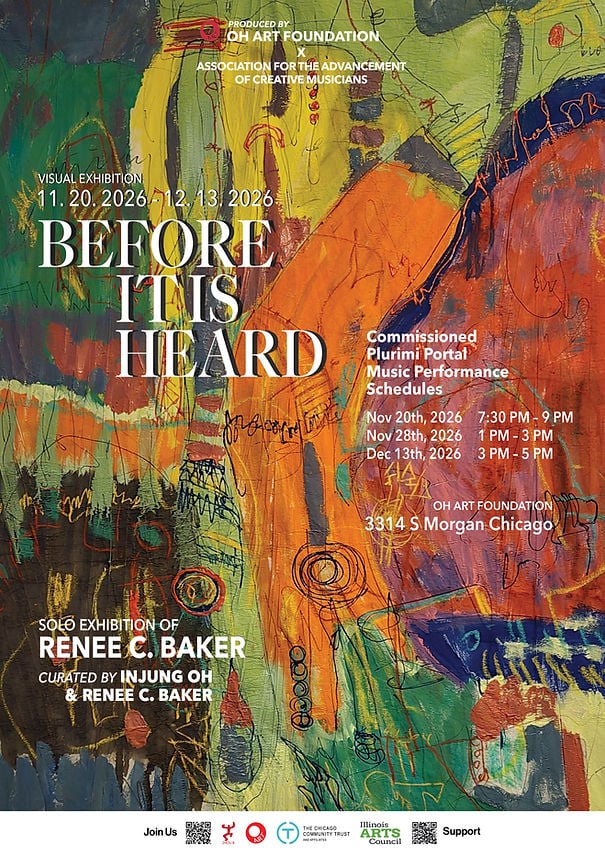
Before It Is Heard
Renée C. Baker

Zhou B Art Center
1029 W 35th St, Chicago, IL 60609
Admission
Free Admission
About
Everything on these walls is music. Not a painting about music. Not an image inspired by a piece. Music, written down — in a language Renée C. Baker built herself, because the one she was handed could not hold what she needed to say. Western notation has agreed for centuries on what music looks like on a page: five lines, a clef, notes stacked into measures. Baker sets that vocabulary aside and works with shape, density, color, interruption and open space instead. A line that thickens might mean pressure. A field of color might mean sustain. A gap might mean silence — or it might mean listening. She calls the system Cipher Conduit Linguistics. The word cipher is doing exact work there: a mark that conceals and reveals at the same time. This puts the works in this room in an unusual condition. They are finished and unfinished at once. Complete as objects, they are still waiting to be played — and each performance will differ from the last, because these scores establish conditions rather than dictate results. Two musicians reading the same mark will not produce the same sound, and neither of them will be wrong. Three days during this exhibition, musicians of the AACM, Association for the Advancement of Creative Musicinas, will enter this room and play the walls. Between those performances, the room holds its sound the way a struck bell holds a tone after it has stopped. Baker arrives here by an unusual route. She was principal violist of the Chicago Sinfonietta for more than twenty years. She has written over two thousand compositions and scored more than a hundred films, many of them silent works by early Black filmmakers, brought back into sound decades later. She founded the Chicago Modern Orchestra Project in 2005 and serves as interim chair of the AACM. These are less credentials than a direction of travel: she came to visual art from inside music, and never stopped being a composer when she picked up a brush. That should change how you look at these. You do not need to read music to read these paintings. You are not being tested, and there is no correct answer waiting to be guessed. Baker built her system so a work could be entered from any direction — as image, as sound, as movement, as feeling. Watch what the marks do. Notice where the space opens and where it closes. If you find yourself hearing something, that is not a failure of interpretation. That is the work doing exactly what it was made to do. There is a Chicago history standing behind this room, and this time it is standing in it. In 1965, Black musicians on the South Side founded the AACM so they could make and present their own original music on their own terms. In 1967, artists painted the Wall of Respect at 43rd and Langley. In 1968, AfriCOBRA formed. Within three years, in one city, Black artists across disciplines built the institutions and the languages that had been withheld from them. Sixty years later, the AACM is not a reference in this exhibition. It is a partner in it, and its musicians are the ones who will make these paintings sound. OH Art Foundation commissioned this new body of work with Renée C. Baker and presents it in that lineage — in the belief that a neighborhood gallery is exactly the right place for it. This music does not require a concert hall. It requires a room, some walls, and people willing to be in it. The score is not a document here. It is a space. You are already inside it.