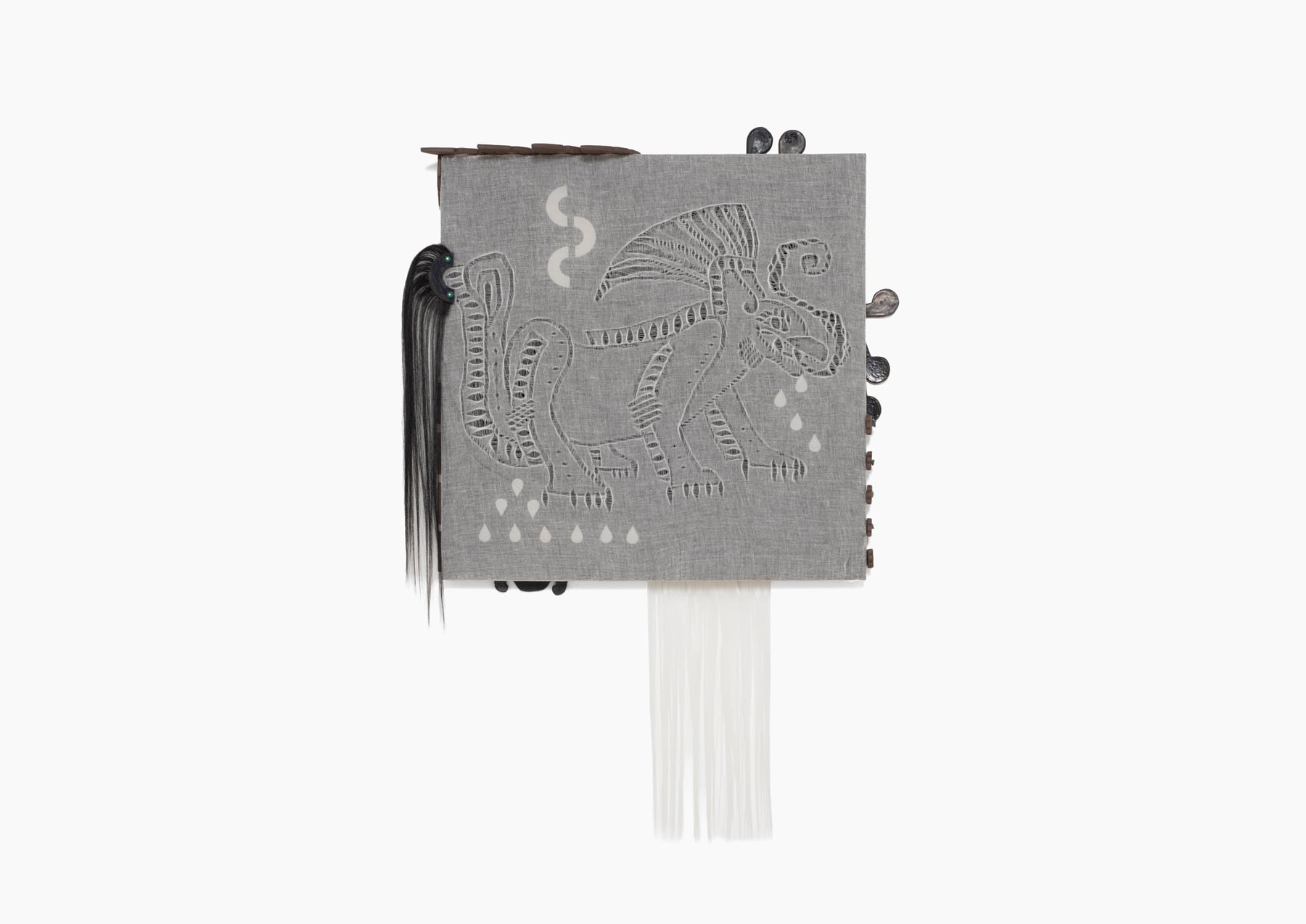
Coyolxauhqui Imperative
Tanya Aguiñiga

Volume Gallery
1700 W Hubbard St, Chicago, IL 60622
Admission
Free Admission
About
Volume Gallery announces _Coyolxauhqui Imperative_, a solo exhibition by Tanya Aguiñiga, opening Saturday, June 13, 2026, from 3 to 6 p.m in gallery two. Tanya Aguiñiga is a Los Angeles-based artist and activist raised in Tijuana, Mexico. Her ongoing investigations of identity and belonging made with meaningful materials are both deeply personal and an expression of her community. In this new body of work, Aguiñiga strategically removes threads from the warp and weft of delicate gauze to create images — a subtractive process like reverse embroidery. Mounted over black velvet, sections of open weave catch light and shadow to outline animals long held sacred across Mesoamerica: opossums, coyotes, vultures, snakes, and bats. These creatures occupied central roles in Indigenous life and cosmology, and some of their Nahuatl names, _tlacuatzin_ and _coyotl_, persist in daily language as quiet evidence of their cultural significance. Today, they are largely vilified as pests or nuisances, despite their vital ecological roles. Aguiñiga's imagery is inspired by depictions of these sacred animals in Pre-Columbian codices, pictorial manuscripts covering everything from history and geography to mythology. The opossum — today dismissed or even feared — was among the most revered figures in Mesoamerican cosmology: a Robin Hood-like hero who stole fire from the gods and delivered it to humanity and who was credited in Maya tradition as an embodiment of feminine creative force, linked to the earth-lunar goddess. The vulture was also seen as far more than a scavenger; across Mesoamerican and South American traditions, it was understood as a transformer, converting death and filth into life and light. Known to the ancient world as a cathartic cleanser, the vulture appears throughout mythology as a keeper of fire and a shamanic figure associated with celestial brightness. These animals were venerated figures, woven into creation myths, healing practices, and the highest expressions of spiritual life. Indigenous Peoples have understood that these animals perform quiet, necessary labor in our ecosystems, consuming decaying materials that spread disease. Performing an essential role, they are indispensable and deserving of respect. Ultimately, Aguiñiga's new textile works are about perception and the effects of misunderstanding. These essential animals are metaphors for those whose value goes unrecognized, whose presence is treated as a burden rather than a gift. Like the migrants who cross the same borderlands these creatures inhabit, they are fundamental to our society, yet widely maligned. For Aguiñiga, this work is also an act of ancestral recovery. Patterns referencing Otomi weaving and the craft traditions of Michoacán and Jalisco — regions tied to her own family history — speak to a Mestizo lineage fractured by colonization, now accessible only via fragments: a tourist object, a surviving codex, a persisting craft tradition. By working with gauze-like textile — used across Mesoamerica for everything from lacework to fishing nets — she draws on a material lineage that is at once sacred and utilitarian. Through material, image, and pattern, she reaches toward what has been lost, making meaning out of erasure. _Coyolxauhqui Imperative_ will be on view through August 14, 2026.