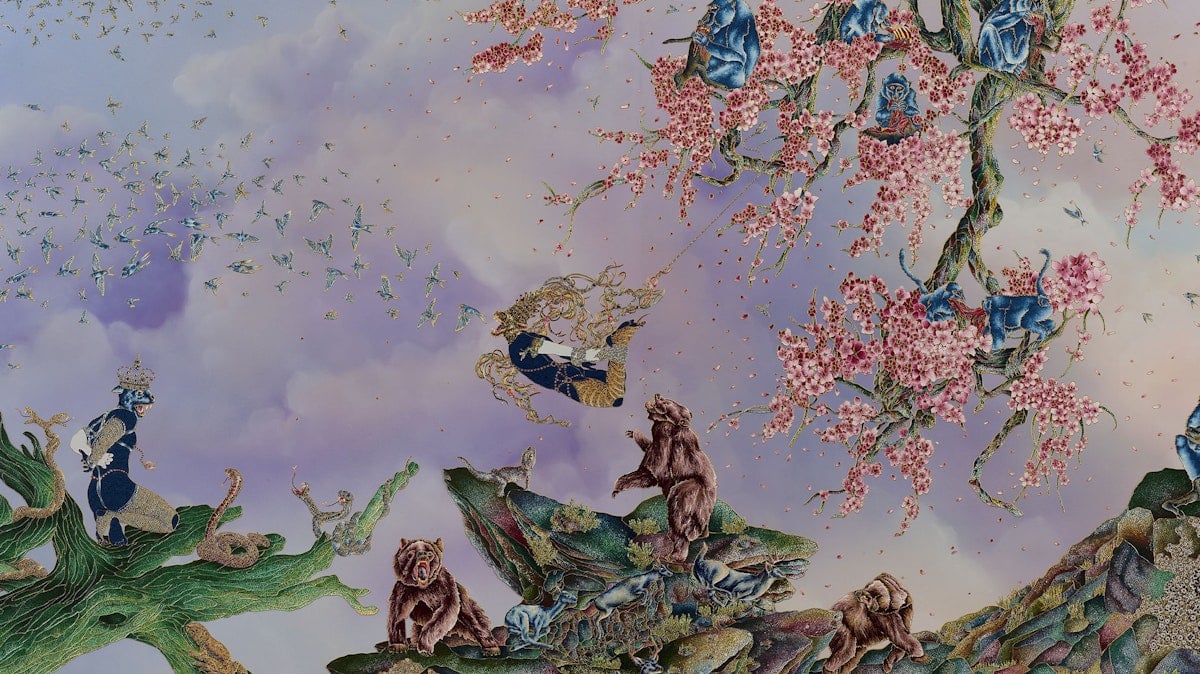
Raqib Shaw: Paradise Lost
Raqib Shaw

Art Institute of Chicago
230 S Columbus Dr, Chicago, IL 60603
Mon 11–5, Tue Closed, Wed 11–5, Thu 11–8, Fri–Sun 11–5
Admission
Free Admission
Exhibitions are free with museum admission.
About
Epic and intricate, monumental and meticulous—the paintings of Kashmir-raised, London-based artist Raqib Shaw offer fantastical meditations on identity, transformation, and the redemptive power of beauty. Born in Calcutta and raised in the verdant Himalayan mountains of Kashmir, Shaw draws deeply on the landscapes and memories of his early life, many of which were fractured by political upheaval. Forced to leave Kashmir as a teenager, he relocated first to New Delhi and later to London, where he studied at Central Saint Martins College of Art and Design. His work is influenced by a broad range of sources—Mughal and Persian miniatures, Renaissance altarpieces, Old Masters paintings, Japanese arts of the Momoyama period, Kashmiri and Urdu poetry, and Hindu and Western mythology—and yet his visual vocabulary and technique are all his own. His signature method involves applying an acrylic liner on gesso to create a golden line almost like the leading of a stained glass window. He then applies automobile enamel paints with needle-fine syringes and manipulates those with a porcupine quill, often adding glittering inset stones and baubles that further enhance the magical and dreamlike quality of the depicted scenes. At the Art Institute, Shaw debuts his more-than 100-feet-wide, 21-panel Paradise Lost (2009–25), the artist's most ambitious and personal project to date. This magnificent allegorical painting takes viewers on a spellbinding journey, from the nocturnal solitude of the artist's childhood in Kashmir to the frenzied daylight of the art world and the West to finally a fragile, renewed dawn. Each panel is dense with symbolism: mythical beasts, anthropomorphic hybrids, collapsing kingdoms, and natural beauty in various states of transformation. Throughout, the work is dotted with images of the artist, sometimes as a humanoid creature with different animal heads, at another time as a monkey looking with awe at the gleaming edifices and the wealth of the West, and sometimes unambiguously in full human form seated on a bed of saffron under a blossoming cherry tree, lost deep in his thoughts. The work is not a direct retelling of Milton's 17th-century poem Paradise Lost, but rather a reflection on the many paradises lost across a lifetime: childhood innocence, creative freedom, mental tranquility, cultural belonging. While Shaw has previously shown the first chapter of Paradise Lost, this exhibition marks the first time all four chapters will be displayed, showcasing the fullest extent yet of this epic masterpiece.